April 12, 2026
You’re at an antiques fair, turning over a vase that doesn’t look like ordinary Scandinavian pottery. The surface is carved with crisp lines. A bird seems to emerge from the clay itself. The colours feel earthy and bold at once. On the base, there’s a name you half recognise: Alingsås Keramik.
That moment is how many collectors meet alingsås keramik winblad for the first time. A single piece can stop you cold, not because it shouts, but because it has character. It feels handmade in the best sense of the word. Not rustic, not factory-slick, but thoughtfully made by people who understood both design and touch.
For new collectors, the questions arrive quickly. Who made it. Is it genuine. Why do some pieces look graphic and modern while others feel closer to Swedish folk art. And where does Ulla Winblad fit into the story.
You spot it before you know its history. A vase on a market table catches the light, and the carved lines hold shadow the way woodcut prints hold ink. Then you turn it over and find the name Alingsås Keramik. For many collectors, that is the beginning of a much longer fascination.
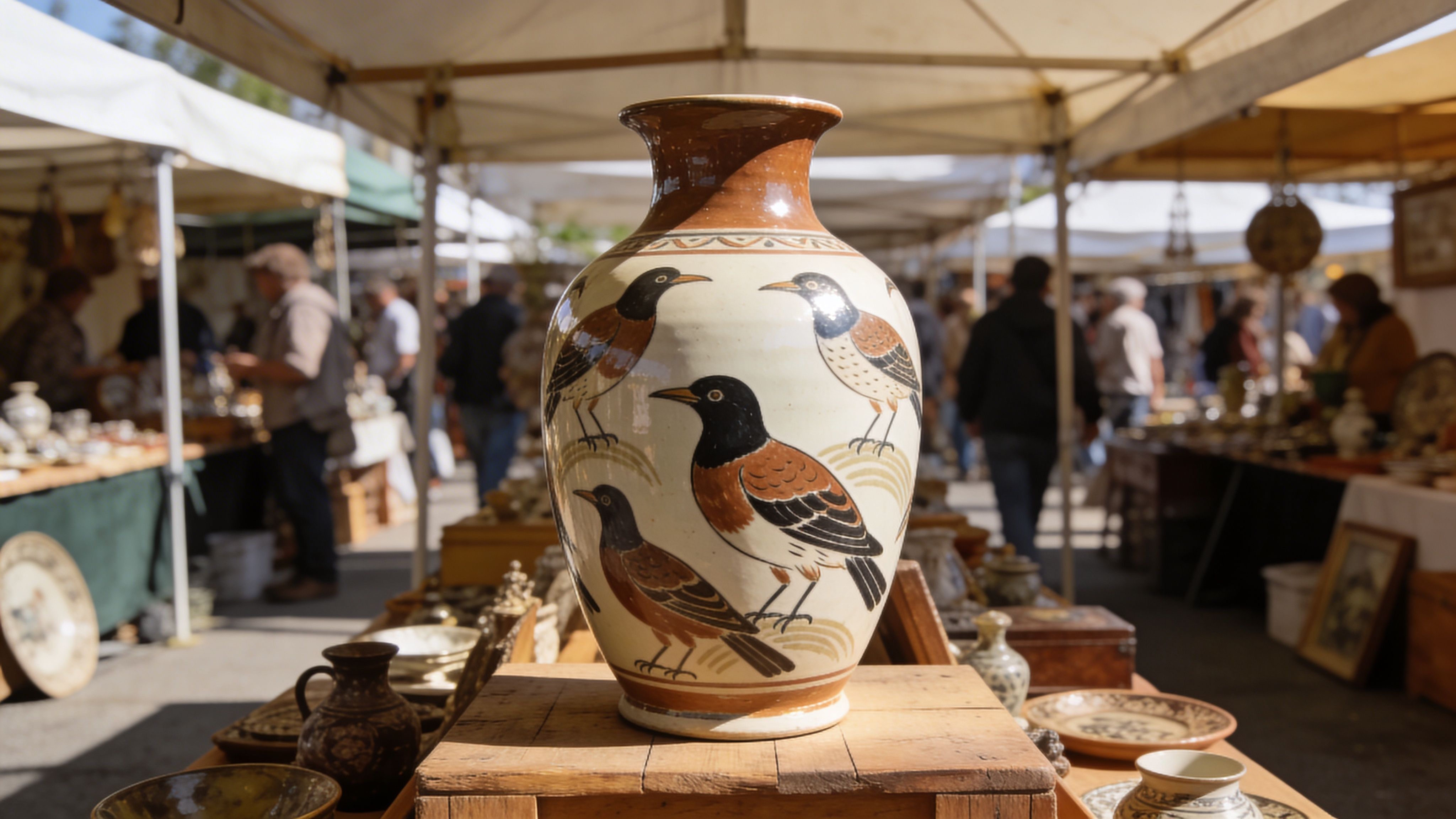
Alingsås Keramik holds a distinctive place in Swedish mid-century ceramics. The forms are often clean and modern, yet the surfaces feel intimate and worked by hand. That combination helps explain why the pottery appeals to both design collectors and people drawn to older Nordic craft traditions.
At the heart of that story is Ulla Winblad-Hjelmqvist. Born in 1933 and active during the studio's most admired ceramic period, she became closely associated with the pieces many collectors seek first: vases, bowls, plaques, and other interior objects whose decoration feels both graphic and alive. Her work rewards two kinds of looking at once. Across the room, you notice silhouette and colour. Up close, you begin to read the incised lines almost like handwriting in clay.
That close looking matters, especially for collectors. Alingsås Keramik is not only a studio with a charming history. It is also a field where attribution, surface treatment, marks, and condition can change how a piece is understood. A serious guide needs more than admiration. It needs a way to tell what belongs to Winblad's hand, what reflects the wider workshop, and what signs on the base or in the glaze deserve extra attention.
Winblad's pottery has a rare balance, and balance is often what makes an object last in the collector's eye.
A well-chosen Winblad piece works almost like a small bridge between worlds. It can sit comfortably with teak and strict modern lines, but it also belongs beside woven textiles, painted wood, and other handmade interiors. That range helps explain its continued appeal today, and it is also why questions of authenticity and studio context matter so much to collectors who want to understand what they are buying, not just own something attractive.
Walk into Alingsås in the postwar years and the story does not begin with a decorated vase on a collector’s shelf. It begins in a working town, with furnaces, skilled hands, and a workshop first known for enamel rather than clay. That origin helps explain why Alingsås Keramik later developed such a distinctive character. The studio grew out of production culture as much as artistic ambition.
The business was established in 1947 by Halvard Oldberg and Hilding Canemark, and its earliest identity was Emaljstudion. Enamel signs and household panels belonged to that first chapter. For a new collector, this is a helpful starting point. It explains why Alingsås pieces often feel unusually assured in their surfaces and finish. The workshop learned discipline before it became famous for decoration.
By the early 1950s, the operation had expanded into a dedicated factory building in Holmalund, with a shop in town. That shift tells us something important. Alingsås was a real local enterprise with public visibility, not a tiny ceramic atelier hidden from daily life.
A pottery studio can work like an orchestra. One person shapes the form, another prepares glazes, another cuts decoration, and another oversees firing. Alingsås developed in that collaborative way. Historical accounts describe a sizeable staff of makers and specialists, which helps explain two things collectors still notice today: a recognizable house identity and a wide range of forms.
That local scale also matters for authentication. In a small one-person studio, you expect every decision to come from one hand. At Alingsås, some objects reflect a lead designer’s vision carried out within a workshop system. Serious collecting starts to make more sense once you see that distinction.
Alingsås Keramik did not remain a purely local concern. Its ceramics travelled beyond the town, and the workshop reached export markets including the United States and Belgium. That wider circulation is one reason pieces still appear far from Västergötland today.
The factory also left marks on the town itself. Former employees carried skills onward into related ventures, and the studio helped shape Alingsås as a place where craft and small industry met. For heritage enthusiasts, this is part of the pleasure. A bowl or wall plaque is not only an attractive object. It is evidence of a local ecosystem of designers, decorators, retailers, and trained ceramic workers.
If you enjoy placing Alingsås within the wider story of Swedish production pottery, it pairs well with this guide to Upsala Ekeby and Karlskrona ceramics.
The studio changed over time. Ceramics rose to prominence, then enamel work again took a larger role in later years, before operations eventually came to an end in the mid-1980s.
Collectors benefit from keeping that long arc in mind.
A piece from Alingsås belongs to more than a single fashionable moment. It comes from a workshop that adapted to changing markets, materials, and tastes over several decades. That fuller history gives context to everything that follows, especially the questions collectors care about most: which objects belong to Winblad’s strongest period, which reflect the broader studio hand, and how local production history can help identify what is authentic.
If Alingsås Keramik had a golden visual identity, many collectors would point to the years when Ulla Winblad-Hjelmqvist served as artistic leader. Her leadership is associated with the period from 1958 to 1967, when the studio became especially admired for modern sgraffito decoration and bold, contemporary motifs.
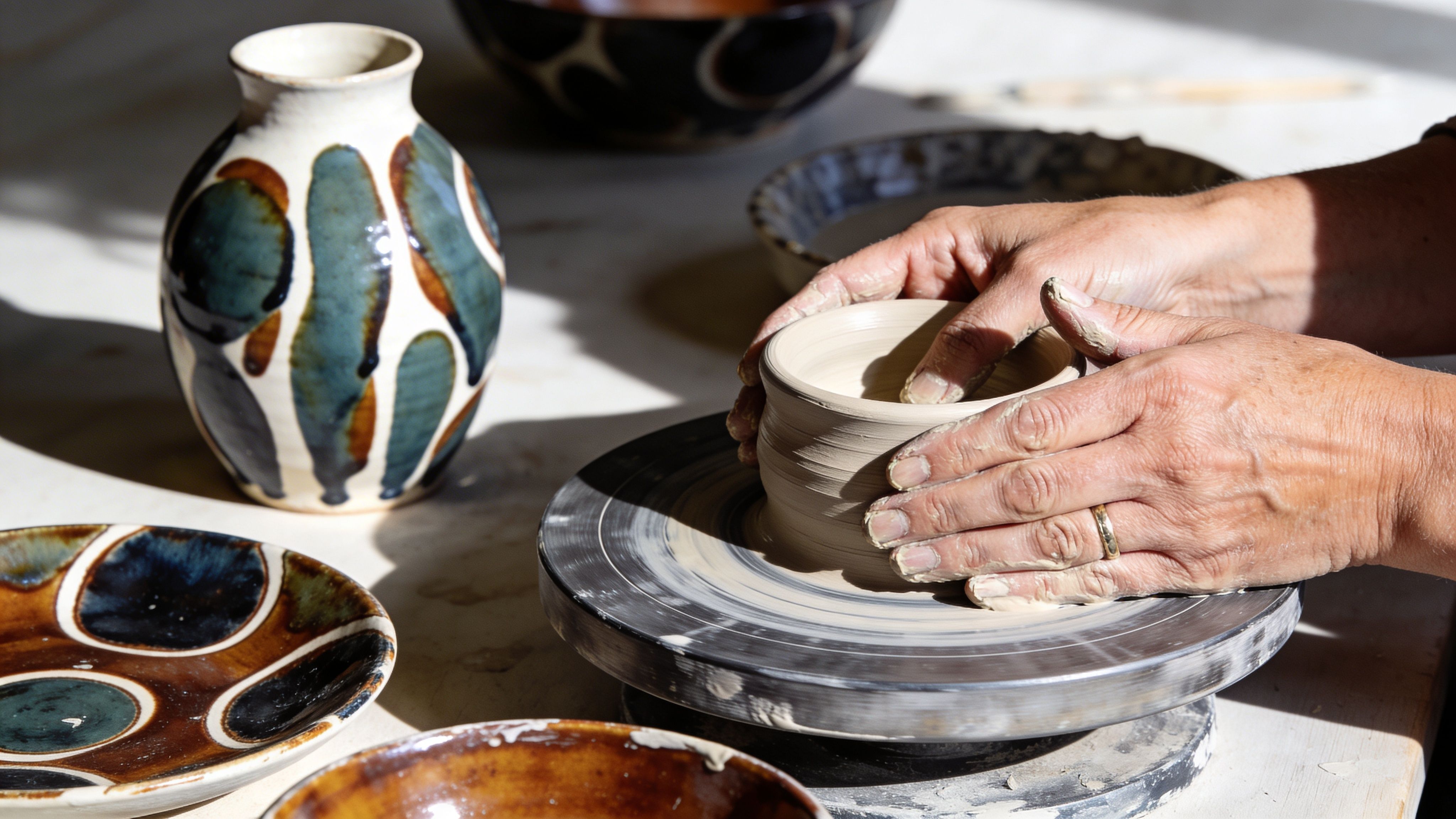
The word sgraffito can sound technical, but the visual idea is simple. A potter or decorator applies a light surface layer, then cuts or scratches through it to create lines and shapes. On Winblad pieces, those incised lines often give the design its pulse.
You’ll often see:
That’s one place new buyers get confused. A genuine piece often looks hand-worked because it is hand-worked. The small irregularities are part of the charm, not a flaw.
Winblad’s best-known pieces often feature nature, but not in a soft or sentimental way. Her birds have presence. Her fish and floral forms feel stylised. Geometric organisation holds the whole thing together.
Three traits usually stand out:
Bold motifs rather than crowded scenes
The decoration tends to be decisive. One bird. A few repeated shapes. A clear rhythm.
Strong colour contrasts
Browns, blues, oranges, and creamy carved lines often work together to create depth.
Interior usefulness
Many pieces were made as bowls, vases, plaques, and other domestic objects, so the art lives on forms people can display and use.
A Winblad design often feels halfway between folk memory and modern graphics. That tension is part of its lasting freshness.
This is why alingsås keramik winblad appeals to more than one kind of collector. A modernist sees disciplined form. A folk-art lover sees birds, handwork, and local craft continuity. Both are right.
The most common collector mistake isn’t buying a damaged piece. It’s buying too quickly because the decoration feels right. With Alingsås Keramik, base details and surface details need to agree.
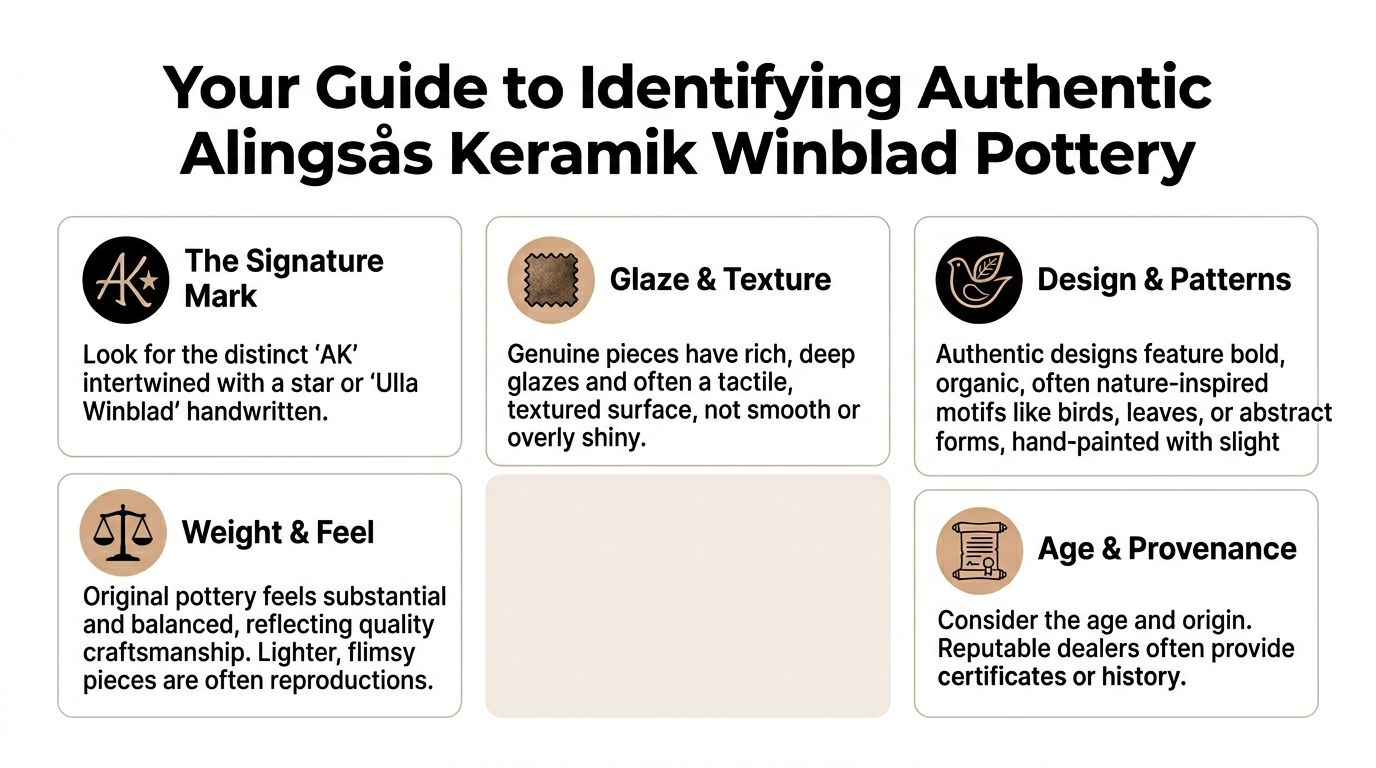
Turn the piece over first. Don’t treat the underside as a formality. For this pottery, it’s one of your best sources of evidence.
Authentic Ulla Winblad pieces are known to feature markings such as “Alingsås Keramik”, “Handgjort”, a model number like 939, and the “U Winblad” signature, as noted in the collector guidance at this Etsy listing documenting typical marks and market demand.
Look for combinations rather than a single perfect stamp.
A mark can be copied. Form, glaze, incision, and wear are harder to fake convincingly.
Here’s a practical checklist I’d use at a market or when reviewing online photos:
Inspect the unglazed body
Winblad-related collector guidance often points buyers towards the unglazed areas. These can reveal whether the object has the right ceramic body and whether the carved decoration feels integral to the making.
Study the carved grooves
The sgraffito should feel cut into the surface, not printed on top. If the lines look mechanically uniform or strangely shallow, slow down.
Check the size against known examples
Listed examples suggest vases can appear in a range of about 10.5 cm to 28 cm. That doesn’t prove authenticity on its own, but an unusual size should prompt closer comparison.
Assess age and patina
A genuine mid-century piece often shows believable wear on the base. That doesn’t mean heavy damage. It means signs of life that match age.
Practical rule: A convincing base mark with an unconvincing surface is still a warning sign.
When you can’t hold the piece in person, ask for very specific photographs.
You can also compare the piece with examples from other Swedish stoneware traditions, such as those discussed in this overview of Gabriel Sweden stengods, to sharpen your eye for authentic mid-century surfaces and forms.
Demand for authenticated mid-century Swedish ceramics has been growing, and regional auction data cited in the same Etsy-based collector note reports 15 to 20% year-over-year price growth in Swedish auctions for similar 1960s items. Rising attention usually brings more casual attributions and more sloppy listings.
That doesn’t mean collectors should be fearful. It means they should be methodical. The best habit is simple. Trust the whole object, not one exciting detail.
Once your eye adjusts to Winblad’s language, certain forms begin to stand out again and again. They aren’t all equally rare, but they are the pieces many collectors remember.
These are often a first love. A rectangular or gently rounded plaque gives Winblad room to let the sgraffito drawing breathe. Birds are especially effective in this format because the long body and wing shapes suit incised line work.
A documented example size is about 28 cm long and 19 cm wide. That’s large enough to read clearly on a wall, but still intimate. These plaques work well because they feel like paintings translated into ceramic terms.
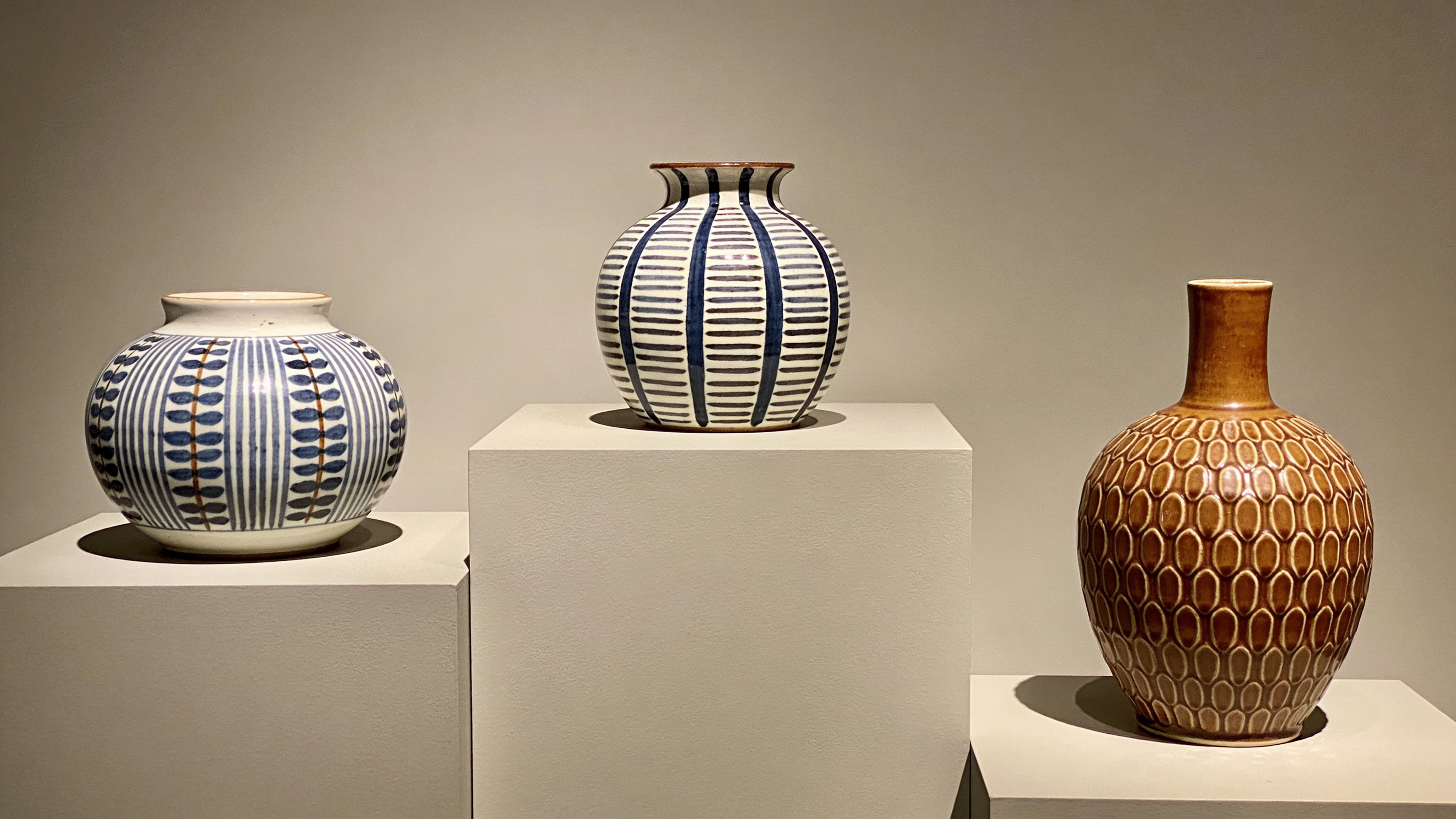
Vases are where many collectors first learn to recognise alingsås keramik winblad from across a room. The silhouettes are often clean and restrained. The drama sits in the surface.
You might see:
A 1960s vase associated with Winblad has been valued by collectors at around $375 in marketplace references. That figure isn’t a universal price guide, but it does show that even a single vase can carry clear collector interest.
Bowls are sometimes overlooked because they feel more functional. That’s a mistake. They often reveal how well Winblad understood interior objects. A bowl has to work from multiple angles. Empty, filled, on a shelf, or on a table.
That practical elegance is one reason her work still fits contemporary homes. It doesn’t feel like ceremonial pottery. It feels lived with.
The best Alingsås pieces don’t separate art from domestic life. They join the two.
Museum representation also matters here, not because every collector needs a museum piece, but because it confirms that these objects are part of a recognised design history rather than a passing resale trend.
You are standing at a fair in western Sweden with two Winblad pieces in front of you. Both are attractive. Both carry the right period feeling. Yet one will reward a careful collector far more than the other. That difference usually comes down to evidence, condition, and artistic strength working together.
Price follows quality, but with Alingsås Keramik it also follows confidence. Collectors pay more readily when a piece answers the quiet questions serious buyers always ask. Is it by Ulla Winblad? Is the decoration one of her stronger compositions? Has the surface kept its original life, or has repair softened what made it appealing?
Condition comes first, as it does with nearly all studio and small-factory ceramics. A plaque or vase with a clean rim, stable glaze, and no restoration will usually command more attention than a similar piece with chips, repainting, or a filled crack.
Then the collector looks closer. Winblad pieces are a little like prints by the same artist. The hand remains recognisable, but not every example has the same force.
The main factors are usually these:
A useful rule is simple. Buy the best example you can verify, not merely the cheapest example you can find.
Winblad ceramics do not always move through the market in the same way as larger Swedish names. That is part of their charm and part of the challenge. Prices can be modest in one sale and surprisingly strong in another, especially when a rare plaque or a particularly resolved vase appears.
For that reason, serious collectors should look at realised prices from established Swedish auction houses rather than informal resale listings. Archived results from firms such as Bukowskis or Stockholms Auktionsverk give a firmer sense of how signed Swedish ceramics are described, photographed, and valued in a specialist setting. They also help you compare like with like, which matters enormously with Winblad, since a common decorative piece and a strong signed work can sit far apart in collector interest.
Regional context matters too. Alingsås pieces are still sometimes encountered close to where they were first sold and used, which can create opportunities for patient buyers who know what they are looking at. If you enjoy comparing local ceramic traditions and how regional markets shape collecting, this guide to Höganäs Keramik stoneware offers a helpful parallel.
Antique fairs are often the best classroom. You can lift the object, study the foot rim, and see whether the glaze pools naturally in the carved lines. That direct encounter teaches the eye faster than any auction listing can.
Online buying requires a stricter method. Ask for photographs of the base, the rim, and any area where the glaze looks unusually flat or glossy. Request close views in angled light. Restoration often hides in exactly those places. A seller who knows ceramics will usually understand why you are asking.
Auction catalogues deserve slow reading. Terms such as "attributed to" or "in the style of" signal uncertainty, not proof. For Winblad collectors, that distinction matters because the market includes pieces that resemble her work without carrying secure attribution.
Before you buy, pause and test the piece against a short set of questions:
That last question is especially important. Alingsås Keramik has a compelling history, and sellers sometimes rely on the warmth of that history to fill gaps in attribution. A good collector enjoys the story, but still asks for proof.
The happiest purchases usually happen when scholarship and affection meet. You recognise the hand, understand the condition, and bring home a piece that still carries the quiet energy of the Alingsås studio into a present-day interior.
Vintage ceramics don’t need fussy treatment, but they do need respectful handling. The goal is preservation, not making them look new.
For glazed areas, use a soft cloth and mild soapy water. Dry the piece promptly. Don’t scrub hard at age marks that may be part of the object’s history.
For unglazed bases, be gentler still. A dry or barely damp soft cloth is usually enough. Collectors often damage value not through dramatic accidents, but through over-cleaning.
Place vases and plaques on stable surfaces away from crowded shelf edges. If a plaque hangs on a wall, make sure the hanging method supports ceramic weight securely.
Try to avoid locations with abrupt knocks, constant vibration, or damp storage. Everyday domestic hazards matter more than dramatic conservation theory.
Not every small imperfection is a disaster. Minor crazing, light base wear, and age-consistent marks can be part of a vintage ceramic’s honest life. What matters more is whether the piece remains structurally sound and visually coherent.
A collector is also a custodian. The aim is to keep the object legible, stable, and loved.
That’s the lasting gift of alingsås keramik winblad. These pieces connect factory history, regional craft, modernist design, and the quiet pleasure of living with handmade things. They aren’t only collectables. They’re survivors of a particular Swedish workshop culture, and they still bring warmth into present-day rooms.
If you enjoy collecting objects that carry real Swedish craft history, Dalaart is a wonderful place to continue the journey. Their selection celebrates authentic handmade traditions from Sweden, with a special focus on pieces that still feel alive in the home rather than locked behind glass.


.svg)


.png)


