December 20, 2025
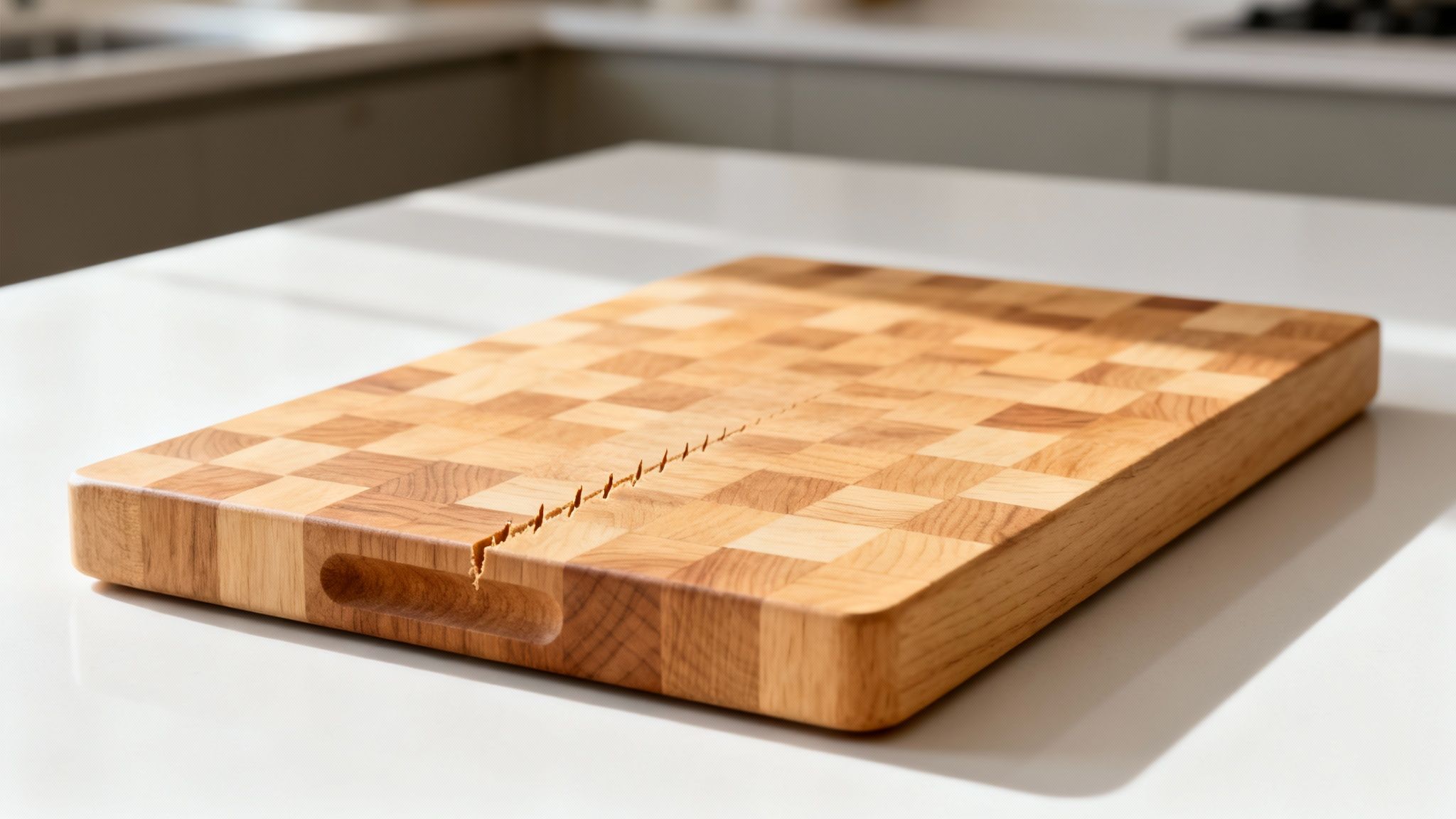
An end-grain chopping board is one of those premium pieces you find in the kitchens of professional chefs and serious home cooks. It's constructed with the wood grain oriented vertically, creating a durable, self-healing surface that’s exceptionally gentle on your knife blades. This unique build means your knives stay sharper for longer, and the board itself resists deep scratches over time.
Ever wondered why culinary experts swear by this specific type of wooden board? The answer lies in its brilliant, yet simple, construction. It’s a design that works in harmony with your knife, not against it.
Think of it like a dense brush with its bristles facing upwards. When you press a knife into the bristles, they part to accommodate the blade and then spring back into place once it's removed. This is exactly how an end-grain board works. The wood fibres are arranged vertically, like those bristles, creating a surface that is both forgiving and incredibly resilient.
This vertical arrangement of wood fibres is what gives an end-grain board its famed "self-healing" quality. Instead of severing the fibres, which is what happens with other types of boards, your knife blade gently slides between them.
Once the cut is complete, the natural elasticity of the wood allows these fibres to close back up. This clever process significantly reduces the appearance of deep knife marks and grooves, keeping the board looking pristine for years. It’s this remarkable property that contributes to its impressive durability.
Perhaps the most significant benefit for any cook is how an end-grain board treats your knives. That "bristle" effect means the blade's edge isn't being dulled by repeatedly striking a hard, unyielding surface. The fibres simply absorb the impact, preserving the razor-sharp edge you work so hard to maintain.
An end-grain chopping board is an investment not just in a beautiful kitchen accessory, but in the longevity and performance of your entire knife collection. It actively helps keep your blades sharper for much longer, reducing the need for frequent honing and sharpening.
This growing appreciation for high-quality kitchen tools is being seen globally. In Southeast Asia, for example, the market for wooden chopping boards, many of which are end-grain, reached USD 49.87 million and is expected to grow significantly. This demand is fuelled by increasing urbanisation and a renewed focus on home cooking.
Beyond its functional excellence, an end-grain board brings a timeless aesthetic to any kitchen. The checkerboard pattern, a natural result of its construction, showcases the wood's beauty from a unique perspective. It’s a functional work of art that signifies a true passion for cooking and quality craftsmanship, much like the traditional pieces found in a Leksands Hemslöjd webshop. This makes it more than just a tool; it's a centrepiece.
When you choose a wooden chopping board, you're not just picking a piece of timber; you're selecting a specific construction that dictates how it feels, performs, and ages. Not all wooden boards are created equal, and understanding the difference between endgrain, edge grain, and face grain is the key to finding the perfect surface for your kitchen.
Each style has a unique story told by its grain, and that story directly impacts your knives, your maintenance routine, and the board's longevity.
Imagine a simple plank of wood. It has three distinct surfaces. The wide, flat top is the face grain, showing off the beautiful, flowing patterns of the wood. The narrower side is the edge grain, revealing long, straight lines. Finally, the end of the plank is the endgrain, where you see the wood fibres as a collection of tiny circles, almost like looking at the top of a bundle of straws. Each of these orientations creates a vastly different chopping experience.
The simplest and often most affordable type of wooden board is the face grain board. It’s typically made from a single, wide piece of wood, which showcases the most expansive and visually striking grain patterns. Think of it as laying that plank flat and using its broadest surface for chopping.
While beautiful, face grain boards are the softest of the three. Your knife blade cuts directly across the wood fibres, severing them with each slice. This action not only dulls your knives but also leaves noticeable scratches on the board’s surface, making it the least durable option for heavy-duty chopping. They are best suited for lighter tasks, like serving cheese or slicing bread.
Edge grain boards represent a big step up in durability and are probably the most common choice for home kitchens. To make one, craftsmen glue several long, narrow strips of wood together side-by-side, with the edge grain facing up. This creates a laminated surface that is much harder and more resilient than face grain.
This construction is sturdy and reliable, offering good resistance to wear and tear. However, just like with face grain, your knife is still cutting across the wood fibres. While it's a tougher surface, it will still blunt your knives faster than an endgrain board and will show cut marks over time. They offer a great balance of durability and cost, making them a popular mid-range option.
The crucial difference lies in how the wood fibres are presented to the knife. With edge and face grain, you are cutting against the grain, but with an endgrain board, the blade works with the grain.
Finally, we arrive at the premium choice for serious cooks: the endgrain chopping board. This is the classic "butcher block" style, constructed by standing short blocks of wood on their ends and gluing them together. This method orients the wood fibres vertically, so the cutting surface is composed of the ends of the wood—those tiny straws we mentioned earlier.
This vertical orientation is a game-changer for two reasons. First, it’s remarkably kind to your knives. Your blade slips between the fibres, which part to accept the cut and then close back up. This means less resistance, less wear on your blade's delicate edge, and a sharper knife for longer.
Second, this "self-healing" characteristic makes the board itself incredibly durable. Because the fibres aren’t being severed, the board shows far fewer scratches and can withstand years of heavy use without developing deep, bacteria-trapping grooves. It’s this exceptional longevity that makes it a worthwhile investment. In fact, these knife-friendly qualities are why endgrain boards, celebrated for their self-healing surfaces, account for about 40% of wooden board sales in the region. Their lifespan can reach 10 years with proper care, compared to just 2-3 years for many edge-grain alternatives. You can discover more insights about the wooden board market on Verified Market Reports.
To truly appreciate the differences, let's break down the key factors for each type of board construction.
Ultimately, while edge and face grain boards certainly have their place, the endgrain chopping board stands in a class of its own. It offers an unmatched combination of knife care, resilience, and timeless beauty, making it the superior choice for anyone passionate about their culinary craft.
Picking out the wood for an endgrain chopping board is about so much more than just looks. It’s a decision that directly affects how long your board will last, how safe it is for your food, and how kind it will be to your knives. Not just any timber will do the job.
The absolute best choices are always closed-grain hardwoods. These woods hit the sweet spot, offering the perfect mix of density, hygiene, and resilience.
Their pores are tiny, which means they’re far less likely to soak up moisture or give bacteria a place to hide. This non-porous quality makes them a breeze to clean and maintain, keeping your kitchen a safe place for prepping meals. Plus, they're tough enough for daily chopping but won’t brutalise your knife's delicate edge.
When you start looking into the best materials for an endgrain board, three names pop up again and again: Maple, Walnut, and Cherry. Each one brings its own unique blend of performance and visual appeal to the table, making them favourites among artisans and chefs.
Maple: Often seen as the classic, quintessential wood for chopping boards. Hard Maple is dense, incredibly durable, and has a lovely, clean creamy colour. Its fine, uniform grain creates an amazing cutting surface that stands up to wear and tear beautifully.
Walnut: If you’re after a darker, more luxurious look, Black Walnut is a fantastic option. It’s a touch softer than maple, which makes it exceptionally gentle on knife edges, but it's still more than durable enough for everyday kitchen tasks. The rich, chocolatey tones can make for a real statement piece.
Cherry: Known for its warm, reddish-brown hue that deepens wonderfully over time, Cherry is another brilliant choice. It falls between maple and walnut in hardness, offering a great balance of durability and knife-friendliness.
This chart gives you a clear visual comparison of how endgrain construction really stands apart from edge and face grain, highlighting its unique structure.
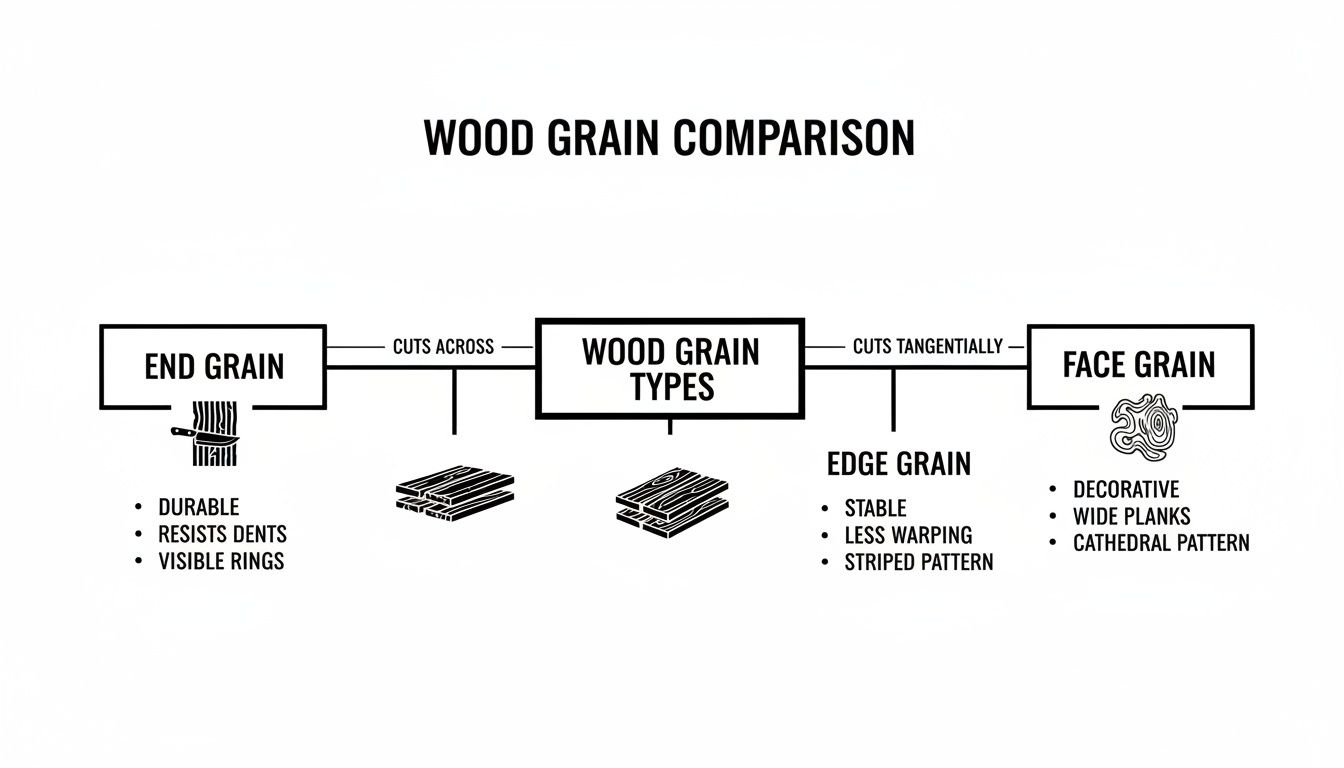
As you can see, the vertical fibres in an endgrain board create a surface that is fundamentally different—and much more forgiving—than the horizontal fibres found in other types of boards.
Just as important as knowing which woods to pick is knowing which ones to steer clear of. Using the wrong type of wood can leave you with a board that's unhygienic, wrecks your knives, or just wears out in no time.
First off, softwoods like pine or fir are a definite no-go. They are simply too soft and will get chewed up by knives, leaving deep gouges that trap food particles and bacteria. Their porous nature also means they soak up liquids, making them almost impossible to sanitise properly.
A crucial takeaway is that the ideal wood has a Janka hardness rating that is high enough for durability but not so high that it feels like chopping on stone. Woods that are too hard, such as exotic species like Ipe, can dull a knife almost instantly.
Equally troublesome are open-grained hardwoods like Red Oak or Ash. While they're certainly hard enough, their large, open pores are a major issue. These pores are magnets for moisture and food bits, creating a perfect breeding ground for bacteria and making the board a real headache to keep clean and food-safe.
Sustainability is also a big part of the picture. Today, 60% of SE producers use FSC-certified end-grain wood, thanks to a regional eco-kitchenware initiative that also saw a 12% uptick in premium board sales. In Indonesia alone, end-grain board production jumped 18%, helped along by government subsidies for wood processing. You can dive into the full research on this growing market over at Verified Market Reports.
Ultimately, choosing a board made from Maple, Walnut, or Cherry is an investment in a piece that’s not only beautiful but also safe, durable, and good for your knives—much like how the right woods are essential for creating beautiful wood wall art.
An end-grain chopping board is so much more than a simple kitchen tool. Think of it as a long-term investment that, with the right attention, can easily become a family heirloom passed down through generations. Its unique construction—with all those vertical wood fibres facing up—demands a specific care routine to keep it hydrated, hygienic, and looking its best.
This isn't a high-maintenance relationship, but it does ask for a little consistency. A few simple, regular habits will protect the wood's natural beauty and ensure it performs flawlessly for years, even decades. If you neglect these steps, you risk dryness, cracking, and warping, undoing all the fine craftsmanship you paid for.
It's a lot like caring for a high-quality leather jacket. You wouldn't just toss it in the washing machine or leave it out in the rain. Instead, you'd clean it gently and condition it now and then to keep it supple and strong. Your end-grain chopping board deserves that same level of mindful care.
Before you even think about making a single cut, your brand-new end-grain board needs to be seasoned. This is an absolutely essential first step. Seasoning creates a protective barrier that repels moisture and stops the wood from drying out by deeply hydrating all those thirsty wood fibres with a food-safe oil.
Your best friend for this task is food-grade mineral oil. It's cheap, easy to find, and most importantly, it won't go rancid like common cooking oils such as olive or vegetable oil ever would.
Here’s a simple routine to get your new board ready for action:
After that initial week-long treatment, a quick oiling session just once a month is all you need to keep your board in peak condition.
Proper daily cleaning is the key to keeping your board hygienic and preventing damage. The rules are simple but absolutely non-negotiable if you want your board to last a lifetime. The goal is to clean it effectively without letting too much moisture in, which is the natural enemy of an end-grain board.
The most common cause of a warped or cracked endgrain chopping board is improper washing and drying. Water is the wood's biggest threat, causing the fibres to swell and contract unevenly.
Here's what you should always do:
And here’s what you must never, ever do:
Over time, you might notice some stubborn stains from things like berries or a lingering odour from garlic and onions. The good news is you don't need harsh chemicals to sort it out. A simple, natural solution from your pantry is all it takes.
To tackle stains and neutralise smells, just grab some coarse salt and half a lemon. Sprinkle the salt generously over the affected area, then use the cut side of the lemon to scrub the salt right into the board. The salt acts as a gentle abrasive, while the citric acid in the lemon juice works wonders to lift stains and break down whatever is causing the odour.
Let that salty, lemony mixture sit for a few minutes, then give it a quick rinse with warm water, dry the board thoroughly, and you're good to go. It’s a fantastically effective—and completely food-safe—way to freshen up your cutting surface.
Ready to bring one home? Choosing the right endgrain chopping board can feel like a big decision, but knowing exactly what to look for transforms the whole process from daunting to exciting. This guide will walk you through how to inspect a board like a pro, making sure you invest in a piece that’s not just beautiful, but truly built to last a lifetime.
When you’re holding a board, the first thing you’ll notice is its physical presence. The thickness and overall build quality are your most immediate clues to how it will perform in your kitchen for years to come.
A well-made endgrain board has a certain heft to it—a reassuring substance. Don't shy away from thicker, heavier boards; this weight is a mark of quality and provides a rock-solid cutting surface that won't dare shift while you work.
Board Thickness: Aim for a board that is at least 4 cm (around 1.5 inches) thick. This substantial thickness is crucial for stability, preventing the warping that can happen as the wood naturally breathes with changes in humidity.
Quality of the Glue-Up: Look closely at the seams where the individual blocks of wood meet. On a high-quality board, these glue lines should be nearly invisible—tight and absolutely seamless. Any visible gaps, no matter how small, are red flags. They can let moisture creep in and eventually compromise the board’s entire structure.
A superior endgrain chopping board is a testament to precision craftsmanship. The final piece should feel like a single, solid block of wood, not an assembly of smaller parts.
The demand for these beautiful boards is massive. In fact, local makers in Thailand and Malaysia are exporting over 1.2 million units every year to Europe and North America. This boom has been helped along by a 15% rise in e-commerce sales since the pandemic. You can dive deeper into the wooden cutting board market trends over at Verified Market Reports.
Beyond the solid core construction, a few clever design elements can make a world of difference in day-to-day use. These thoughtful additions are often what separate a good board from a truly great one.
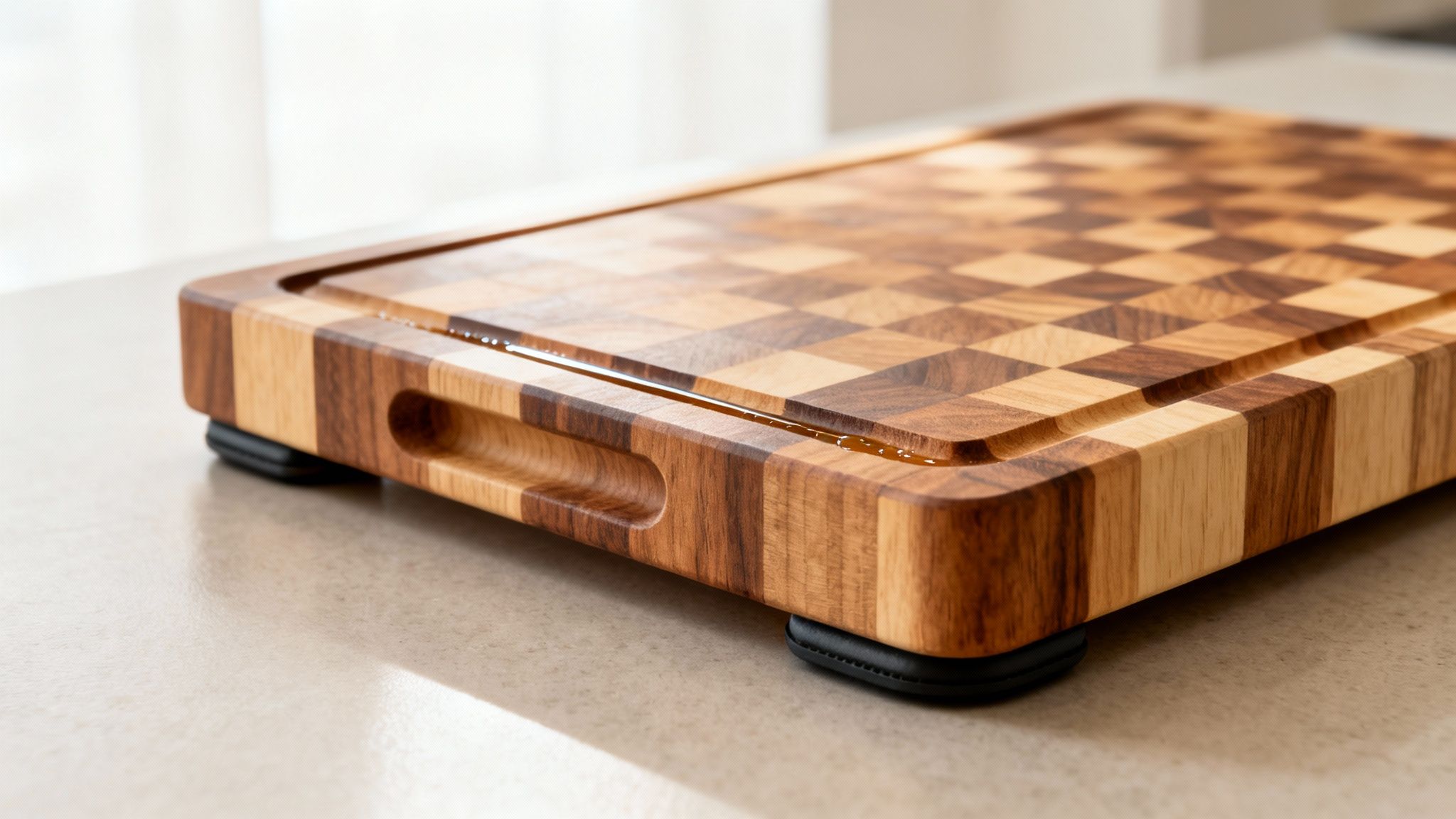
Non-Slip Feet: Rubber or silicone feet are a fantastic feature. They lift the board slightly off the counter for better air circulation (preventing moisture buildup) and give it an unshakeable grip, even during the most vigorous chopping.
Juice Grooves: If you often find yourself carving roasts or slicing juicy tomatoes, a "juice groove" is a must-have. This simple channel carved around the edge expertly catches liquids, keeping your countertops clean and dry.
Finger Grips: Keep an eye out for routed-out handles or grips on the sides. These small details make lifting and moving a heavy endgrain board so much easier.
Finally, think about the right size for your kitchen and your cooking style. A board that's too small will feel cramped and frustrating, while one that's too big can completely take over your counter. Measure your space and consider your typical prep work to find that perfect fit.
When you're ready to buy, remember that artisan-made boards often have a superior finish and a level of detail that mass-produced alternatives just can't match. For a few tips on navigating online marketplaces for unique crafted items, check out our guide on understanding shipping from Sweden on Etsy.
Even the most beautiful, well-made objects can come with a few questions, and endgrain boards are no exception. Their unique construction is what makes them so special, but it also means they need a slightly different kind of care. Let’s clear up some of the common queries and myths that surround them.
Getting to grips with the facts about looking after your board will help you feel confident bringing one into your kitchen. These pieces are crafted for a lifetime of use, and a little knowledge goes a long way.
Yes, they absolutely are, and the science behind it is quite fascinating. Quality hardwoods possess natural antimicrobial properties that help keep the surface clean. Even more importantly, the “self-healing” nature of the endgrain means that when your knife slices into the wood, the fibres tend to close back up, preventing bacteria from getting trapped deep inside.
Plastic boards, on the other hand, are a different story. Over time, they develop deep grooves and scratches from knife use. These cuts become a permanent refuge for bacteria and are notoriously difficult to fully sanitise, making a well-maintained wooden board a far superior choice for kitchen hygiene.
Warping and cracking are almost always the result of a moisture imbalance. Think of an endgrain board as a bundle of tiny straws standing on end; these vertical wood fibres absorb and release moisture. If this happens unevenly—say, one side gets wet while the other stays dry—it can cause the board to twist, cup, or even split.
The two biggest culprits are the dishwasher and leaving the board to soak in the sink. The combination of intense heat and prolonged water exposure will cause irreversible damage. Always wash by hand and dry it straight away.
Another common mistake is storing the board flat on a wet counter, which traps moisture underneath. To prevent this, always let your board air dry standing on its edge. This simple step allows air to circulate evenly around all sides, keeping it stable and happy.
With oiling, consistency is far more important than a rigid schedule. When your board is brand new, it's thirsty. You’ll want to oil it daily for the first week to build up a robust, protective seasoning deep within the wood fibres.
After that initial break-in period, a simple rule of thumb is to oil it about once a month. But honestly, the best way to know is to just look at it. If your board starts to look a bit pale, dry, or lacklustre, it's telling you it needs a drink. Regular oiling keeps it hydrated, prevents cracks from forming, and maintains that rich, beautiful colour.
Absolutely. The natural properties of wood make it perfectly safe for preparing raw meat, poultry, and fish. The most crucial factor here is your cleaning process. As soon as you’re finished, wash the board thoroughly with hot, soapy water, rinse it clean, and dry it completely with a towel.
For extra peace of mind, many cooks like to designate one side of their board exclusively for raw meats. This is an excellent practice and one we highly recommend.
At Dalaart, we celebrate craftsmanship that lasts a lifetime. Explore our collection of authentic, artisan-made Swedish treasures by visiting https://dalaart.com and find a piece of tradition for your home.


.svg)


.png)


