January 12, 2026
If you're looking into Orrefors Anne Nilsson, you're delving into the work of a designer who truly reshaped modern Scandinavian glass. Her pieces for Orrefors are cherished for their clean, elegant simplicity and artistic touch, marking a clear move away from the heavy, traditional crystal of the past toward something lighter and more suited for everyday life.
Spend any time in the world of Swedish glass, and you'll inevitably come across the name Anne Nilsson. For collectors, her work isn't just beautiful; it represents a pivotal moment in design history, a time when functional objects were elevated to the level of accessible art. She had this incredible knack for seeing the quiet beauty of nature and translating it into fluid, graceful glass forms that just feel right in a modern home.
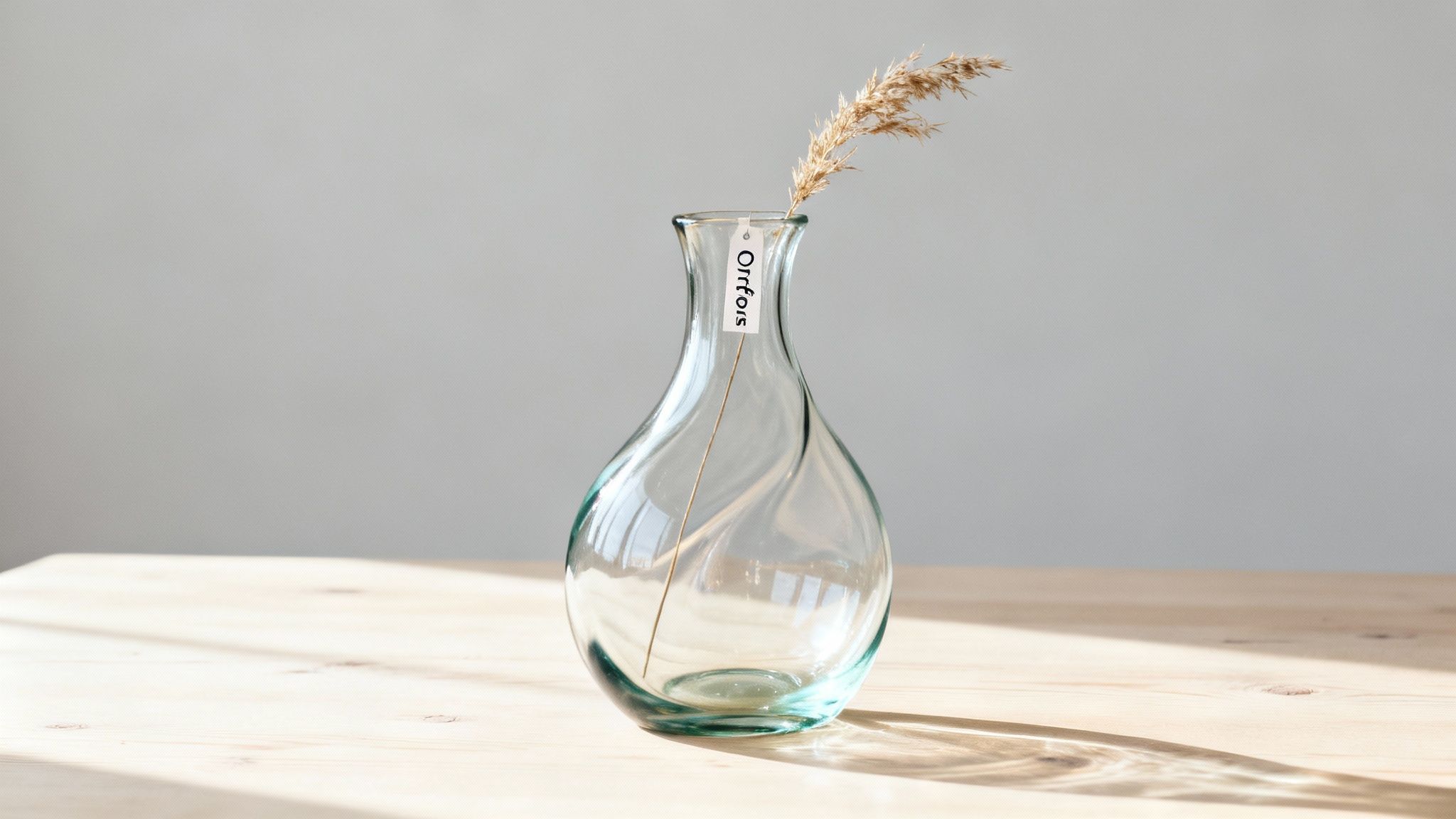
You could almost think of her work as a bridge between two very different eras. She expertly steered Orrefors from the dense, ornate crystal that dominated for so long towards a lighter, more refined style that came to define the late 20th century. This wasn't just a change in weight; it was a fundamental shift in how people saw and used art glass.
For those of us who collect Swedish glass, Anne Nilsson's work is one of the most important threads connecting the historic Orrefors name to contemporary Scandinavian design. Born in 1953, she studied at the renowned Konstfack in Stockholm and even spent time learning in California before returning to the heart of Sweden's glass country.
Her time at Orrefors, from 1982 to 1999, was a remarkable 17-year period. This was exactly when Sweden was moving away from heavy lead crystal and embracing lighter, more functional glass for daily use, and Nilsson was at the forefront of that movement. You can get a great overview of her foundational career on the official Kosta Boda page about her work.
This guide is designed to walk you through the highlights of her Orrefors legacy, helping you to understand:
By exploring her contributions, you’re doing more than just learning about glassware. You’re gaining an appreciation for an artist who helped shape an entire movement in Scandinavian design. And that journey begins with understanding the woman behind the glass.
When you hold a piece of glass designed by Anne Nilsson for Orrefors, you’re not just holding an object; you’re holding a story about a specific moment in Swedish design. Her time at the glassworks, from 1982 to 1999, wasn't just a job—it was a period of huge cultural change. The world was moving away from the heavy, formal crystal of the past and embracing something more organic, light, and deeply tied to the natural world. Nilsson wasn't just following that trend; she was one of the people shaping it.
Her workshop was a place of exploration. She had a fresh way of looking at glass and its inherent magic—its ability to capture light, hold colour, and take on fluid, almost liquid shapes. What really made her special was her unique talent for blending pure artistry with everyday practicality. She made things that looked just as beautiful on a display shelf as they did on a dinner table. This perfect balance is the true cornerstone of her legacy.
So, what makes an Orrefors piece scream 'Nilsson'? Her creative signature comes down to a few key things that really set her work apart. She found endless inspiration in nature, but not in a literal, picture-perfect way. Instead, she captured its essence—the gentle curve of a leaf, the soft wash of colour in a morning sky, or the ripple of water on a still pond.
This approach gave her designs a feeling of being both timeless and alive. You can see it clearly in the subtle, almost watercolour-like way she applied colour. It was a real departure from the deep, saturated tones you often saw in art glass at the time, offering a much softer, more atmospheric quality.
Her defining characteristics include:
At its core, Anne Nilsson's vision was about softening the edges of modernism. She brought a poetic, nature-inspired sensibility to functional glass, making her pieces feel personal and approachable.
You can see this unique vision come to life in some of her most celebrated collections for Orrefors. The Celeste series, for example, is famous for its delicate forms and ethereal quality. These pieces seem almost weightless, capturing a sense of movement and grace that was a total revelation back then.
In the same way, the Pastel collection introduced a palette of soft, gentle colours that felt incredibly fresh and modern. In a world used to either perfectly clear or boldly coloured crystal, these understated tones offered a new way to think about decorative glass. Suddenly, it was easier to bring beautiful glass into contemporary homes. These collections weren't just new products; they were powerful statements about the future of Swedish design.
Becoming a confident collector of Anne Nilsson's work for Orrefors really boils down to knowing what to look for on the base of each piece. These engraved marks are like an artist's signature and the factory's stamp of approval all rolled into one, telling a story about the object's origin and authenticity. Learning to read these small details is far and away the most reliable method for separating a genuine treasure from a piece that just looks similar.
Think of it as learning a secret language etched into the glass. Once you get the hang of the basic elements, you can quickly spot the key markers that confirm a piece was designed by Nilsson during her tenure at the famous Swedish glassworks. This skill gives you the power to browse antique shops, online auctions, and galleries with a truly discerning eye.
The visual guide below breaks down the key characteristics of form, colour, and function you'll often find in her work, showing how she balanced these elements.
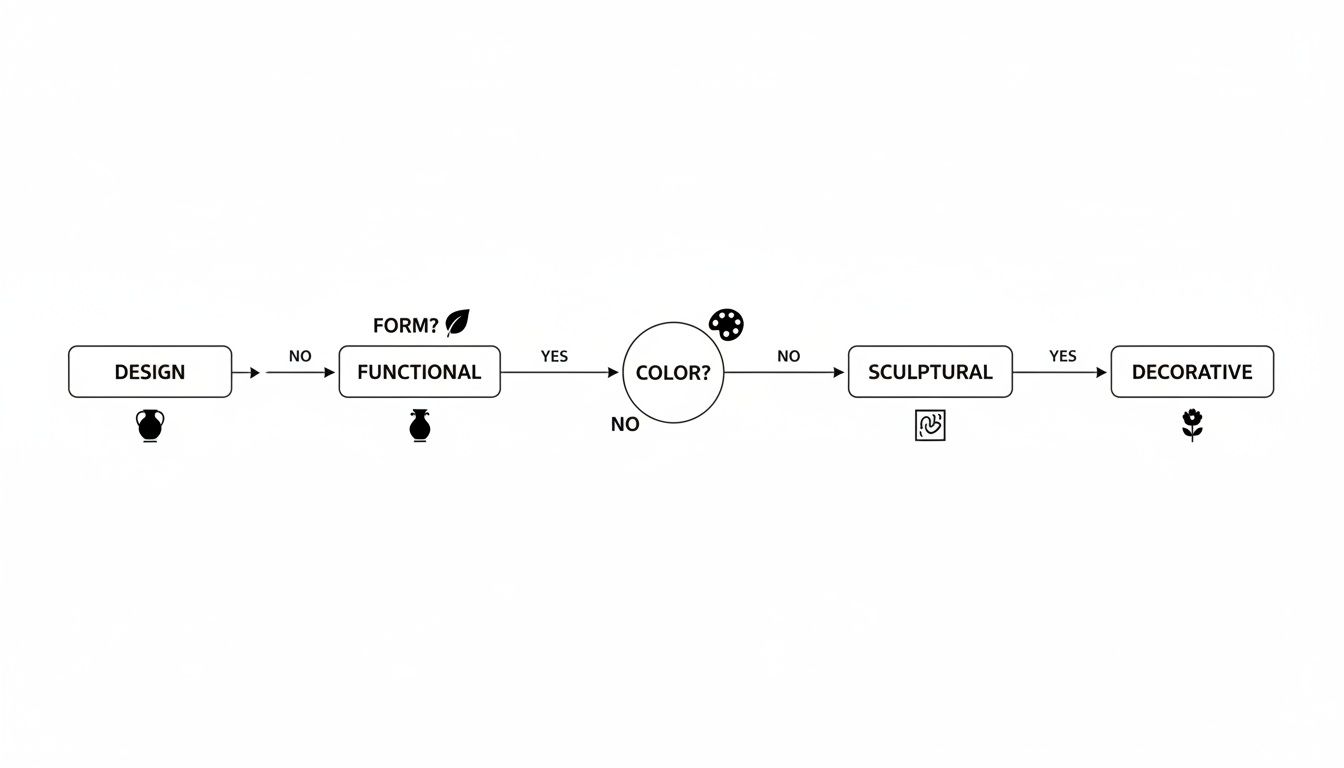
This decision tree gives you a good feel for how Nilsson's designs manage to be sculptural, decorative, and purposeful all at once.
The most critical information is almost always found on the underside of the base, carefully engraved by hand. When you're examining a potential Orrefors Anne Nilsson piece, you're looking for a combination of marks. Just finding one isn't enough; you need the complete set of identifiers to be sure.
A full, authentic signature typically includes several components:
By looking for the combination of 'Orrefors', 'AN', and the series/production numbers, you are piecing together the full provenance of the object. This complete signature is the gold standard for authentication.
Sometimes the marks can be faint or tricky to read, especially on older pieces or those that have seen a lot of use. A small magnifying glass and good, bright light are essential tools for any serious collector. And remember, these marks were engraved by hand, so slight variations in the script are perfectly normal—they’re part of the character of the piece.
Also, a quick word on labels. While some pieces might still have their original Orrefors sticker, these can be easily removed, fall off, or even be faked. The engraved signature is the primary and most trustworthy method of authentication, period. For those new to the Swedish terms you might see in auction listings, having a quick reference can be a lifesaver. This Swedish-English lexicon for art collectors offers a fantastic starting point for understanding common descriptions.
To really get a feel for Anne Nilsson's work with Orrefors, you have to spend some time with the collections that truly defined her career. These aren't just collections of glassware; they're the physical embodiment of her artistic vision. Each series tells a story, revealing her unique way of playing with colour, light, and form, and giving collectors tangible benchmarks to look for.
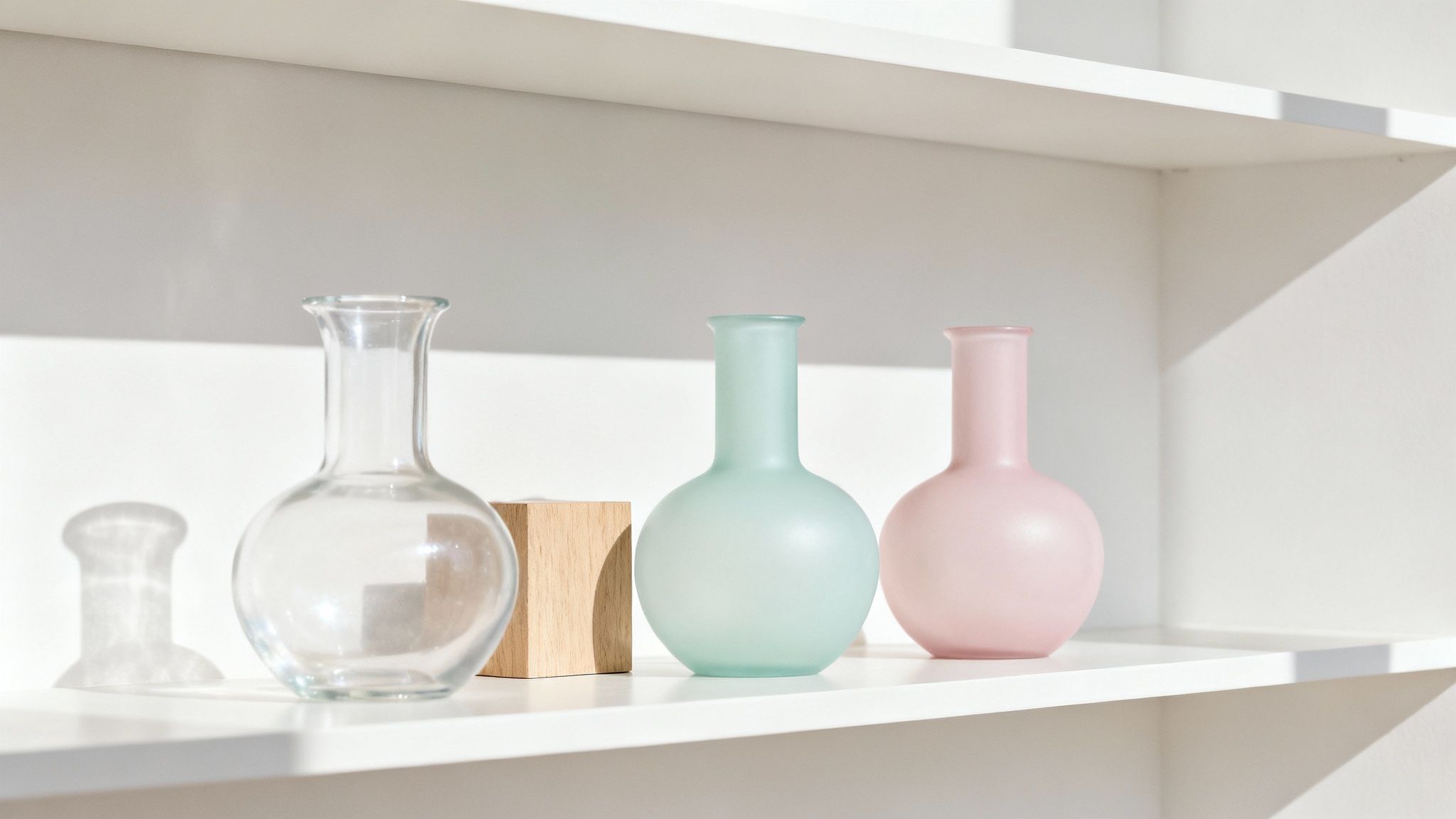
By zooming in on a few of her landmark series, you start to grasp what makes her designs so special. It's one thing to identify her work, but it's another thing entirely to understand the creative spark behind it. That's when the hunt for a specific piece becomes so much more satisfying.
The Celeste series is, without a doubt, one of Nilsson's most recognisable contributions to Orrefors. When it launched in the 1980s, it captured a feeling of incredible lightness and motion that was completely captivating. The signature of the series is the thin, swirling threads of colour encased within crystal clear glass, creating an effect that's both delicate and full of energy.
To hold a Celeste vase is like holding movement itself. The forms are fluid, organic, and often asymmetrical, giving them an almost weightless feel despite being made of solid glass. This collection is a perfect example of Nilsson's mastery in making glass do the impossible—turning a heavy, solid material into something that feels like air or water. For many collectors, Celeste is the absolute pinnacle of her work at Orrefors.
The Celeste collection is a masterclass in subtlety. Its design inspiration draws from natural phenomena like wind and water, translating these abstract concepts into graceful, tangible forms that interact beautifully with light.
Another cornerstone of Anne Nilsson's legacy is the Pastel collection. This was a breath of fresh air. At a time when art glass often veered towards either bold, primary colours or stark clarity, this series introduced a soft, refreshing palette that felt entirely new. The gentle tones of rose, mint, and sky blue were perfectly in tune with the changing tastes of modern interiors.
What really made the Pastel collection work was its quiet elegance. The colours never shout; they're applied with a light touch, often concentrated at the base or rim, which lets the pure clarity of the crystal do the talking. It gives the pieces a serene, calming presence that's hard to resist.
Key features of the Pastel series include:
These iconic examples offer a clear window into Anne Nilsson's creative world, making it that much easier to spot her signature touch out in the wild.
The fact that Anne Nilsson's work for Orrefors is still so sought-after decades later really says something about her design legacy. Her pieces continue to catch the eye of seasoned collectors and newcomers to Scandinavian glass alike. Getting a feel for what drives this market is the first step towards building a collection you can be proud of.
So, what makes one piece more desirable than another? A few things. Rarity is a huge one; a limited production run or a one-off experimental item will always generate more buzz. The specific collection it belongs to also plays a big part. A piece from her celebrated Celeste or Pastel series, for instance, often has a stronger following—and a higher price tag—than some of her lesser-known designs.
When you're looking at a piece of Orrefors Anne Nilsson glass, collectors are essentially weighing a combination of attributes. Condition is everything. Any chips, deep scratches, or cloudiness in the glass can seriously knock down its value. The signature is just as important. A clear, complete engraving is your undeniable proof of authenticity and tells the story of where the piece came from.
To make smart buys, keep these points in mind:
It's best to think of these factors not as a rigid checklist, but more as a set of guiding principles. Of course, a flawless piece is the ideal. But sometimes a rare design with a tiny imperfection can still be a fantastic addition to your collection if you truly love it.
The thrill of the hunt is half the fun of collecting. Established Nordic auction houses are a great place to start. Bukowskis, for example, regularly features Orrefors by Anne Nilsson, and they provide detailed listings that show the full signatures and production marks. This level of transparency is pretty standard in the Swedish market, where proper designer attribution is key to how mid-century glass is catalogued and sold. You can get a better sense of how Nilsson's work is presented at major auctions on Lot-Art.
Beyond the big auction houses, keep an eye on specialised online marketplaces and reputable antique dealers. These are often run by sellers who really know their Scandinavian glass. If you're exploring broader online platforms, it helps to understand the local scene; our guide to buying vintage items on eBay in Sweden offers some useful context. Building a great collection is a journey that takes patience and a bit of knowledge, but it leads to finds that are both personally meaningful and strategically sound.
To really get a feel for Anne Nilsson's place in Scandinavian design, you have to follow her story after she left Orrefors. In 2001, she made a significant move to another titan of Swedish glass, Kosta Boda, where she continued to leave her mark on the industry until 2005. This wasn't a reinvention but an evolution. It was a chance for her to explore new ideas and apply her signature artistic voice in a different, yet equally legendary, creative setting.
Her time at Kosta Boda proved that her design sensibilities were both adaptable and timeless. She wasn't an artist defined by a single glasshouse; her vision was bigger than that. This period truly cemented her status as a leading force in Swedish design, showing her influence reached far beyond her celebrated beginnings at Orrefors.
The work she produced at Kosta Boda didn't take long to turn heads. One of the most telling signs of her success there was the staying power of her designs. Her Pagod collection, for instance, has remained in production for years—a rare feat in an industry known for rapidly changing product lines.
Then there was her Nero collection, which earned a nomination in 2004 for the prestigious Elle Deco International Design Awards (EDIDA). This placed Nilsson in an elite circle of Swedish glass designers recognised on the world stage. You can see more about this chapter of her career on Kosta Boda's profile for Anne Nilsson.
This recognition really drives home a key point for collectors: Anne Nilsson's creative journey is a story of sustained excellence. The ability to create work that is both commercially successful and critically acclaimed at two of Sweden’s most famous glasshouses is a true testament to her incredible talent.
Looking at this later work gives you the full picture, connecting the dots of a remarkable career. For anyone interested in the wider world of Swedish design heritage, her journey through both glass and ceramics is a fascinating study. You can explore a related tradition in our article on the enduring appeal of Höganäs Keramik stoneware.
As you start your journey into the world of Orrefors Anne Nilsson, a few practical questions are bound to pop up. This final section is here to give you straightforward answers to the things collectors, both new and experienced, often ask. Think of it as a final checklist to help you move forward with confidence.
Building a collection should be a joy, not a worry. Knowing how to properly select and care for your pieces is a massive part of that pleasure, so let's get into the practical side of owning these beautiful objects.
Proper care is the secret to keeping your glass brilliant for decades. The golden rule? Always, always wash these pieces by hand. The combination of high heat and harsh detergents inside a dishwasher can, over time, cause the glass to become cloudy. This condition is often called "sick glass," and sadly, it's irreversible.
Instead, a little gentle care goes a long way. Just follow these simple steps:
By avoiding harsh chemicals and sudden temperature changes, you're preserving that incredible clarity that makes Nilsson's work so captivating. Gentle, consistent care is the absolute best way to protect your investment.
For anyone just starting out, a smaller vase or a beautiful bowl from one of her more widely produced series is an excellent entry point. Pieces from the Pastel collection, for example, are often a bit more accessible and give you a wonderful feel for her signature use of subtle colour and clean, functional shapes.
Starting with a single, well-documented piece is a great way to familiarise yourself with the feel of the glass, the style of the engravings, and how it plays with the light in your own home. That hands-on experience is priceless. From there, you can decide if you want to hunt for rarer items or perhaps build out a collection based on a specific colour or form that really speaks to you. At the end of the day, the best first piece is one you genuinely love looking at every single day.
At Dalaart, we celebrate the artistry and heritage of Swedish craftsmanship. While you explore the world of Scandinavian glass, discover our curated collection of authentic, hand-carved Dala horses and folk art straight from Dalarna. Find your perfect piece at https://dalaart.com.


.svg)


.png)


