April 13, 2026
A resident glances up at dusk, sees a small group in dark clothing walking together, and wonders if they’re police, protesters, or something else. That uncertainty sits at the heart of how many people first encounter sons of odin sverige.
The Swedish name sounds old, almost legendary. Its character is modern, political, and contested.

People often hear the name and assume it refers to Viking history, pagan religion, or general Swedish heritage. That confusion makes sense. Sweden’s visual culture includes runestones, saga references, folk motifs, and a long public interest in Norse stories, much like the broader set of typical Swedish things that visitors and heritage enthusiasts recognise at a glance.
But sons of odin sverige is more than a heritage label. In public discussion, it refers to a Swedish branch or variant of the wider Soldiers of Odin phenomenon, a vigilante movement that emerged in a climate of anxiety about migration, crime, and national identity.
The first source of confusion is the word Odin. For many readers, Odin belongs to myth, literature, museums, and school lessons about Scandinavia’s past. For the group, the name works differently. It acts as a badge of strength, ancestry, and cultural ownership.
The second source of confusion is the word Sverige. That can make the group sound official, almost civic. It isn’t an arm of the state, and it isn’t part of the police.
A useful starting rule: if a group presents itself as protecting public space but operates outside formal law enforcement, treat its symbols and claims separately from its actual authority.
Three questions help clear away the fog:
That distinction matters for readers interested in Swedish culture. A symbol can belong to a civilisation for centuries, then be repurposed by a modern movement in a very different way.
The group becomes clearer when it is not viewed as a historical society. It’s closer to a self-appointed neighbourhood watch, except with a stronger ideological edge and a visual style that borrows from Norse myth.
At its most basic, sons of odin sverige presents itself as a group of civilians who patrol public areas and claim to increase safety. That is the self-description.
The public criticism is different. Critics argue that these patrols can blur the line between observation and intimidation, especially when members use confrontational symbols, nationalist messaging, or anti-immigrant language.
The group’s branding does a lot of work for it. Odin is not chosen at random.
The name suggests:
That gives the group an aura of legitimacy for some supporters. It can make a modern street patrol look older, deeper, and more “native” than it really is.
Think of two different people wearing high-visibility jackets.
One is a trained road worker employed by a municipality. The other bought a similar jacket online and started directing traffic on his own. They may look superficially alike, but only one has formal authority, training, and accountability.
The same logic helps with sons of odin sverige. Patrol members may dress in a coordinated way and talk about safety, but that doesn’t make them police, social workers, or emergency responders.
When groups of this type communicate, they often mix several layers at once:
Not every post or statement will contain all of these. The point is to notice the pattern.
If a movement says it is “only about safety” but repeatedly wraps that message in ethnic or civilisational language, the identity message is not incidental. It’s part of the appeal.
A common mistake is to compare the group only to crime-prevention volunteers. A better comparison is street-level identity activism. Safety talk may be sincere for some members, but symbolism, belonging, and public visibility also matter.
Another mistake is to assume every person who uses Odin imagery supports such groups. That’s false. Norse symbolism has many meanings in Sweden, from scholarship and literature to tourism, art, and religion.
The story starts outside Sweden. That matters because the Swedish branch didn’t arise from nowhere. It followed a model that had already taken shape elsewhere.

The wider Soldiers of Odin movement was founded in Finland in 2015, and it had a Swedish presence starting in March 2016, according to the background outlined in the Wikipedia overview of Soldiers of Odin. That timing is important because it places the Swedish development in the atmosphere of the European migrant crisis and the sharp political debate that surrounded it.
When readers search for sons of odin sverige, they often find fragments rather than a neat organisational history. That’s partly because naming varies. Some references use “Soldiers”, while searchers may type “Sons”. In practice, people are often trying to locate the Swedish chapter or offshoot associated with the broader movement.
The movement’s formula was simple and media-friendly. It combined visible patrols, dramatic symbols, and claims about defending ordinary people when authorities were said to be failing.
That formula made it easy to photograph, easy to argue about, and easy to spread online.
A few features helped it travel across borders:
The same overview notes a history of neo-Nazi leadership in the Swedish context, including Mikael Johansson, identified there as an ex-member of Nationaldemokraterna, and it also notes that many involved had convictions for assaults. That doesn’t mean every individual supporter shared the same background. It does mean the movement’s public image was shaped by serious extremist associations from early on.
Opposition also formed quickly. Counter-demonstrators, journalists, and local residents often challenged the patrols. In some settings, encounters were tense enough that the group required police protection.
Details of this aspect are sparse. The same source highlights a major information gap. There is no recent Sweden-specific data in that summary on active patrols, membership numbers, or formal disbandment in the period after April 2025.
That absence matters. It means a careful writer shouldn’t claim the group has vanished, surged, or reorganised on a national scale unless newer evidence appears.
Current-status rule: lack of fresh data is not proof of activity, and it is not proof of disappearance. It only tells us the public record is incomplete.
A qualitative interpretation is still possible. The source notes that shifts in Swedish migration policy since 2015 may have reduced the sense of crisis that originally fed vigilante appeal, but it also states that online coverage does not quantify any decline.
So the honest answer to “Is sons of odin sverige still active in 2026?” is restrained. There’s a documented history, there are known extremist associations, and there is a notable recent data gap. Readers should resist anyone offering a neat, overconfident answer unsupported by current evidence.
The public image of sons of odin sverige centres on patrols. In plain terms, that usually means groups of civilians moving through public spaces in a coordinated and visible way.
A patrol is not the same as a random group of friends walking home. It usually has intent. Members may move together, wear matching or similar clothing, and choose streets where they expect an audience.
The point is partly practical and partly theatrical. Visibility is the message.
Common observable features can include:
Groups of this kind often say they are deterring disorder, checking on public safety, or providing a reassuring presence. Those claims can sound familiar because they borrow the language of volunteer safety work.
The difference lies in accountability. Formal community safety programmes usually have explicit cooperation with local authorities, training standards, safeguarding rules, and clear reporting procedures. Self-styled patrol groups often don’t offer that same clarity.
Even when a movement looks loose from the outside, it often has some internal structure. Not always a rigid chain of command, but enough coordination to maintain branding and decide where to appear.
A simple way to think about it is:
This kind of structure can be fuzzy. That fuzziness can be useful to a group. It allows public claims of decentralisation while still preserving a recognisable identity.
Not every person using Norse imagery belongs to this movement. Not every dark hoodie with a mythic symbol means a patrol. Context matters.
Look for a cluster of signals rather than a single one:
A symbol on its own proves very little. A symbol, a group, a patrol route, and a public claim of protective action tell you much more.
For journalists, residents, and visitors, that’s the safest interpretive method. Don’t overread one image. Do assess the whole pattern.
The name Odin gives the movement its most powerful symbolic shortcut. To understand why, it helps to separate heritage from appropriation.
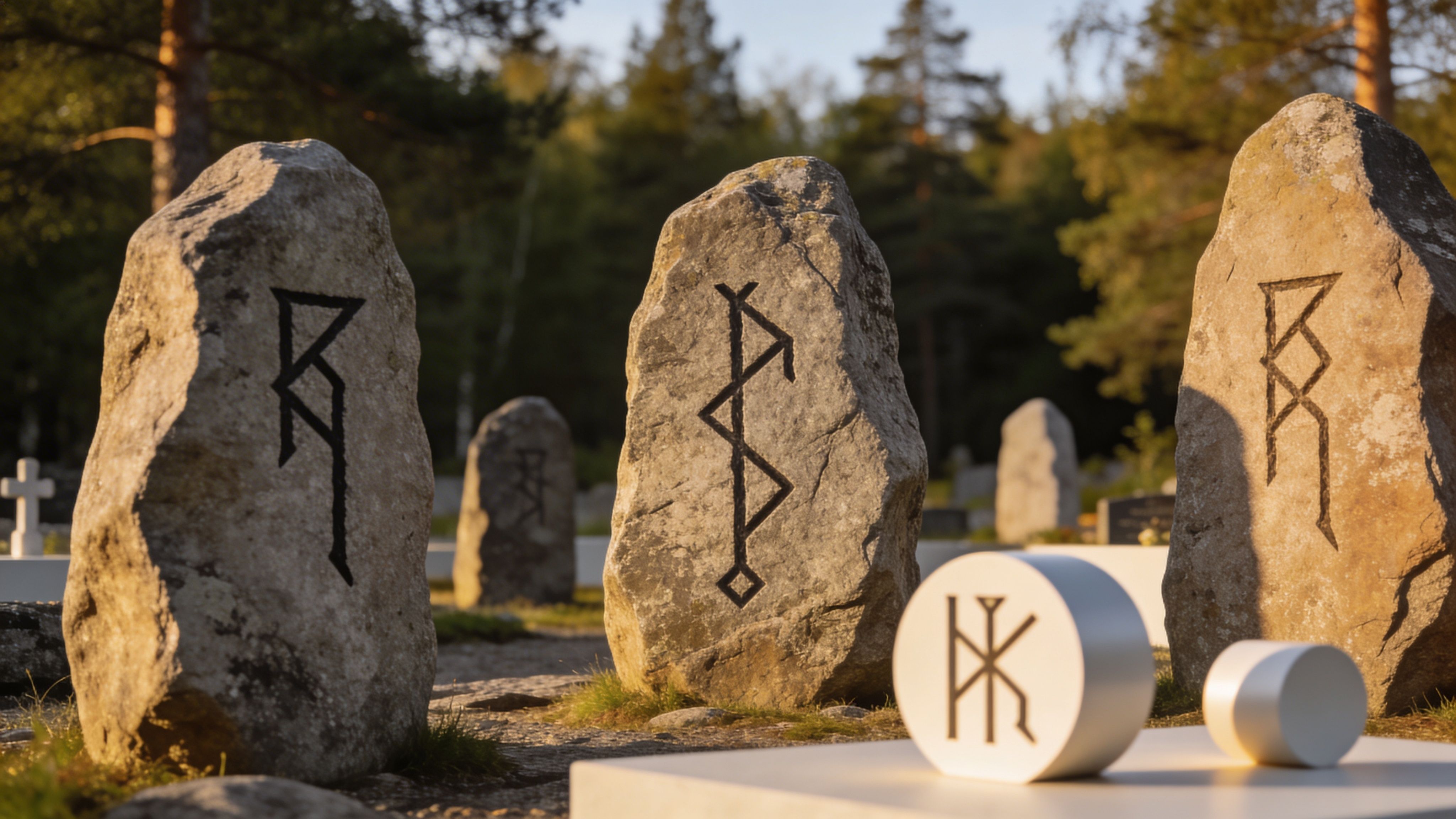
In Swedish legendary tradition, Odin (Oden) is presented as the founder of the Yngling dynasty, with Njord succeeding him and Freyr following in the line, as described in medieval king lists and saga material summarised in the list of legendary kings of Sweden. In that tradition, the dynasty is treated as the first royal bloodline of the Swedes, centred on Uppsala.
The same summary notes that the Ynglings ruled for approximately 20 generations before being displaced by Ivar Vidfamne, and that later Swedish tradition linked this legendary ancestry to kings such as Olof Skötkonung (c. 995 to 1022), Sweden’s first Christian king. It also notes archaeological interest in Gamla Uppsala, where over 15 royal mounds had been excavated by the 19th century, and that the site now draws over 100,000 annually.
That long arc matters because Odin is not a fringe symbol in Sweden. He sits inside a deep, layered historical imagination that includes saga writing, kingship, conversion to Christianity, archaeology, and heritage tourism.
When a modern patrol movement adopts Odin, it borrows prestige from that older cultural reservoir. It is doing something similar to hanging a museum banner over a contemporary political project.
That doesn’t make the project ancient. It makes the branding effective.
The symbolic move works like this:
For supporters, that can feel like cultural defence. For critics, it looks like selective appropriation.
Many people engage with Norse material through literature, archaeology, museums, or books on myth such as this guide to Norse mythology books. In those settings, Odin is part of study, storytelling, or heritage.
A vigilante movement changes the emotional charge of the symbol. It drags it from archive and monument into street politics.
Heritage symbols don’t stay neutral once a movement uses them as uniforms for public confrontation.
That’s why some readers feel a jolt when they hear sons of odin sverige. The phrase compresses two very different things into one package. It invokes one of the best-known figures in Scandinavian myth, then applies that name to a modern movement associated with exclusionary politics.
A helpful analogy is a museum exhibit gone rogue. The exhibit contains old names, old stories, and old symbols. Then someone wheels it into a live political conflict and starts using it as a badge of territorial authority.
The objects are old. The use is new.
Public reaction to sons of odin sverige tends to split quickly. Some people see visible patrols and think “extra eyes on the street”. Others see the same patrol and think “organised intimidation”.
Both reactions are shaped by context.
A calm walk through a town centre may look one way in a photo and another way to someone standing nearby. Clothing, posture, slogans, and the surrounding political atmosphere all influence how the group is read.
For that reason, safety isn’t only about whether violence occurs. It’s also about whether a group’s presence makes others feel targeted, watched, or excluded from public space.
If you’re a traveller, expat, journalist, or heritage visitor, use a simple checklist instead of relying on rumour.
Ask:
A patrol that is merely visible is different from a patrol trying to dominate a square, provoke reactions, or attach itself to a local conflict.
There are good reasons many Swedes have treated such groups cautiously. The documented history discussed earlier includes extremist associations and opposition encounters that required police protection.
That history doesn’t justify panic in every situation. It does justify seriousness.
At the same time, readers should avoid treating every display of Norse symbolism as a security issue. Sweden’s culture includes legitimate uses of Viking-age and saga-related imagery in festivals, scholarship, reenactment, design, and tourism.
The key is behaviour. A heritage event invites interpretation. A vigilante patrol asserts social power.
Safety judgement: pay less attention to the mythic costume and more attention to what the group is doing to the people around it.
A sensible response is usually quiet observation, not confrontation.
You can:
That approach keeps the focus where it belongs. Not on mythic theatre, but on conduct in public space.
Specific contemporary incident data is limited in the material available here, so the safest way to understand patrols is through plausible on-the-ground scenarios based on the movement’s known style and public role, rather than invented case studies presented as verified fact.

A small group gathers near a transport corridor in Gothenburg on a weekend evening. They wear coordinated clothing, keep close together, and make sure they are noticed.
Local residents react in different ways. Some ignore them. Some photograph them. Some ask whether the police know they are there.
In this kind of urban setting, the most important question isn’t whether they claim good intentions. It’s whether their presence calms the area or raises tension. Large cities already contain many actors competing to define public order, from police and security staff to nightlife workers and residents.
A similar patrol in a smaller place can feel more intrusive, even if the numbers are modest. In a town where people recognise each other, a coordinated group walk can carry a stronger message of “we are watching this place”.
That’s one reason local context matters so much. The same act can feel symbolic in a city and personal in a smaller community.
Readers trying to map locations or urban context may find a transport reference such as this Metro Stockholm map useful when thinking about how public movement, visibility, and patrol routes shape perception in Swedish settings.
When police appear, the meaning of the scene often shifts. The patrol stops looking like an independent show of force and starts looking like one actor among several in a managed public-order situation.
That doesn’t automatically reduce unease, but it does restore a visible line between official authority and self-appointed activism.
The useful question is never “Did they say they were helping?” It’s “How did their presence affect other people in the shared space?”
That’s the clearest lens for understanding sons of odin sverige in practice.
The clearest way to understand sons of odin sverige is to hold two ideas at once.
First, it belongs to a modern vigilante-style movement with roots in the migration politics of the mid-2010s, and the documented public record includes extremist associations and a recent gap in reliable updates. Second, its power as a name comes from borrowing Odin and other Norse references from a much older Swedish cultural world.
Those two layers shouldn’t be blurred together.
If you want to research the topic responsibly, use a few habits. Check whether a report describes a current patrol or repeats old coverage. Separate mythic symbolism from actual behaviour. Treat claims of public protection cautiously when the group operates outside formal authority.
Useful next steps include reading established reporting on the wider movement, checking public statements from Swedish authorities when available, and using academic work on Norse symbolism to avoid giving modern branding more historical legitimacy than it deserves.
If you discuss the topic publicly, keep the language precise. Don’t sensationalise. Don’t romanticise either.
If you’re interested in Swedish heritage without the political distortion, explore Dalaart for authentic hand-carved folk art made in Dalarna. It’s a grounded way to engage with Scandinavian tradition through skilled craftsmanship, historical motifs, and objects that reflect living culture rather than vigilante branding.


.svg)


.png)


