March 31, 2026
There's a special kind of magic in holding a piece of Winterling Bavaria Germany porcelain. It’s more than just a teacup or a plate; it's a tangible link to over a century of German craftsmanship. For collectors and enthusiasts, every piece whispers a story of family heritage and enduring design.
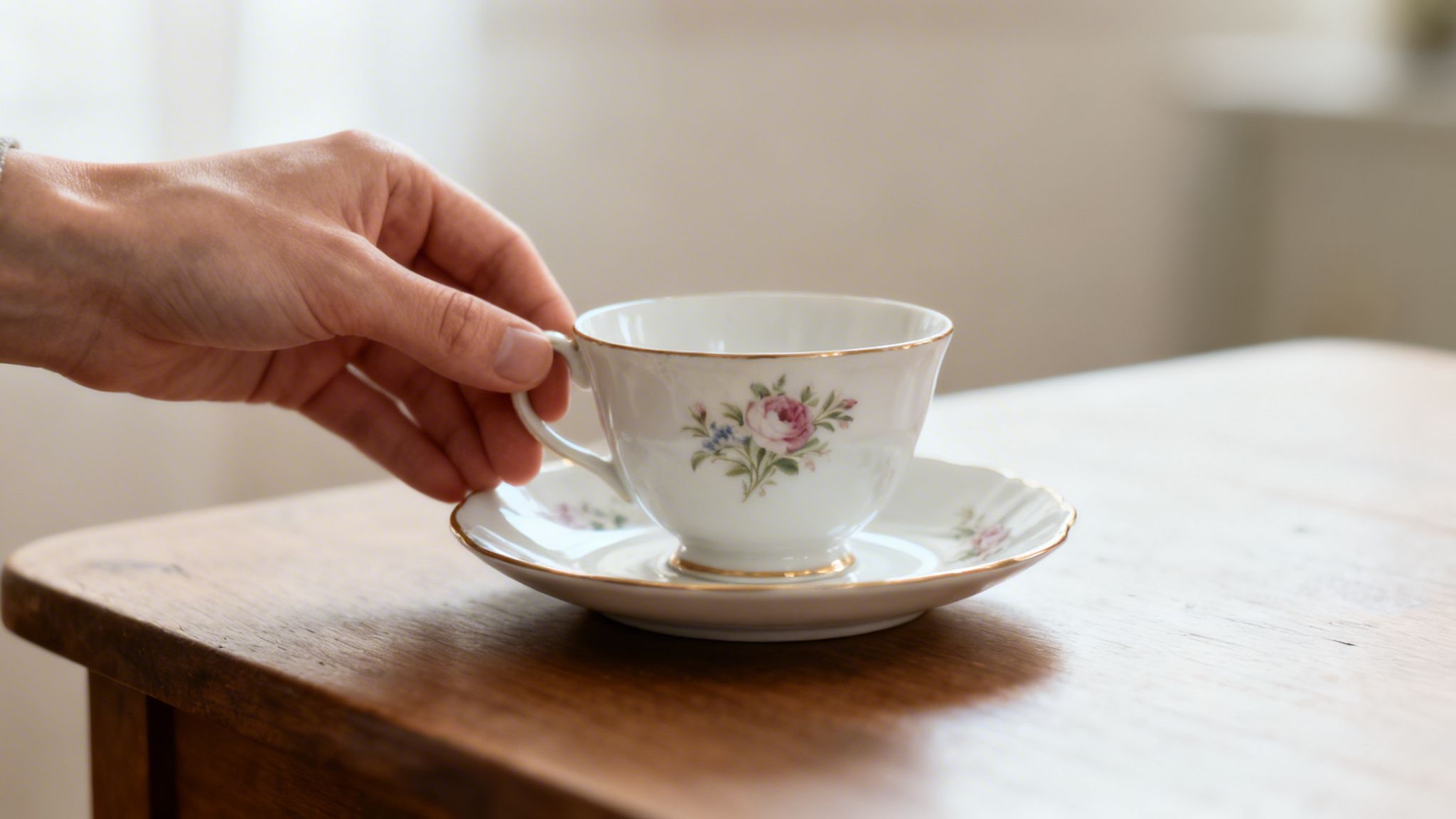
This guide is your map to that world. We're going on a journey that starts in the heart of Germany's famed porcelain region, tracing the Winterling family's story and the major events that shaped their creations over the decades.
Soon, you won't just see a pretty pattern. You'll see a timeline, a piece of economic history, and a work of art all in one.
This is about more than just identifying pieces; it’s about genuine appreciation. We’ll give you the tools to understand the why behind each design, shape, and mark. To build your expertise, we’ll dive into a few key areas:
The real joy of collecting comes from understanding the story behind the object. A simple "Bavaria Germany" stamp can unlock tales of post-war rebuilding and changing artistic tastes, making each find a small historical treasure.
By the time you finish this guide, every piece of Winterling porcelain will represent more than just its beauty; it will hold a rich narrative. Understanding these details elevates your entire collection, much like appreciating the nuances in other famous German ceramics. If you're interested in the region's broader legacy, you can learn more about Rosenthal Classic Rose in our detailed article.
To really get a feel for a piece of Winterling Bavaria Germany porcelain, you have to understand the family behind it and the slice of history it represents. The whole story kicks off in 1907 in Röslau, a little town right in the heart of Bavaria’s famous porcelain region. This is where seven ambitious Winterling brothers decided to pool their know-how and funds to start their very own porcelain factory.
Their goal was straightforward: to make beautiful, high-quality porcelain that was tough enough for everyday use. This wasn't about creating stuffy, look-but-don't-touch art. It was about bringing a bit of craftsmanship to the family dinner table. And they hit the nail on the head, tapping right into the growing desire for fine German ceramics.
Things moved quickly from there. A huge moment for the brothers came just a decade later when they acquired the Oscar Schaller & Co. factory in the nearby town of Schwarzenbach an der Saale. This was a massive step up, dramatically boosting their production and cementing the Winterling name as a serious contender in the competitive world of Bavarian porcelain.
The 20th century was anything but smooth sailing, yet the Winterling company proved to be incredibly resilient. They steered their way through the economic chaos of two World Wars, shifting their production to match what people needed and wanted in a completely changed world. The post-war years, in particular, were a period of explosive growth.
As Germany witnessed its Wirtschaftswunder—the economic miracle—so did Winterling. The company flourished, churning out enormous quantities of dinnerware that soon graced tables all across Europe and even further afield. It was during this boom time that the brand's reputation for quality and style was truly sealed.
The company's deep roots in the Bavarian landscape also tied its fate to the region's fortunes. For instance, the area saw a remarkable event during the 1978/79 winter. Record-breaking snowfalls in the Fichtelgebirge mountains brought in 15% more tourists than the decade's average. This surge in tourism gave local inns a 22% bump in occupancy—a ripple effect that surely benefited local suppliers, including the porcelain factories that provided their tableware. You can read more about Bavaria's historic tourism trends at travelandtourworld.com.
As the world market became more connected in the latter half of the 20th century, the company knew it had to adapt. The various family-run factories were brought together under a more formal corporate structure to keep up with the times.
Even as the business side of things changed, the heart of the company didn’t. The Winterling name always stood for quality porcelain that perfectly walked the line between time-honoured craftsmanship and modern style.
That is the legacy you’re holding when you pick up a piece today. Every single cup, saucer, and plate is a small piece of the Winterling family's century-long story. It's a tale of ambition, survival, and a love for the art of porcelain that never faded. Knowing this history gives every piece in your collection a story and a soul.
Every piece of Winterling porcelain has a story to tell, and the key is hiding in plain sight right on its base. That small stamp, known as a backstamp, is like a passport through time, telling you exactly where and when your treasure was created. For any collector of Winterling Bavaria Germany porcelain, learning to read these marks is the most essential skill you can develop.
Think of it like learning a simple new language. At first, the marks might seem like a jumble of symbols and words. But once you know the secrets, you'll start to recognise patterns that instantly place a teacup or a dinner plate within a specific era.
The system is surprisingly straightforward once you get the hang of it. The marks evolved over the decades, mirroring the company's own journey and the seismic shifts in 20th-century German history. Let's break down the key clues you'll need to become fluent.
The very earliest pieces, from the original factory in Röslau, are often the most simply marked. In the beginning, some items were stamped with just a simple 'R' for Röslau, sometimes worked into a small design. Finding one of these today is a real treat, as they represent the company's fledgling days and are quite rare.
You're more likely to come across marks from the Oscar Schaller & Co. factory, which the Winterling brothers took over. These backstamps often include the Schaller name or initials. Since this was a key acquisition, these pieces are a vital part of the greater Winterling family story.
When most people think of Winterling, one image comes to mind: the crowned 'W'. This quickly became the company's signature insignia, and seeing it is a sure sign you're holding a genuine piece of Winterling history.
The crowned ‘W’ is the classic Winterling hallmark. Seeing it should immediately tell you that you're on the right track. The variations that accompany it are what help you narrow down the specific time frame.
These little variations are everything. The words that appear next to the crowned 'W' are the most powerful clues you have for pinpointing a piece's age and specific factory of origin.
This infographic shows how the Winterling brand evolved through several key historical moments.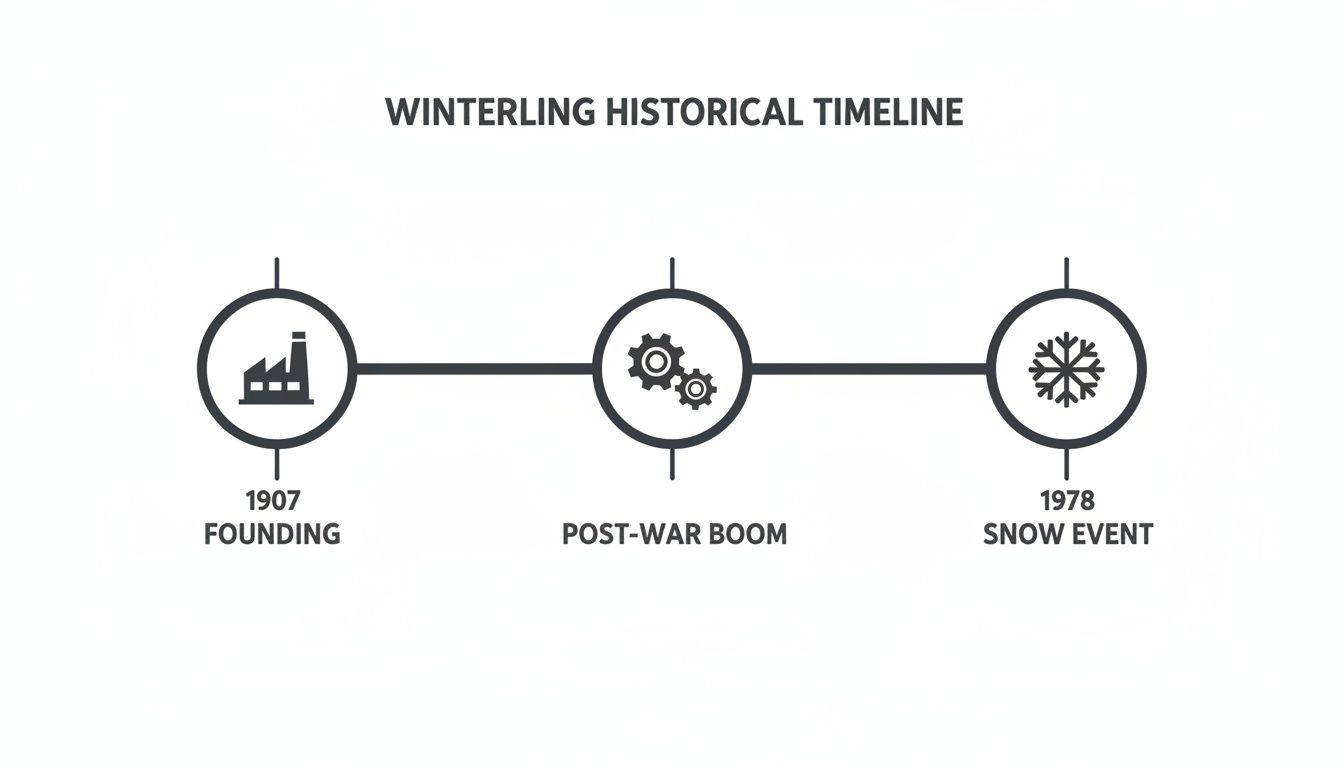
As you can see, major events directly influenced the company's timeline and, by extension, its products.
This is where your inner detective can really shine. The place names added to the backstamp are a direct reflection of European history, and they provide the clearest timeline of all.
Putting these puzzle pieces together lets you date your finds with surprising accuracy. A mark featuring "Winterling," "Bavaria," and "W. Germany," for example, firmly places its creation within that specific 41-year window.
The region's rich craft traditions extend beyond porcelain. For Dalaart's audience of interior designers, it’s interesting to note that Winterling's local markets boast that 40% of stalls sell hand-painted wooden figures, much like Dalaart's vibrant roosters and moose. Recent data shows a 12% increase in demand for eco-painted crafts using safe, sustainable paints. Discover more insights about Germany's vibrant resort market at futuremarketinsights.com.
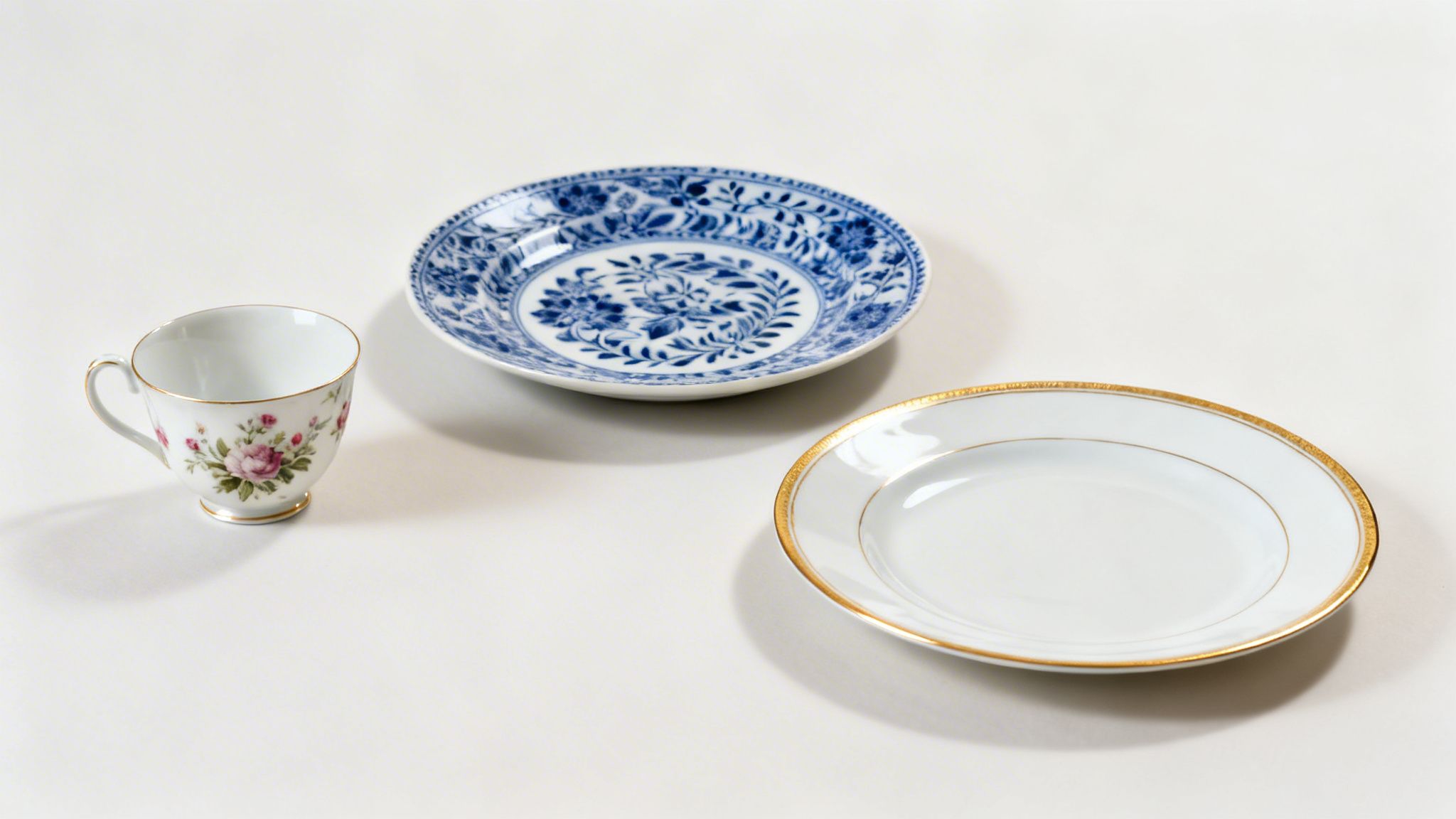
While flipping a piece over to read the backstamp tells you its history, the pattern on the front is what truly gives it a personality. Learning to recognise the signature styles of Winterling Bavaria Germany porcelain is a lot like learning the brushstrokes of a favourite painter. Each design is a little window into the tastes and trends of its era, adding a rich new layer to the story of your collection.
Winterling’s workshops turned out an incredible range of patterns over the decades. Still, a few key styles are much more common and easier to spot. Getting to know these popular designs is the first real step toward developing a sharp collector’s eye.
In the years following the war, as the economy boomed, Winterling became a true master of floral and chintz designs. These patterns spoke to a public hungry for a bit of beauty and optimism in their homes. For a long time, these were the brand’s bread and butter.
When you’re out treasure hunting, you’ll most often come across designs with:
For most people, these mid-century pieces are their first introduction to Winterling. They were produced in huge numbers, which means they are usually accessible and affordable, making them a fantastic starting point for any new collector.
The company’s deep ties to its Bavarian home were always on display. Take the Winterling Snow Festival in the 1980s, which drew an average of 10,000 attendees each year. A remarkable 65% of visitors said the wooden handicraft stalls were a major highlight, full of items with a similar spirit to Dalaart's hand-carved pigs and bears. You can dive deeper into Bavaria's cultural and economic data on statistik.bayern.de.
As the world’s tastes shifted toward modernism, Winterling’s designs followed. The company wholeheartedly embraced the bold, confident style of the 1960s and 70s, creating patterns that are a world away from their earlier floral work.
Think of this era as Winterling's "pop art" phase. The delicate pastels gave way to earthy tones and vibrant primary colours, while soft petals were replaced by sharp, repeating geometric shapes.
These patterns are all about strong lines, circles, and abstract forms. Colours like avocado green, harvest gold, and burnt orange are the unmistakable hallmarks of this period. Finding a complete set from this era can be a fantastic way to bring a statement-making retro vibe into your home.
Whether flowery and romantic or bold and geometric, each pattern tells a story of the time it was born in, making every piece of Winterling porcelain a tiny time capsule waiting to be discovered.
This is where the real fun begins. Once you can confidently identify a piece of Winterling Bavaria Germany porcelain, you're ready to move from simply admiring it to truly understanding its worth.
Think of yourself as a ceramics detective. You’re searching for clues that, when pieced together, tell the true story of an item. It's a skill that combines knowledge with a keen eye, focusing on three critical areas: condition, rarity, and completeness.
Nothing impacts value more than the physical state of a piece. Even the rarest pattern will see its price plummet if it's chipped, cracked, or heavily worn. When you're holding a potential find, you need to check it thoroughly.
A piece in mint condition—no chips, no crazing, and a bright, crisp pattern—is the gold standard. It’s what every collector dreams of finding, and it will always command the highest price.
After you've given the piece a clean bill of health, it's time to figure out how rare it is. A pattern that was only in production for a few years, or one with an unusual backstamp, will always be more sought-after than something made in huge quantities for decades. This is where your knowledge of Winterling's timeline and marks really pays off.
For dinnerware, completeness is king. A full dinner service with all its plates, cups, saucers, and serving dishes is often worth much more than the sum of its individual parts. For collectors interested in similar Scandinavian porcelain, our guide on Rörstrand Fågel Blå provides valuable insights into how sets are valued.
With Winterling, a large post-war dinner service could fetch anywhere from £250 to £400 at auction. However, you might find that selling individual place settings online over time yields an even better return. It all comes down to knowing what you have, so you can build a collection you're proud of while avoiding costly mistakes.
When you bring a piece of Winterling Bavaria Germany porcelain into your home, you're not just buying a dish; you're becoming the next caretaker of its story. Proper care is all that stands between it being a cherished heirloom and just another faded antique. The golden rule is simple: a gentle touch goes a long way.
Think of the dishwasher as the arch-nemesis of your vintage porcelain. The intense heat and harsh detergents are a fast track to faded patterns and, most tragically, will wear away any delicate gold or platinum trim over time. To keep the finish pristine, always choose to hand-wash with a soft cloth and mild soap.
Keeping your collection safe when not in use is just as important as cleaning it correctly. If you're stacking plates, always slip a soft felt divider or even a simple paper napkin between each one. It's a small step that prevents the unglazed, rougher foot of one plate from scratching the beautiful glazed surface of the one below it.
But please, don't just tuck these beautiful pieces away! Modern homes are the perfect backdrop for showcasing vintage ceramics in creative ways.
Displaying your porcelain isn't just about showing it off. It’s about weaving its history into the fabric of your daily life, letting old stories mingle with the new ones you're creating in your home.
Getting creative with how you display your collection is one of the real joys of owning it. For more ideas on styling classic ceramics, you might enjoy our guide on Hoganas Keramik Stoneware.
As you start your collecting journey, a few practical questions are bound to come up. It happens to everyone! Here are some clear, straightforward answers to the things I get asked most often about Winterling Bavaria Germany porcelain.
Not really, and that’s actually one of its biggest charms. The value of any piece comes down to its age, how rare the pattern is, its condition, and what collectors are looking for right now. While some of the very early or more unusual designs can fetch a good price, most of the mid-century dinnerware was made for everyone to enjoy and is still quite affordable.
This is fantastic news for new collectors. It means you can build a beautiful, historically interesting collection without needing a huge budget to get started. A large post-war dinner service might go for £250-£400 at auction, but you can often find individual plates, cups, and saucers for just a few pounds.
Bavaria was the heartland of German porcelain, home to giants like Rosenthal and Hutschenreuther. Winterling carved out its own special place by focusing on creating high-quality, durable, and stylish porcelain for the everyday home, rather than just the display cabinet.
While some other famous brands were chasing the high-end, exclusive art market, Winterling’s passion was bringing excellent craftsmanship to the family dinner table. They made beautiful things to be used and loved.
In many cases, yes! But it really depends on the piece and its decoration.
Here’s a golden rule: any set decorated with gold, silver, or platinum trim should never go in the microwave and should always be washed gently by hand. The metallic details are delicate and will be ruined.
For simpler patterns without any metal, careful daily use is often fine—this porcelain was built to last, after all. Before you do, always check for crazing, which looks like a fine web of cracks in the glaze. This weakens the piece and can trap bacteria, making it best for display only, not for serving food.
At Dalaart, we believe in celebrating heritage through beautiful, handcrafted objects. Explore our collection of authentic Swedish Dala horses and other folk art treasures at dalaart.com.


.svg)


.png)


