May 18, 2026
You might already have the room right. The teak sideboard is in place. Linen runners soften the table. A painted wooden horse stands where it catches the afternoon light. Perhaps you've even chosen the coffee carefully, because the smell matters as much as the look. Yet the room still feels slightly silent, as if the decade hasn't quite arrived.
That's often the missing piece in a vintage interior shaped by Swedish memory. 60-tals musik svensk isn't just background sound. It changes how a room feels, how objects relate to one another, and how the whole setting moves from styled to lived-in. A folk-painted figure, a ceramic vase, a radio cabinet, and a record playing a Swedish vocal from the 1960s belong to the same cultural weather.
In a museum setting, we see this all the time. Visitors respond to objects first with their eyes, then with recognition. The recognition usually comes through sound. A familiar melody, a certain vocal phrasing, or the polished lift of a radio-friendly chorus can place an object back into everyday life far better than a label card can.
That is why the world of Swedish 1960s music deserves more than a nostalgia playlist. It belongs with the textures of home, ritual, and memory, much like the everyday comfort described in this piece on Swedish coffee traditions and Arvid Nordquist. The songs tell us how modern Sweden sounded while it was becoming itself.
A collector spends months getting the details right. She finds a lamp with the right lines, a wool textile with the right woven rhythm, and a painted folk object that doesn't feel mass-produced. The room begins to speak Swedish design fluently, but it still lacks tone of voice.
Then she puts on a 1960s Swedish song.
Suddenly the room changes. The furniture no longer looks arranged for display. It looks inhabited. A polished schlager vocal can make a dining corner feel social and bright. A softer jazz-inflected song can turn a cabinet of ceramics into something intimate and evening-like. The space starts to carry time, not just style.
That is the special value of 60-tals musik svensk. It isn't only a category for record collectors. It is part of a complete cultural atmosphere. In Sweden, the decade's music sits between folk memory and modern pop. It carries dance halls, radio programmes, youth clubs, translated hits, local stars, and a country learning how to make popular music feel both international and unmistakably its own.
A vintage room can look correct and still feel empty. Music is often what gives the objects their social life back.
Readers often get confused here because they expect one sound. They search for “Swedish 60s music” and assume they'll find a single genre. Instead, they encounter a whole listening culture. Some songs are elegant and melodic. Some are beat-driven and restless. Some lean toward lyric warmth and domestic familiarity. That variety isn't a problem. It is the point.
If you want a Swedish sixties interior to feel authentic, the soundtrack matters as much as the objects on the shelf. Music helps explain why the objects were there in the first place.
The Swedish 1960s weren't musically important by accident. The decade's popular music grew inside a changing society, and one of the clearest engines was radio. People didn't discover songs privately. Broadcasters, programmes, and chart formats helped organise what the country heard together.

A key turning point came when Sveriges Radio expanded its offer in response to outside pressure. According to the historical overview of Tio i topp and related radio developments, Sveriges Radio introduced Melodiradion on 1 May 1961, and P3 launched Kvällstoppen in the summer of 1962, in response to growing competition from Radio Nord and Radio Luxemburg. The same source notes that Tio i topp premiered on 14 October 1961 and used a live youth-voting structure with 200 young people in Stockholm and 200 in another city.
That last detail matters more than it may seem. It tells us that Swedish hit culture was organised around audience participation from an early stage. Young listeners were not just passive receivers. They were part of the mechanism that determined what counted as popular.
This is one of the most interesting features of Swedish sixties music. A state broadcaster did not freeze pop culture. It helped formalise it. Faced with competition from pirate and foreign radio, Swedish broadcasting created programmes that gave youth music a national stage.
That meant songs could move across regions through a shared listening system. It also meant the idea of a “hit” in Sweden became linked to broadcast recognition, recurring exposure, and public familiarity. If you want to understand why certain songs remain lodged in cultural memory, radio is often the first place to look.
Readers who know only British or American music history sometimes miss this. They expect record sales alone to explain the canon. In Sweden, radio formats mattered significantly. The chart wasn't just a list. It was a cultural institution.
For anyone building a fuller picture of Swedish heritage, this broader context helps. The objects of the decade sit inside the same story as the songs. Design, domestic life, and pop culture were all part of a country becoming more modern, more youth-oriented, and more media-connected. For a wider look at those everyday markers, this guide to typical Swedish things offers useful cultural companions.
If you say 60-tals musik svensk to two different listeners, they may hear two different worlds. One hears polished melodies and memorable choruses. The other hears electric guitars and beat groups. Both are right.

One major strand is schlager and radio pop. This is the sound many people associate first with Swedish popular memory. The melodies are clear, the arrangements are accessible, and the songs are built to stay with you after a single listen. Vocals matter. So does lyrical directness.
This style often feels domestic in the best sense. It works in kitchens, family rooms, summer houses, and shared gatherings. The song isn't trying to shock you. It wants to accompany ordinary life and make it brighter.
Another strand came from imported youth energy. Swedish performers absorbed British and American beat, rock, and pop forms, then filtered them through local singers, local labels, and local audiences. The result wasn't a simple copy.
The best way to understand this is through repertoire itself. The Apple Music compilation discussed in Svensk 60 Tals Pop includes tracks such as “Caravan,” “Apache,” and “The Letter” alongside Swedish artists like Hans Edler and The Caretakers. That line-up shows a Swedish market localising Anglo-American songs through domestic performers. The same background also aligns with a documented cultural push toward “en svensk nationell folkton”, a Swedish national folk tone.
That blend is the key. Swedish 1960s pop often joined imported arrangements to local lyric culture. A song could carry foreign structure and still feel Swedish in voice, phrasing, and identity.
Practical listening rule: When you hear a familiar international song form delivered through Swedish performers or Swedish-language sensibility, you're hearing one of the decade's defining mechanisms.
Not every song aimed for smooth radio comfort. Some artists and scenes pushed toward rougher textures, youth-club energy, or more exploratory sounds that would later feed into psych and progg. Even when the later labels became more visible in the following decade, their roots were already forming in the late 1960s.
That doesn't mean every late-1960s recording sounds radical to modern ears. It means the habits were changing. Bands were listening outward, experimenting with image and arrangement, and widening the idea of what Swedish pop could be.
A short listening companion helps make those differences easier to hear:
To hear that contrast in action, it helps to watch period performance style as well as listen.
The decade becomes easier to understand when you attach it to people rather than labels. Swedish sixties music wasn't one anonymous stream of radio songs. It was carried by artists who represented different rooms within the same house.
Monica Zetterlund stands for a more refined and inward register of Swedish popular music. Her presence in enduring sixties curation matters because she reminds us that the decade was not only about charts and youth frenzy. It also held wit, restraint, and a distinctly Scandinavian kind of emotional clarity.
The Spotify collection Svensk Musik 60-tal includes Monica Zetterlund's “Trubbel”, alongside other canonical tracks from the period. That inclusion reflects how her work remains part of the durable national repertoire of the decade.
If Zetterlund can make a room feel reflective, Trio Me' Bumba often brings in warmth and social memory. Their song “Man ska leva för varandra”, also named in the same curated collection, belongs to the kind of Swedish popular music that people don't just admire. They live with it. It lingers in family memory, shared singing, and public nostalgia.
This is one reason playlist culture alone doesn't tell the whole story. Some songs survive because they represent a social function. They belong to gatherings, not just headphones.
The Hep Stars are essential when people want to understand how Swedish acts took international beat energy and made it national. Their significance lies not just in popularity, but in the confidence they gave to domestic pop. A Swedish group could stand at the centre of youth attention rather than act as a local echo of foreign trends.
The historical chart record noted earlier also lists annual leaders from the 1960s, including The Beatles in 1963 and The Hep Stars in 1966, which illustrates a shift from imported Anglo-American dominance to Swedish acts competing at the top. That change helps explain why the decade feels foundational rather than derivative.
Some artists carry the open, public, bright quality of the decade especially well. Claes-Göran Hederström's “Det börjar verka kärlek banne mej”, included in the same Swedish sixties curation, is part of that story. It shows how a song can be playful, accessible, and still deeply rooted in national memory.
The canon of Swedish 1960s music lasts because it includes more than one emotional register. Intimacy, humour, romance, and youthful momentum all have a place in it.
Together, these artists show why the decade won't fit into a single label. It was broad enough to include elegant vocal interpretation, communal pop warmth, beat-driven self-belief, and cheerful chart accessibility.
A useful playlist shouldn't try to include everything. It should teach your ear what to notice. In Sweden, “60-tals musik” is closely tied to Svensktoppen, described in Spotify's archive as “Sveriges Radios lista sen 1962” in the playlist Svensktoppen 1960-1969. That matters because Svensktoppen offers a region-specific way to identify what counted as mainstream domestic listening.

Rather than chasing rarity first, begin with tracks that show the breadth of the era's listening culture.
“Man ska leva för varandra” by Trio Me' Bumba
Listen for the communal warmth. This is the kind of song that helps explain why Swedish sixties pop stayed alive in collective memory.
“Trubbel” by Monica Zetterlund
Listen for phrasing and atmosphere. It reveals the more intimate, literary side of the decade.
“Det börjar verka kärlek banne mej” by Claes-Göran Hederström
Listen for bright public-facing charm. It captures the accessible side of mainstream Swedish pop.
A serious introduction should also include the Swedish habit of adapting international styles through local performers.
A Swedish-performed version of “The Letter”
This helps you hear how imported song structures were absorbed into the Swedish market.
“Apache” in a Swedish compilation context
This gives you the performance and arrangement side of the decade's international listening.
“Caravan” in a domestic pop setting
This shows how repertoire could travel while still entering a recognisably Swedish listening culture.
These choices aren't random. They help your ear map the difference between domestic songwriting, adapted repertoire, and beat-era performance language.
Try arranging your listening by mood rather than date:
Readers often ask whether a definitive list must be purely Swedish-language. Not necessarily. For historical listening, what matters is the Swedish context of performance, circulation, and reception. A song can belong to Swedish sixties culture because of who recorded it, how it was broadcast, and how audiences lived with it.
The most interesting question isn't whether Swedish 1960s music was good. It is why the decade still matters so much. The answer lies in infrastructure as much as style.
Many nostalgic playlists stop at recognition. They gather familiar songs and leave it there. But the 1960s also built habits, networks, and expectations that shaped what Swedish pop could become later. The decade taught Swedish musicians and industry actors how local music could interact with international forms without disappearing into imitation.
One useful way to think about this is provenance. A song from the era carries traces of radio play, label choices, cover-version culture, and the practical routes by which music travelled. That broader story turns listening into cultural history.
The background note gathered in the Spotify curation focused on Swedish 60s export roots frames an important question often missed in simple nostalgia. It asks how the 1960s built Sweden's modern pop export ecosystem, through factors such as radio play, label licensing, touring circuits, or cover versions. That angle matters because it connects domestic hits to later international confidence.
The endurance of this music also comes from its balance. It was modern enough to feel fresh in its own time, but anchored enough in language, melody, and public culture to remain recognisable decades later. That is why the era survives so well in compilations, archives, and domestic memory.
A Swedish 1960s record is rarely just a song. It is evidence of how a nation learned to sound modern in its own voice.
Det är det sanna arvet. Inte en förseglad guldålder, utan en grund.
A convincing vintage atmosphere isn't purely visual. If the room looks like Sweden but sounds anonymous, the effect remains unfinished. Sound, colour, material, and object scale need to support one another.
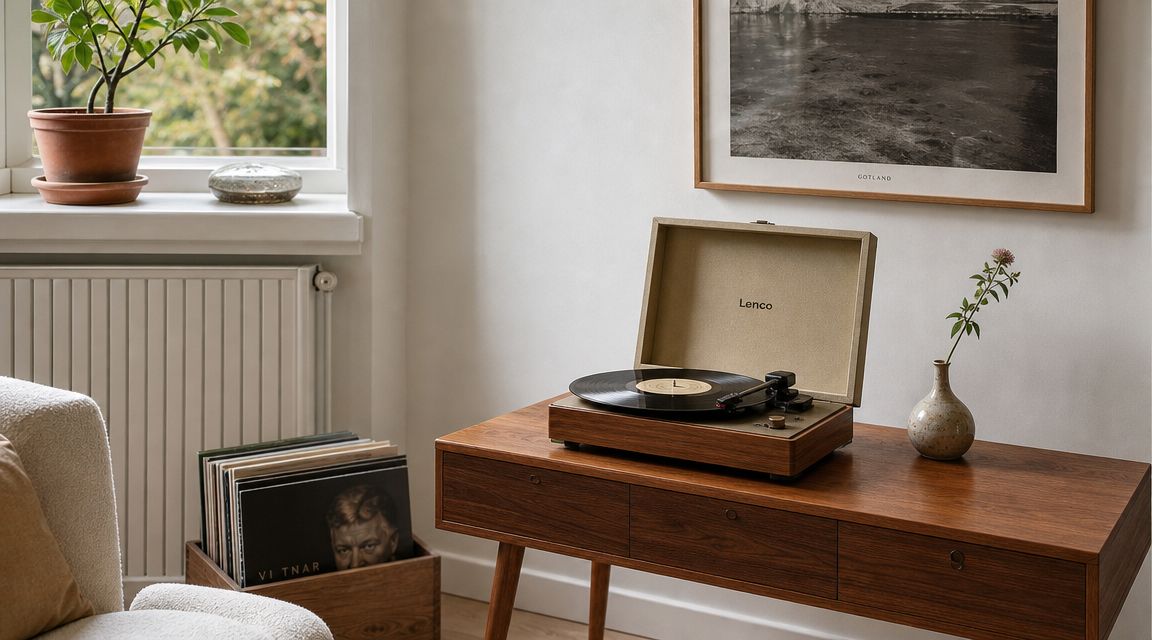
A polished vocal track from the softer end of Swedish sixties pop pairs well with clean-lined furniture, restrained ceramics, pale wood, and a limited colour palette. In that setting, one painted folk object can act as the room's accent rather than its centre.
Rougher beat material asks for something else. It often works better with stronger colour contrasts, graphic posters, visible record storage, and textiles that feel less formal. The room can hold a little more playfulness.
For lyrical, intimate songs
Use muted blues, soft whites, brushed wood, and smaller-scale objects. This suits evening listening and quieter corners.
For bright chart-friendly pop
Use sunny textiles, warm timber, simple glassware, and objects that feel social rather than solemn. Dining areas and kitchens respond well to this mood.
For beat-driven tracks
Add bolder graphic elements, stacked records, and wall art with stronger contrast. This creates more movement in the space.
One practical option for wall styling is to combine period-inspired listening with Scandinavian print culture, such as the visual ideas collected in this guide to vintage posters from Sweden. Poster graphics can carry the sharper, youth-facing side of the decade especially well.
Indeed, a carved and painted Swedish figure earns its place. Used sparingly, it gives the room regional identity without turning it into a stage set. Dalaart offers hand-carved and hand-painted Dala horses and companion animals made in Sweden, including vintage and collectible pieces, which can work as a focal accent in a music corner or on a cabinet near a turntable.
The key is restraint. One or two heritage objects, placed with intention, often do more than a shelf crowded with themed décor.
The goal isn't to decorate “like the 1960s”. It's to make the room feel as if music, objects, and memory belong to the same household.
When people get this balance right, guests notice it immediately. They may not identify the song or the object by name, but they recognise coherence. The room feels inhabited by culture rather than assembled from references.
No. That is one of the most common misunderstandings. The decade included melodic chart pop, beat-group energy, jazz-inflected vocal work, Swedish-language adaptations of international material, and late-1960s sounds that pointed toward more experimental scenes.
Because it helps define what mainstream Swedish listeners heard. For anyone researching 60-tals musik svensk, it is one of the clearest benchmarks for domestic popularity and recurring radio exposure.
Yes. Swedish 1960s music wasn't one single scene. Larger cities and smaller towns could support different audiences, venues, and memories. Youth clubs, dance halls, and public-service broadcasting all affected which songs became local favourites and which entered the national canon.
Start with compilations and curated playlists before hunting original vinyl. Learn the difference between domestic hits, Swedish-performed covers, and beat-group recordings. Once your ear is trained, record fairs, vintage dealers, specialist shops, and carefully documented online listings become easier to explore.
Listen for language, arrangement, and vocal style. Ask three simple questions. Does it sound built for radio? Does it adapt an international form into a Swedish setting? Does it feel intimate, communal, or youth-driven? Those clues will tell you a great deal.
If you'd like to bring that atmosphere into your own home, explore Dalaart for authentic Swedish folk art that pairs naturally with a vintage listening corner, a record cabinet, or a carefully curated Scandinavian interior.


.svg)


.png)


