May 19, 2026
You've found a tree you love. The trunk has character, the movement feels right, and the foliage finally looks organised. Then you start looking for a bonsai plant pot, and the confidence slips. Every option seems to change the tree's mood. One pot looks too heavy, another too shallow, another somehow makes the whole composition feel younger, softer, or less convincing.
That hesitation is healthy. In bonsai, the pot isn't packaging. It's part of the work. A good pot supports root health, controls water, anchors the tree physically, and completes the visual story. A poor pot can weaken the tree or distract from everything you've spent years shaping.
If you've ever felt that choosing the pot is harder than styling the tree, you're in good company. The craft has rules, but those rules make more sense once you understand the reasons behind them. Then the decision becomes less about memorising formulas and more about seeing clearly.
A common approach involves asking the wrong question. This question is, “Which pot looks nicest?” A more useful question is, “What kind of home does this tree need, and what kind of story does it tell?”
That shift changes everything. A bonsai plant pot has to do two jobs at once. It must keep the tree healthy, and it must belong to the composition. If either part fails, the pairing feels incomplete.
When students bring me a tree and a shortlist of pots, I ask them to describe the tree first.
These questions stop you shopping by impulse. They train your eye to read the tree before judging the container.
A pot changes more than proportion. It changes atmosphere. A dark unglazed pot can make a tree feel grounded and old. A pale glazed pot can make the same tree feel lighter and more lyrical. This is why pot choice often feels surprisingly emotional.
For readers who enjoy Scandinavian interiors, this is familiar territory. You already know that one vessel can make a room feel calm, spare, rustic, or sculptural. The same sensitivity applies here. If you enjoy looking at handcrafted forms and decorative objects, you may also enjoy exploring other pots and planters in thoughtful design settings.
A bonsai pot should never compete for attention. It should deepen the viewer's understanding of the tree.
Hold three ideas together as you choose:
That order matters. Beginners often reverse it and end up with a beautiful object that's wrong for cultivation. Experienced growers sometimes make the opposite mistake and choose something technically sound but visually dull. The best pairings do both.
A bonsai pot is often described as a container, but that word is too passive. A true bonsai pot is an active part of the composition and an active part of the tree's care.

Think of a picture frame around a painting. A good frame doesn't shout. It guides the eye into the work and helps the painting feel complete. The bonsai pot does the same.
The history of bonsai makes this clear. Chinese container-cultivation traditions, often called penjing or pun-sai, reach back to at least the Tang era, with the practice of growing dwarf trees in special containers by around 700 AD, and in Japan by the 1780s connoisseurs were already holding annual exhibitions in Kyoto where the pot formed part of a judged display culture, as noted in this history of bonsai traditions. That matters because it shows the pot was never merely practical. It was part of the artwork's public meaning.
A severe pine in a blunt rectangle tells one story. The same pine in a delicate glazed oval tells another. Neither choice is neutral.
The artistic side is only half the truth. A bonsai tree lives in a controlled root environment, and the pot shapes that environment every day.
A bonsai plant pot influences:
If a standard houseplant pot is like a roomy flat, a bonsai pot is more like a carefully designed studio. Every centimetre matters. The tree can thrive there, but only if the design is intelligent.
The confusion usually comes from trying to separate beauty from function. In bonsai, they're woven together. A shallow form can look elegant, but it also changes watering rhythm. A heavier wall can look more stable, but it also affects the pot's physical balance and presentation.
Practical rule: Don't ask whether a pot is decorative or functional. Ask how its form serves both the tree's health and the tree's image.
Once you begin seeing the pot this way, many old rules stop feeling rigid. They start to feel compassionate. The tradition isn't trying to limit expression. It's trying to help tree, pot, and viewer arrive at harmony.
The material and shape of a bonsai plant pot speak in a quieter voice than the tree, but they still speak. They suggest weight, age, refinement, weather, warmth, and restraint. Learning that vocabulary makes pot selection much easier.

If I had to teach pot feeling in one afternoon, I'd start here.
Unglazed pots usually feel more earthy, restrained, and architectural. They suit trees with rugged bark, deadwood, strong trunks, and a sense of age. Pines, junipers, and many masculine compositions often sit comfortably in unglazed clay or stoneware because the finish doesn't soften their character.
Glazed pots introduce colour and reflected light. They can be subtle or lively, but even a soft glaze changes the mood. Flowering and fruiting trees often welcome that touch of refinement. Delicate deciduous trees can also benefit from glaze when you want elegance rather than severity.
Neither is automatically better. The finish has to answer the tree.
Construction matters as much as appearance. A bonsai pot is designed for root health with large drainage holes, wiring holes for anchoring, and feet that lift the pot for airflow. Classic unglazed stoneware is often preferred because it supports stable moisture management better than many plastics, as explained in this guide to bonsai pot structure and material.
That's one reason many growers return to fired clay and stoneware even when cheaper materials are available. A good ceramic pot feels settled. It belongs to the long rhythm of bonsai care.
If you're drawn to Scandinavian craft traditions, you may also appreciate the tactile quality of Höganäs stoneware and its design language, which shares that same respect for material honesty.
A practical demonstration helps more than description alone.
Here the language becomes visual.
I often tell students to make two passes. First, choose by instinct. Which pot feels emotionally right? Then test that choice against horticultural logic. Does it drain well? Can it anchor the tree? Is the material sensible for the growing conditions?
That second pass keeps romance from becoming carelessness.
A pot can be beautiful and still be wrong. Proportion and drainage are where many attractive choices fail.
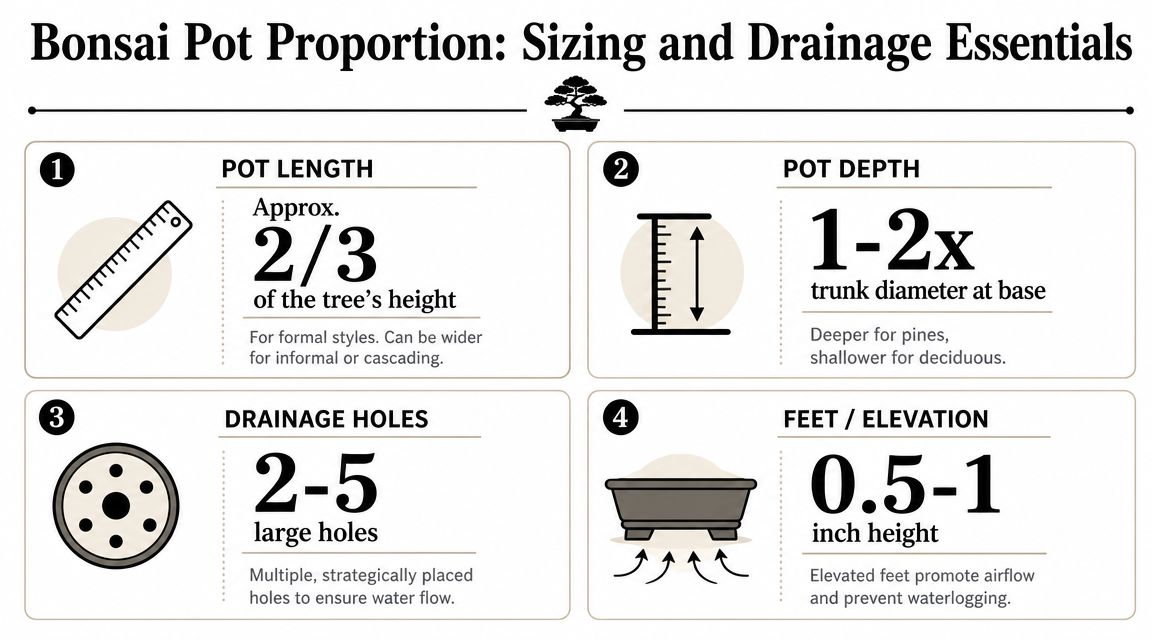
A reliable guideline is this: the pot's longest side is usually about 1/2 to 2/3 of the tree's height, while round pots are often sized to roughly 1/3 of tree height, according to this practical sizing guide for bonsai pots. That ratio gives you a starting point, not a prison.
Why does it work? Because the eye wants equilibrium. If the pot is too large, the tree loses presence and the composition feels heavy. If the pot is too small, the tree can look cramped or unstable.
The same guidance notes that oversizing can create visual imbalance and can also hold too much moisture, while undersizing restricts root volume and may force more frequent watering. That's the heart of bonsai design. Aesthetic judgement and cultivation reality meet in the same decision.
Many new growers focus only on length. Depth is often more important. In practice, pot depth is commonly related to trunk or nebari width because that relationship helps preserve stable root development and anchorage.
A shallow pot can be exquisite, but shallowness should feel earned. It suits a tree with a root system, design maturity, and growing pattern that can live comfortably in that reduced space. A young or vigorous tree often needs more generosity.
A bonsai pot must shed excess water quickly and breathe well. That means checking details that buyers often overlook:
If a pot is stylish but badly drained, it isn't a bonsai pot in any meaningful sense.
For growers in Sweden and similar climates, size has another layer. The issue isn't only appearance. Pot size affects how moisture behaves across short outdoor growing periods and indoor wintering conditions. Existing guidance is often generic, while region-specific advice rarely connects pot depth, drainage, and material to local temperature swings and daylight patterns, as discussed in this ceramics-focused note on choosing bonsai pots.
That means you need to observe your own conditions carefully. In a hot summer spell, a very small pot may dry faster than you expect. In cool, low-light periods, an oversized pot may stay wet too long. Good growers don't just ask, “Does this look right?” They ask, “Will this behave well where I live?”
Rules become art when you can read the tree's character. A bonsai plant pot then stops being a category and becomes a sentence in the tree's story.

Japanese pot-to-tree pairings became more standardised during the Meiji period (1868 to 1911), when demand for bonsai pots rose and Japanese makers established rules for proportion, helping define the pot as an integral part of bonsai design and presentation, as described in this overview of bonsai pot development in Japan.
Think of an old pine with plated bark, firm branch structure, and a trunk that suggests years of wind and hardship. This tree rarely wants a flashy vessel. It usually asks for restraint.
A low, unglazed, darker pot with clear geometry often strengthens that feeling. Rectangle works well when the tree stands with dignity. The pot should feel weighty enough to support age, but not so ornate that it steals authority from the trunk.
Now consider a deciduous tree with fine ramification and seasonal grace. In spring and autumn, the tree itself becomes more lyrical. A harsh, severe pot can flatten that expression.
An oval form or a softened rectangle often works better. Depending on the tree, a quiet glaze can support delicacy without becoming sentimental. The point isn't “maples need glazed pots.” The point is that refinement in the tree often welcomes refinement in the vessel.
The right pot doesn't explain the tree. It lets the tree speak more clearly.
A juniper with strong movement asks for a pot that respects direction. If the trunk bends and flows, a rigid shape can feel argumentative. That doesn't mean the pot must imitate every curve, but it should allow the movement to breathe.
For a semi-cascade, the pot often needs to acknowledge downward travel and visual tension. The wrong choice can make the design feel trapped. The right choice gives the composition an edge of inevitability, as if tree and pot were discovered together.
Set the tree in front of several candidate pots and narrow your attention to one question: Which pairing makes the tree feel most itself? Not more expensive, not more decorative, not more unusual. More itself.
That is usually the strongest answer.
Once you've chosen the pot, the physical work begins. Repotting intimidates people because it feels surgical. In truth, it's careful, methodical work. If you prepare well and move calmly, it becomes one of the most satisfying jobs in bonsai.
Start with the new pot on the bench and get it ready first. Cover the drainage holes with mesh and secure the mesh with wire so it stays put during watering and root work. Thread anchoring wire through the wiring holes before the tree goes in. If you skip this step, you'll end up fumbling while roots dry in the air.
Have your substrate ready as well. Repotting goes smoothly when every tool is within reach and every decision has already been made.
Ease the tree out of its old container rather than yanking it free. If it resists, work around the edges carefully. Once the root ball is visible, tease out compacted roots with patience. You're trying to understand the root system, not attack it.
At this stage, look for three things:
Add a base layer of substrate, position the tree, and check the front and planting angle before tying anything down. This is the moment when many compositions improve dramatically. A small change in tilt can make the trunk line feel far more convincing.
Once the position is correct, secure the tree with the anchoring wire. It should not wobble. Movement after repotting damages tender new root tips and slows establishment.
Aftercare note: A freshly repotted tree needs stability more than attention. Don't keep disturbing it to check progress.
Work substrate into the root mass so there are no large air pockets. Use a chopstick or similar tool to settle the soil gently. Then water thoroughly until the substrate is evenly soaked and the drainage runs clear.
After repotting, place the tree where it can recover without added stress. Protect it from extremes while it re-establishes. Watch moisture carefully. The tree is adjusting to a new root environment, so your old watering rhythm may not fit immediately.
Repotting is one of the clearest examples of bonsai discipline. The act looks technical, but the deeper skill is attentiveness. You're not forcing the tree into a new object. You're helping it enter a better relationship with its container.
Tradition gives us a language. It doesn't ask us to stop speaking in our own voice.
That matters now because more bonsai enthusiasts are looking beyond the classic categories. There is growing interest in distinctive, non-traditional forms, including crescent-shaped pots for semi-cascade styling, highlighted in this recent bonsai discussion on contemporary pot choice. That interest suggests many growers want vessels that respond more directly to movement and mood, not only to old category labels.
A custom or unconventional pot works when it still respects the tree.
It should still provide sound drainage, sensible root space, and visual balance. It should still support the composition rather than turn the display into a novelty act. The fact that a pot is unusual doesn't excuse it from bonsai logic.
For many Scandinavian-minded collectors, the art becomes especially alive. Bonsai aesthetics and Nordic design can meet beautifully in shared values: restraint, material honesty, sculptural silhouette, and respect for emptiness. A spare, modern form can work very well if it helps the tree feel calm, inevitable, and complete.
Some trees don't fit standard options. That may be because of their movement, their planting angle, or the atmosphere you want to build.
You might choose a custom pot when:
If you enjoy decorative vessels as part of interior styling, even a contemporary chrome plant pot in a Scandinavian setting can sharpen your eye for how finish, reflection, and silhouette affect mood, though bonsai itself still demands the structural features discussed earlier.
Creative choice in bonsai isn't freedom from discipline. It's freedom built on discipline. Once you understand proportion, drainage, mood, and tree character, you can bend conventions intelligently.
That's where real personality enters. Not in ignoring the craft, but in using it well enough to make something that feels both rooted and fresh.
If you're drawn to objects where tradition, craftsmanship, and Scandinavian character meet, Dalaart is worth exploring. Their collection of authentic Swedish folk art offers the same pleasure that a fine bonsai pot does: material presence, hand-made detail, and a strong sense of place.


.svg)


.png)


