April 19, 2026
A child in the early 1980s could disappear into a waiting room with a single orange handheld and emerge feeling as if they’d travelled through a jungle. That’s part of the enduring magic of game and watch donkey kong jr. It was small enough for a coat pocket, yet rich enough to feel like a world.
For many people, a Game & Watch wasn’t just a game. It was a private theatre of light, timing, and touch. You pressed a button, a tiny figure shifted position, and your mind completed the motion. In that act of imagination, a static LCD became action, peril, rhythm, and triumph.

The appeal of game and watch donkey kong jr still surprises people who know it only by photographs. On paper, it sounds slight. A fixed screen. Pre-drawn art. A handful of buttons. Repeating play. Yet in the hand, the object feels purposeful in a way that many modern gadgets don’t. Nothing is wasted. Every surface has a job. Every visual element serves both charm and function.
Collectors who love folk art often understand this instinctively. A hand-painted wooden horse from Dalarna is never just wood and pigment. Its value lives in form, tradition, regional memory, and the hand of the maker. A Game & Watch carries a different tradition, but a similar dignity. It belongs to the age of mass electronics, yet it still reflects a design culture that prized restraint.
That’s why the orange casing matters. The printed jungle background matters. The click of the buttons matters. The little speaker chirps matter. They create an object that’s remembered not only through gameplay, but through texture, colour, and ritual.
Practical way to see it: Don’t judge this handheld by modern expectations of content. Judge it as a complete design object, where hardware, art, sound, and play all fit within severe limits.
People often get confused about why these devices inspire such affection. They assume nostalgia does all the work. Nostalgia is part of it, but not all of it.
A worn but honest unit can move a collector for the same reason an old kitchen clock or Bakelite radio can. It stands for a moment when consumer electronics still felt compact, legible, and intimate. You could hold the whole idea in your palm. You could understand what it was for at a glance.
In that sense, Donkey Kong Jr. represents a pocket-sized revolution. It made portable play feel personal. It also showed that limitation can produce beauty. The machine doesn’t overwhelm you. It invites you.
Nintendo didn’t arrive at the Game & Watch line by trying to imitate a grand machine in miniature. The brilliance was subtler than that. The company used familiar technology in a new way and treated constraints as a design discipline rather than a defeat.
That approach is often associated with Gunpei Yokoi, whose design thinking has become legendary among historians of games and industrial design. His gift wasn’t chasing the most advanced component available. It was recognising when an older, stable technology could be turned into something elegant, affordable, and memorable.
That idea explains why the Game & Watch family still matters. The LCD display technology was not futuristic in the science-fiction sense. It was already known, already practical, already proven. Nintendo’s achievement was to combine it with strong visual design, approachable controls, and game concepts that worked within its limits.
For a collector, this matters because it helps explain why these machines feel so coherent. They weren’t overengineered. They were well-edited. The casing, the printed overlays, the segmented characters, and the button layout all came together as one solved problem.
The DJ-101 belongs to the New Wide Screen branch of the Game & Watch family, and that label matters to collectors because it signals a distinct presentation style. The screen is broad and theatrical. The device has a stronger visual stage than some earlier units, and that stage suits the jungle setting especially well.
This model also carries extra historical interest because of its place within the broader Donkey Kong story. In the arcade world, Donkey Kong and Donkey Kong Jr. helped establish character relationships that would echo through Nintendo history. On Game & Watch, those relationships were distilled into a more intimate, object-based form. The narrative became simple enough to read in seconds, but vivid enough to remember decades later.
A classic collectible earns its status when form and memory fuse. That’s what happened here. Children saw a game. Parents saw a self-contained gadget. Designers now see a clear expression of portable electronics at a particular cultural moment.
It’s easy to call a Game & Watch “simple”. It’s more accurate to call it resolved.
That distinction matters. A simple object can feel empty. A resolved object feels complete. The DJ-101 doesn’t need more hardware, more colours, or more complexity to justify its place in design history. Its achievement lies in knowing exactly how much was enough.
For people who collect heritage objects, that’s a familiar pleasure. The best pieces don’t merely survive. They keep teaching you how they were meant to be seen.
A strong collectible invites close looking. The DJ-101 rewards it.

Collectors often judge a vintage handheld first with the eyes, then with the fingertips. Game and watch donkey kong jr succeeds on both counts. The orange shell gives it an inviting warmth, while the dark faceplate sharpens the screen area like a framed illustration. On a shelf, it reads as industrial design. In the hand, it feels personal.
That balance is part of the model’s appeal. It was built as a toy, but it carries the composure of a well-made household object from the early 1980s.
The casing does more than hold parts together. It shapes the whole experience of ownership. The plastic body is light enough for portability, yet substantial enough to avoid feeling flimsy. A clean example still communicates the care Nintendo put into proportions, colour contrast, and hand feel.
Buttons matter more than many new collectors expect. Original controls should respond with a clear, definite press. If they feel soft, sticky, or uneven, the issue is not only cosmetic. It changes how the object speaks back to your hands, and that tactile conversation is part of its authenticity.
This is also where many people misread LCD handhelds. The screen is not a miniature television. It works more like a mechanical picture book with illuminated positions. The character poses are pre-drawn segments, and motion appears because those segments switch on and off in sequence.
The printed background is doing real artistic labour. It provides the jungle scene, the climbing routes, the cage, and the sense of place. Without that printed layer, the active LCD figures would feel abstract and disconnected.
The result resembles stage design in miniature. The background acts like painted scenery. The character segments perform in front of it like small moving cutouts. That is why the DJ-101 keeps so much of its charm even when the batteries are removed. The scene still exists. The object still presents itself.
Collectors who favour design history often value this quality as much as playability. A fine Game & Watch is not only a machine that functions. It is also a composed visual object.
Three elements work together:
Inside the shell, the machine becomes even more interesting. Game & Watch units depend on disciplined timing and carefully arranged electronic simplicity. Their personality comes from consistency. Press a button, and the response should feel crisp. Watch hazards cycle, and the rhythm should feel steady enough to learn, yet lively enough to keep tension in the hands.
For a collector, this matters because proper function is not limited to a screen that appears to work. A vintage handheld can light up and still feel wrong. Corroded battery contacts, tired button membranes, or timing issues can make an original unit seem dull, sluggish, or strangely unfair.
That is why restorers pay such close attention to the hidden parts. Clean contacts help preserve reliable power. Healthy internal timing keeps the game’s pace believable. Well-kept buttons preserve the sharp physical feedback that owners remember decades later.
Seen this way, the DJ-101 is more than a portable game. It is a small piece of electronic craftsmanship, built with the economy of a pocket watch and the visual confidence of a printed toy theatre. For collectors, that union of design, memory, and function is where its lasting value lives.
A good run on Donkey Kong Jr. rarely begins with speed. It begins with restraint. The little screen asks you to read motion the way a clockmaker reads gears, one relationship at a time, until the whole mechanism makes sense in your hands.

For anyone new to game and watch donkey kong jr, the display can seem crowded for a few minutes. Then a pleasing order appears. You are not managing a full jungle. You are reading a sequence of fixed positions, judging when one safe perch becomes the next. Once that clicks, the game feels less like chaos and more like a tiny mechanical performance, repeated with small changes in tension.
New players often waste attention on every moving hazard at once. The better habit is narrower and calmer. Study the lane directly in front of Jr., then the next resting point above it. That is usually enough information to make a sound decision.
A practical beginner's routine looks like this:
Collectors who also play their handhelds often describe this learning process with particular affection. The pleasure comes from recognition. A machine made of fixed LCD poses somehow teaches patience, tempo, and nerve with remarkable clarity. If you browse vintage Game & Watch listings on eBay in Sweden, that blend of object value and lived play history becomes part of the appeal.
The scoring system matters because it shapes behavior. As noted in this DJ-101 scoring overview, steady, mistake-free play improves scoring, while collisions and failed jumps break that advantage and push the action into a harsher rhythm.
That design choice gives the handheld much of its character. The machine does not admire reckless bravery for long. It rewards composure, then asks you to protect it.
Players sometimes assume score is only a record of performance. Here it also acts as instruction. A rushed move may gain a few points in the moment, but a careful stretch of accurate climbing builds the conditions for a stronger run overall.
Collector's play insight: Part of the DJ-101's lasting charm is how much teaching it does without words. Its rules live in timing, not explanation.
The key sequence is the point where many otherwise tidy attempts come apart. Patience helps more than urgency. Watch the motion first, then commit. The hands should follow a pattern the eyes already understand.
This is one reason the unit has aged so gracefully as a collectible object. Its challenge is legible. Failures rarely feel random on a healthy original device. You can sense the craftsmanship in that fairness, much like the satisfying repeat of a well-made music box.
For readers who want to see that rhythm in action, this gameplay clip helps make the movement logic easier to read:
Players chasing better scores usually improve faster by building habits than by chasing speed.
Mastery on Donkey Kong Jr. feels physical and visible. The stronger player looks calmer because the stronger player is calmer. That quiet discipline is part of the game's artistry, and part of why the DJ-101 still feels worthy of a collector's shelf as well as a collector's hands.
Buying a vintage handheld well is less like buying a modern gadget and more like buying a small decorative antique that happens to function. The wisest collectors don’t start by asking whether the game powers on. They start by asking whether the object is honest.
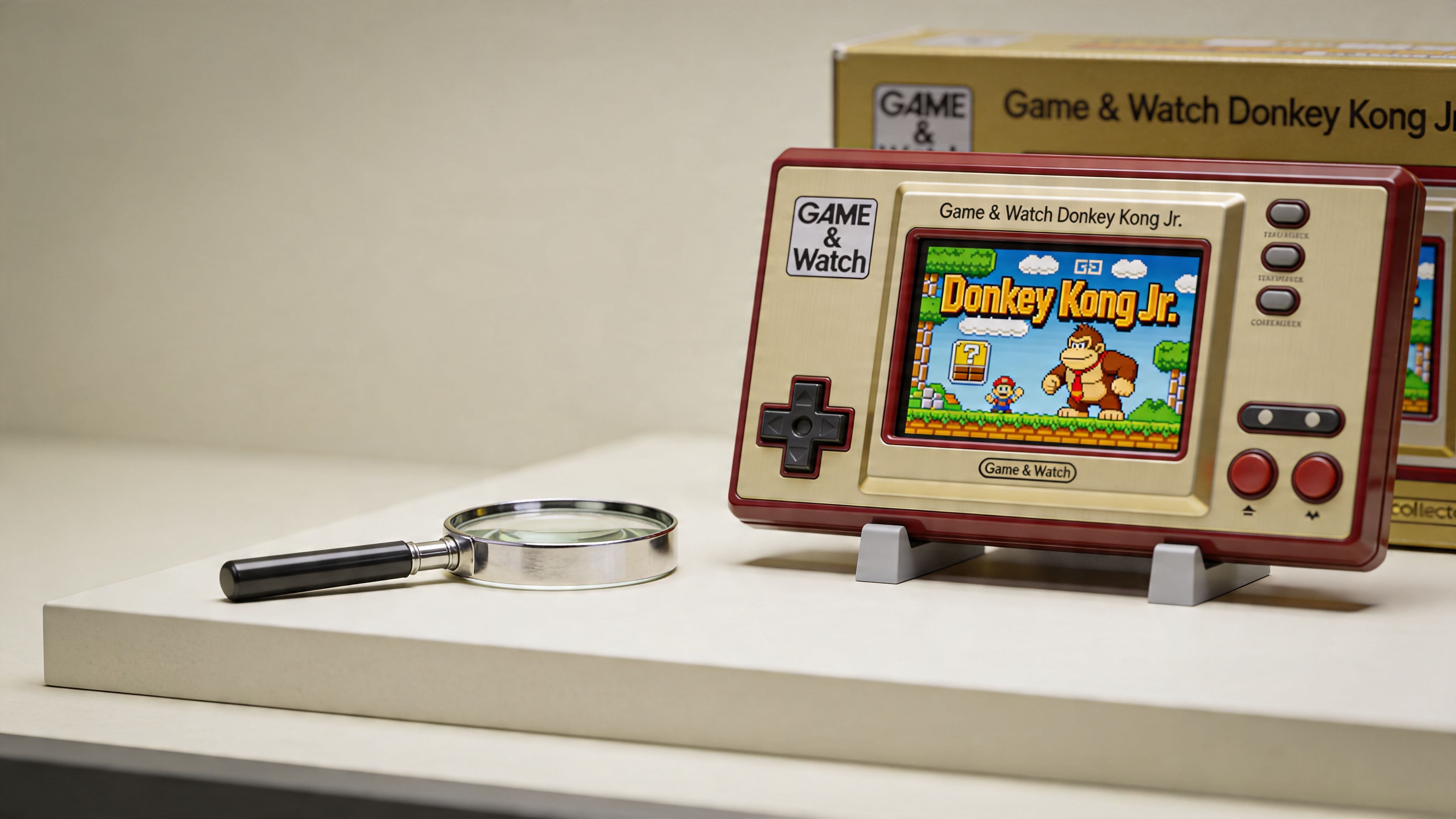
An honest unit shows its age without pretending to be something it isn’t. Light wear can be acceptable, even attractive. A badly replaced screen lens, crude battery repair, or mismatched parts usually isn’t. Collectors who care about heritage value should put originality above cosmetic overcorrection.
When evaluating game and watch donkey kong jr, inspect it in layers.
Packaging matters, but not only because collectors like completeness. Original boxes, inserts, and manuals preserve context. They turn the handheld from an isolated object into a surviving retail artefact. That distinction often shapes how a collection is perceived, especially if you display electronics alongside other design objects.
A useful habit is to compare sale listings slowly, not emotionally. If you browse platforms and regional marketplaces, guides on buying through eBay in Sweden can help sharpen your eye for seller descriptions, condition language, and the difference between attractive photography and trustworthy detail.
Buy the seller’s accuracy as much as the device itself. Good listings describe flaws plainly, photograph them directly, and don’t hide wear in flattering shadows.
Collectors sometimes chase the cleanest-looking example and end up with a unit that has lost too much of its original fabric. That’s a mistake familiar in many collecting fields. A bright replacement can look impressive for a moment, then feel hollow once you know what has been changed.
Ask questions that reveal provenance and intervention:
A great collection isn’t built by buying the glossiest item in sight. It’s built by choosing objects that still carry their own story with dignity.
Once you own a Game & Watch, your role changes. You’re no longer just a buyer or player. You’re a custodian of a fragile electronic object that has survived decades of use, storage, and changing fashions.
The first preservation rule is simple. Remove batteries during long storage. Old cells can leak, and battery damage is one of the fastest ways to turn a display piece into a repair project.
Store the unit in a stable, dry environment away from strong sunlight. Harsh light can affect plastics, printed surfaces, and screen materials over time. Avoid lofts, sheds, and damp basements, even if they seem convenient.
If you collect other ageing electronics, the same broad care principles often apply. Articles on preserving sensitive devices, such as this piece on a vintage digital camera, can be useful as a reminder that old plastics, screens, and battery compartments all dislike heat, moisture, and neglect.
Clean gently. Use a soft dry cloth first. If you need more, use a barely damp cloth on the casing only, and keep moisture away from openings and seams.
Avoid harsh solvents and aggressive polishing compounds. They can cloud clear surfaces, lift printed markings, or create a shine that looks wrong on a vintage object. The goal isn’t to make the handheld look new. The goal is to keep it stable and presentable.
Some faults are manageable. Dirty contacts, tired buttons, and minor battery residue can sometimes be addressed by a careful technician. Other problems are more permanent. Screen bleed, severe polariser deterioration, and major corrosion may compromise both function and authenticity.
Preserve first, restore second. Every intervention should answer a clear need, not a vague wish for perfection.
If you do seek repair, ask for reversible work where possible and request that original parts be retained. That approach mirrors good practice in many collecting fields. A vintage handheld deserves the same respect you’d give an old clock, camera, or radio.
A DJ-101 can live two lives at once. It is a game, and it is also a small industrial artefact from Nintendo’s early handheld era. That distinction matters because modern ways to experience Donkey Kong Jr often preserve one side better than the other.
Official re-releases, reinterpretations, and museum-minded preservation projects make the game easier to study and enjoy without placing more strain on ageing hardware. They let new players learn the rhythm of the vine-swings, the pressure of the moving hazards, and the peculiar timing that LCD design imposed. Yet the original unit still teaches lessons no modern screen can fully carry. The reflective display catches light in a particular way. The buttons answer with a firmer, older kind of tactility. Even the tiny speaker colours the action, much like hearing a folk tune played on its original instrument rather than through a clean digital file.
Original hardware gives you the whole object. Modern access usually gives you the rules, the visuals, and some approximation of the pacing.
For a collector, that difference is substantial. The DJ-101 is not only software trapped in plastic. It is printed graphics, hinged construction, material ageing, and a very specific relationship between hand, eye, and machine. For a casual player, a modern version may be the wiser choice because it lowers cost and removes the anxiety of wearing down a piece that has already survived decades.
Both paths can show respect. One preserves the artefact. The other preserves familiarity with the design.
Legal questions deserve plain language. Emulation as a technical method is often discussed in preservation circles, but game files and ROM distributions can involve copyright issues that depend on where you live and how the files were obtained. The safest course is simple. Use official releases when they exist, and be cautious about downloading or sharing software tied to rights you do not hold.
That same tension appears in other collecting and maker communities. Discussions around ownership, copying, and authenticity also surface in projects built around 3D printable miniatures and reproducible design files, where access is easy but provenance still shapes value.
Ultimately, the original DJ-101 remains more than a way to play. It stands as a carefully resolved object from a period when portable electronics still felt crafted, personal, and worthy of being kept for the next pair of hands.


.svg)


.png)


