April 17, 2026
I still remember the first time I saw a Base Set Mewtwo in a binder at a card shop. The owner didn’t pitch it as cardboard. He held it up like a relic.
Long before collectors argued about grades and print runs, Mewtwo already felt different.
It arrived in Pokémon as a warning story. Scientists tried to create the ultimate life-form from Mew’s DNA and produced something powerful, intelligent, and hard to control. That origin matters more than it may seem. Other rare Pokémon are mysterious. Mewtwo feels man-made, dangerous, and almost forbidden, which gives the character a dramatic weight that carries straight onto its cards.
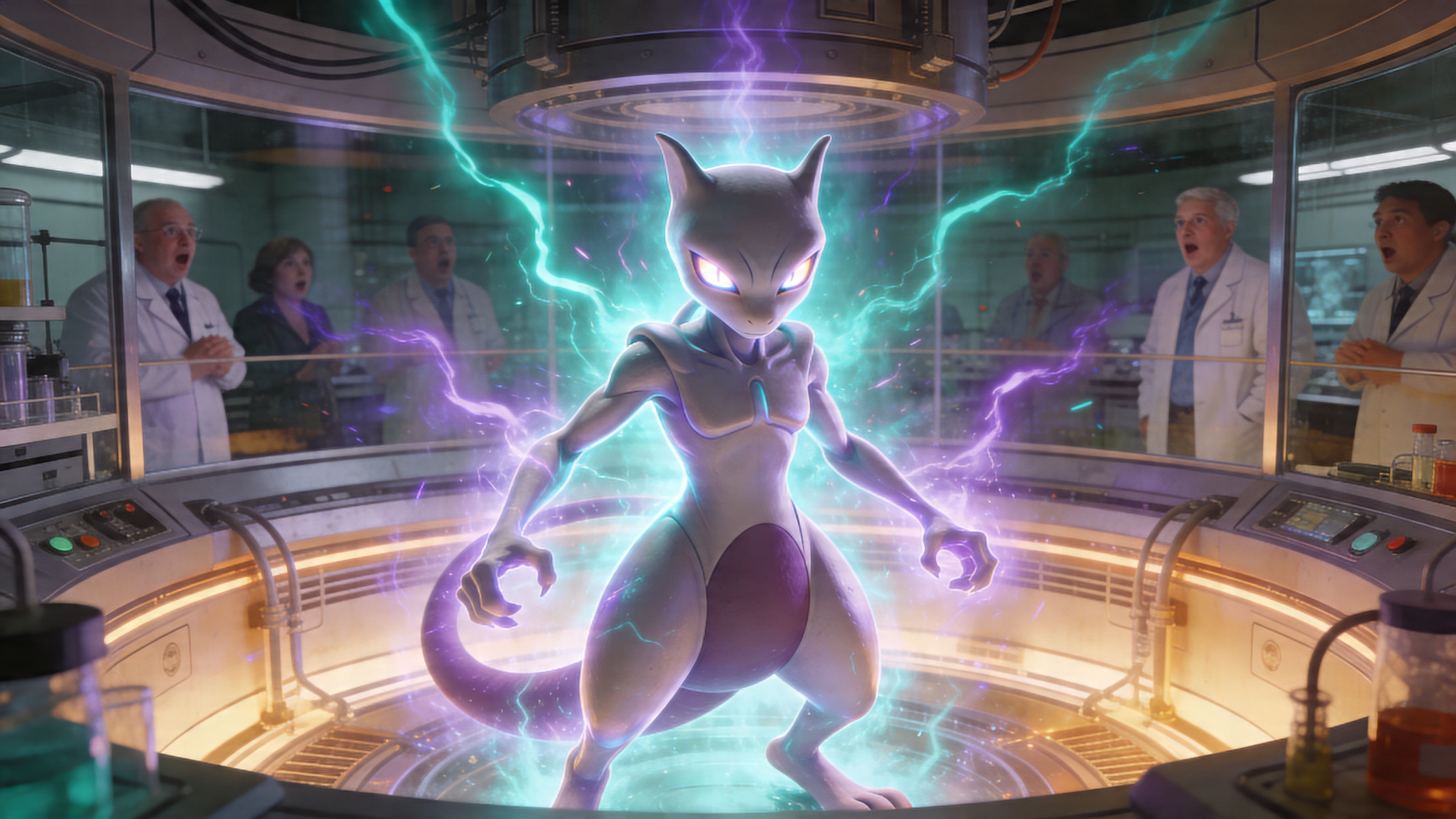
That is a big reason collectors care so much about a mewtwo pokemon card. Value does not come from foil alone. It grows from a character’s place in people’s memory. In the original games, Mewtwo was the endgame test, the Pokémon hidden at the far end of Cerulean Cave, waiting after the story was already supposed to be over. Catching it felt like finding the final boss and then convincing that boss to join your team.
Collectors remember that feeling.
A card’s price usually reflects more than scarcity. It reflects demand, and demand is often emotional before it is rational. Mewtwo built that emotional demand early because it represented peak power in the first generation, both in the games and in the wider Pokémon story.
That helps explain why Mewtwo cards often carry extra prestige beside similarly old holos. A Charizard can feel fiery and iconic. A Pikachu can feel friendly and universal. Mewtwo feels like a challenge conquered. For many collectors, owning one of its standout cards is a way of holding onto the moment Pokémon first felt huge, mysterious, and a little intimidating.
The best Mewtwo cards work like movie posters for that memory. The artwork often shows containment chambers, psychic energy, or a cold stare that suggests the card is holding back something dangerous. Even people who never played the card competitively can feel that design language right away.
Mewtwo also benefits from a visual identity that ages well. Its silhouette is clean, its expression is severe, and Psychic-type art gives illustrators room to show pressure, motion, and strange light without overcrowding the frame. That is why so many Mewtwo cards have presence in a binder page. Your eye tends to stop there.
Lore strengthens that effect. The franchise has always treated Mewtwo as more than a strong battler. Official Pokédex entries and film appearances present it as intelligent, isolated, and almost tragic, a creature defined by power and by the question of why it was created in the first place. That mix of strength and sadness gives Mewtwo unusual depth for a collector favorite.
And depth matters in this hobby.
Collectors return to characters that tell a story at a glance. Mewtwo’s cards do that better than almost any Pokémon from the original era. They are not only reminders of rarity or age. They are souvenirs from one of Pokémon’s strongest myths, which is exactly why the character’s best cards continue to command such respect.
The earliest Mewtwo cards landed at the exact right moment. Pokémon was exploding, the trading card game felt new, and children were learning very quickly which names carried status. Mewtwo was one of them.
In the late 1990s, owning a holo Mewtwo meant something even before anyone discussed grading, centring, or long-term collectability. It meant you had a card tied to the Pokémon many people already viewed as the strongest creature from the original era. That emotional head start matters. TCG history often rewards the characters that arrived with instant myth.
Base Set gave Mewtwo one of its most enduring cardboard identities. The card’s artwork, holo treatment, and placement in the earliest English release made it feel foundational. For long-time collectors, Base Set Mewtwo isn’t merely old. It’s one of the cards that helped define what an important Pokémon card looked like.
Its gameplay identity added to that status. The card was associated with strong Psychic damage output and a deckbuilding presence that people remembered long after formats changed. When a card becomes both collectible and playable in memory, its reputation becomes much harder to shake.
As the Pokémon TCG evolved, Mewtwo kept returning in forms that mirrored the game’s changing mechanics. That’s part of why collecting Mewtwo is so satisfying. You can trace the history of the hobby through one character.
Some collectors build Mewtwo binders almost like timeline projects:
Not every Pokémon gets chosen repeatedly to carry headline mechanics. Mewtwo does because it already represents power in the wider franchise. If a set wants a card that feels important the moment someone sees it, Mewtwo is an easy choice.
That pattern turned Mewtwo into one of the best examples of continuity in the Pokémon TCG. Older collectors recognise the original prestige. Newer players recognise modern versions from recent formats. Both groups meet in the same collecting lane.
Collector’s lens: A strong character with repeat appearances across many eras often stays relevant longer than a card that spikes for one format and then fades.
Many vintage icons become museum pieces. Mewtwo didn’t. It kept appearing in decks, premium products, and collector conversations. That matters because it means demand comes from several directions at once. Some people want the earliest holos. Others want modern competitive versions. Others want one striking Mewtwo card for a display shelf.
There’s also a cultural reason Mewtwo ages well. Its design doesn’t feel trapped in one decade. Pikachu can feel cute, Charizard can feel explosive, but Mewtwo often feels severe and timeless. That visual tone suits both vintage and modern card art.
A mewtwo pokemon card, then, isn’t one chapter of TCG history. It’s a thread running through the whole book.
A good Mewtwo collection usually starts with one card that makes the character feel real in your hands.
For one collector, that might be the Base Set holo pulled from a childhood binder. For another, it is a later card with sharper art, bigger attacks, and a finish that catches the light across the room. The important part is not memorising every release. It is learning which cards changed how collectors saw Mewtwo, because those are the cards that shaped demand, nostalgia, and price.
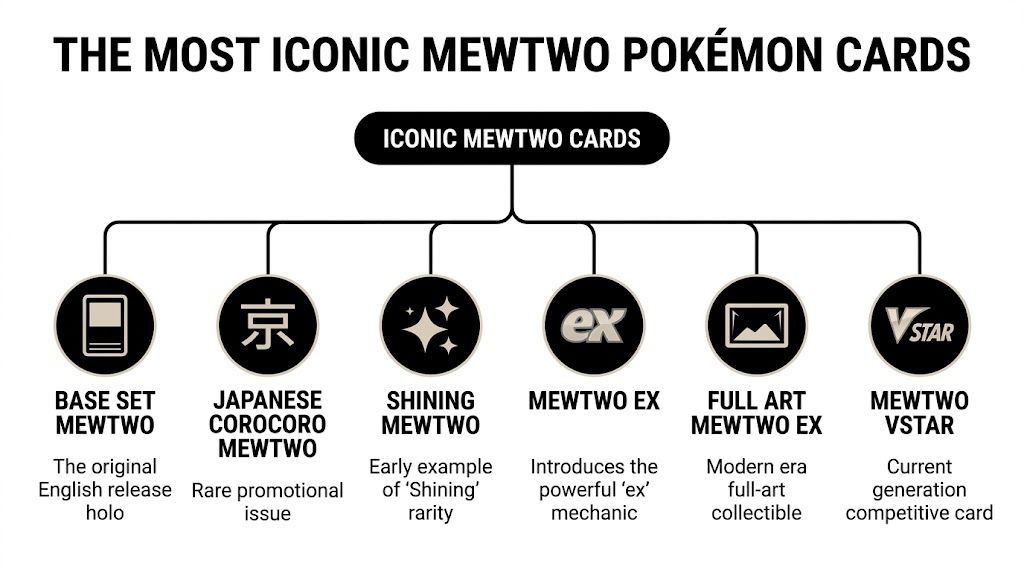
Base Set Mewtwo is the card many collectors picture first, and that matters. In collectibles, the first image that comes to mind often becomes the benchmark for the whole character. Mewtwo already carried the reputation of being Pokémon’s engineered psychic powerhouse. The Base Set holo turned that reputation into cardboard.
Its appeal comes from several layers working together. It is early. It is recognisable. It has the classic holo treatment collectors associate with the start of the hobby. In top condition, early print details like 1st Edition and Shadowless push it into a different class of demand because buyers are chasing both Mewtwo and a specific moment in print history.
Japanese promo Mewtwo cards tell a different kind of story. They feel less like the card everyone had and more like the card dedicated collectors went hunting for years later.
That hunt is part of the appeal. Promos from magazines, campaigns, and special distributions often carry a sense of discovery that standard set cards do not. For Mewtwo, that fits the character unusually well. In the games and films, Mewtwo is not ordinary or easy to reach. The card history mirrors that feeling. Some Japanese promos feel almost hidden in the hobby, which gives them a mystique English-only collectors often notice the moment they branch out.
Shining Mewtwo is where many collectors first understand that rarity can have a personality.
The card does not just look rare. It feels intentional, almost ceremonial, like the hobby decided Mewtwo deserved a version set apart from the usual rules. That is why Shining Mewtwo often becomes a milestone card. A collector who starts with nostalgia and then learns about subsets, special treatments, and lower-print prestige often lands here sooner or later.
There is a simple reason it works so well. Mewtwo already has an aura of controlled power. A special rarity treatment amplifies that aura instead of fighting it.
Mewtwo ex represents a shift in the TCG’s language of power. Earlier iconic cards made Mewtwo feel important through status and presence. The ex era made that importance more explicit. Bigger mechanics, bolder presentation, and a name format tied to standout Pokémon all signaled that this was a card meant to lead.
Collectors often use cards like this as era markers. Owning a Mewtwo ex is not only about owning one attractive card. It is about holding a chapter where the game started presenting star Pokémon with more spectacle. If Base Set Mewtwo is the old portrait in the museum, Mewtwo ex is the moment the lights got brighter.
Mewtwo Star sits in the tier of cards that can stop a conversation at a trade table.
Part of that comes from the Gold Star label itself. Part comes from how naturally Mewtwo fits the idea of a card that was meant to feel scarce, unusual, and a little intimidating. A rare Pikachu can be charming. A rare Mewtwo often feels severe. That difference shapes collector response more than beginners expect.
Cards like Mewtwo Star also teach an important lesson about value. Price is not only about age. It comes from a mix of rarity, character popularity, visual impact, and the story collectors tell about the card. Mewtwo Star scores highly in all four.
The cards collectors remember best usually combine two things. They look special at a glance, and they carry a backstory that rewards closer attention.
The Tag Team version with Mew changed the mood of Mewtwo collecting. Instead of presenting raw isolation and dominance, it framed Mewtwo alongside the Pokémon most closely tied to its origin.
That pairing gives the card narrative weight. Even a newer fan can sense that the artwork is doing more than showing a battle-ready attacker. It is reflecting one of Pokémon’s most famous relationships. For collectors who care about lore as much as rarity, that matters. The card turns Mewtwo from a symbol of power into part of a larger story about creation, identity, and rivalry.
Mewtwo VSTAR shows why modern Mewtwo cards still earn respect. According to Serebii’s Mewtwo card listing, Mewtwo VSTAR from the Pokémon GO set has 280 HP, and its VSTAR Power scales with the opponent’s Prize cards. That kind of design keeps Mewtwo aligned with what fans expect from the character. High impact, late-game threat, and a sense that if it gets set up properly, it can take over a match.
That connection between lore and mechanics helps explain modern demand. Collectors are not only buying foil and artwork. They are buying a familiar fantasy. Mewtwo is supposed to feel dangerous, rare, and important. The most iconic Mewtwo cards, whether vintage or modern, are the ones that preserve that feeling best.
Two Mewtwo cards can look almost identical at first glance and still live in very different price brackets. That’s where beginners often get tripped up. The artwork looks the same, the name is the same, and the seller says “Base Set Mewtwo”, but the details decide the card’s place in the hobby.

Consider classic cars. One might be the standard production version. Another might be an earlier run, a rarer trim, or a special market edition. To a casual passer-by they’re “the same car”. To collectors, they’re not.
For early English Pokémon cards, 1st Edition is the easiest special marker to grasp. It’s the stamp that signals an earlier print run. If a Mewtwo has that stamp, collectors pay attention immediately.
Shadowless confuses more people. The term refers to a specific early print style where the card frame lacks the later shadow effect. You don’t need advanced tools to learn this. You need comparison images, patience, and a habit of looking at the border rather than only at the artwork.
A simple checklist helps:
“Holo” means the card has a reflective foil area, but not all holo cards are equal in collector appeal. The pattern, print era, and condition all matter. A scratched holo surface can change how a card presents, even if the front image still looks good at a glance.
This is why beginners should learn to tilt a card under light. Holofoil tells the truth quickly. Hairline scratches, print lines, clouding, and edge wear often reveal themselves only when the card moves.
Here’s a useful visual refresher before you inspect your own cards more closely.
Set symbols are like timestamps for the hobby. They tell you which release a card belongs to, and that matters because collectors often organise by era, mechanic, or franchise moment. If you know the symbol, you can usually place the card in a bigger story.
Rarity marks work the same way. They don’t tell you everything about value, but they tell you how a card was positioned within its set. A newcomer often thinks rarity mark equals price. It doesn’t. It’s one clue, not the whole answer.
Practical rule: Learn to identify the card before you try to price the card.
Promos create another layer of complexity. A Mewtwo promo may share art direction or even a familiar pose with standard set cards, yet its release method changes how collectors treat it. Box promos, event promos, and special commemorative issues each have their own audience.
Modern labels like EX, GX, V, and VSTAR also need plain-English translation:
If you’re sorting a binder, don’t ask only, “Is this Mewtwo rare?” Ask, “What version of Mewtwo is this trying to be?” That question usually leads you to the right category faster.
A new collector often learns this lesson the hard way. Two Mewtwo cards can sit side by side in a binder, both flashy, both beloved, yet one draws serious offers while the other stays affordable for years. The difference usually comes from three forces working together. Scarcity, condition, and demand.
Mewtwo makes those forces easier to see because the character already carries weight before the card enters the market. In the games and films, Mewtwo is not just another strong Pokémon. It was introduced as a created, unstable, almost mythical weapon with overwhelming psychic power. That story matters. Collectors tend to pay more attention to cards that feel tied to a larger legend, and Mewtwo has had that aura from the beginning.
A rarity symbol gives you one clue. It does not tell the full story.
Real scarcity begins with how the card was released, how many people kept it, and how many clean copies still survive. A Mewtwo from a standard set can be easier to track down than a promo tied to a special product, tournament, or limited distribution. The card stock is the same. The path into collectors' hands is different, and that difference often shapes long-term value.
Sealed promotional products add another layer. A Mewtwo promo included in a box or special collection can gain attention from two groups at once: people who want the single card, and sealed-product collectors who want the entire release untouched. That split can put pressure on supply over time.
The reason this happens is simple. Mewtwo cards rarely feel disposable. Even newer releases with modern mechanics often present Mewtwo as a headline character, not filler. If the artwork, attack text, or product theme reinforces that "final boss" feeling, collectors remember it.
Condition does more than nudge the price up or down. It changes the audience for the card.
A played vintage Mewtwo can still be a wonderful binder piece. A sharp copy with clean holo, strong corners, and little whitening appeals to a different buyer entirely. That buyer may be building a graded set, upgrading an old favorite, or hunting for a copy that captures the card as it looked on release day.
This catches beginners by surprise. They hear "rare" and assume every old card belongs in the same price tier. Collecting does not work that way. A worn early holo and a near-mint copy are almost like two separate products that happen to share the same artwork.
The same rule appears in other paper collectibles. If you are curious how collectors judge age, wear, and desirability across categories, this guide to the value of older paper collectibles and bookmarks explains the pattern well.
Some characters rise and fall with one generation of fans. Mewtwo has several audiences at once.
You have original players who remember Cerulean Cave and the shock of meeting the strongest psychic Pokémon in the game. You have film fans who connect Mewtwo with one of Pokémon's most memorable stories. You have TCG players who remember eras where Mewtwo cards were legitimate threats on the table. You also have art collectors who chase dramatic poses, laboratory imagery, or battle scenes that make Mewtwo feel dangerous and intelligent at the same time.
That layered demand gives Mewtwo unusual staying power. Interest does not depend on one mechanic or one nostalgia wave.
Collectors usually pay more for a Mewtwo card when several traits overlap:
That last point matters more than many newcomers expect. A card can be technically scarce and still move slowly if only a small niche wants it. Mewtwo's best cards tend to avoid that problem because they connect power, story, and recognisable design in one package.
Some Mewtwo cards are expensive because the market is crowded. Some are important because they mark a turning point in the hobby, a new mechanic, or a memorable era of Pokémon history. The sweet spot is a card that does both.
That is why good Mewtwo collections usually feel personal rather than purely financial. One collector may chase a pristine early holo because it captures the character's origin as Pokémon's ultimate psychic. Another may prefer a modern full-art or promo that shows how each generation keeps retelling that same legend in a new visual language.
If you want a practical rule, ask three questions before buying. Why do people care about this version of Mewtwo? How hard is it to find a clean copy? What story does the card carry with it?
Those answers usually explain the price better than the rarity symbol alone.
The moment you buy a card, preservation becomes part of collecting. A strong Mewtwo card can lose appeal quickly if it picks up scratches, binder dents, or moisture damage. Protection isn’t only for high-end pieces either. Good habits should start with your cheapest cards so they become automatic when you handle the expensive ones.
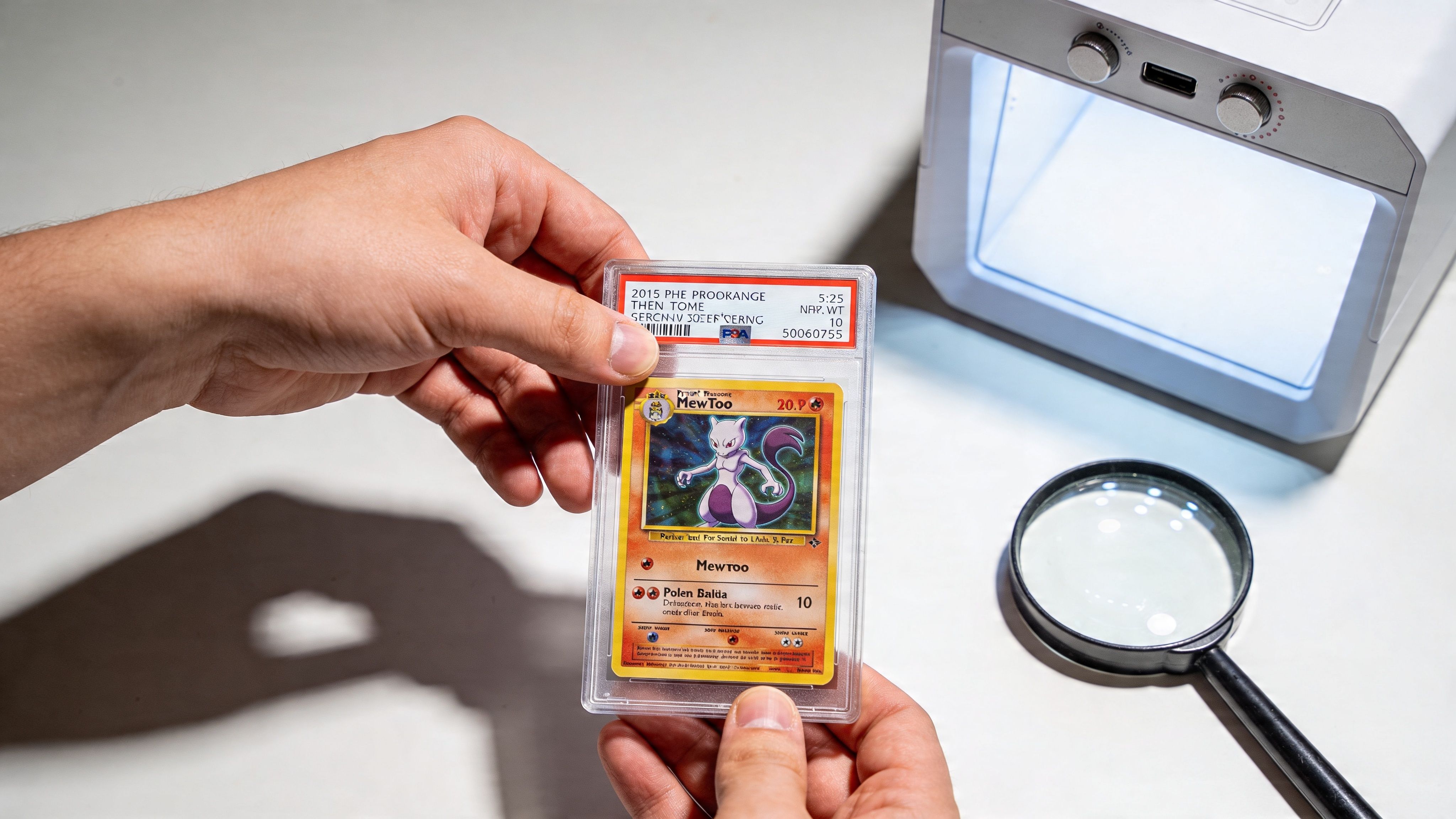
Counterfeits target popular characters, and Mewtwo absolutely counts as a target. You don’t need to become a forensic expert overnight. You do need a repeatable inspection routine.
Check these first:
The so-called light test gets discussed often, but don’t rely on one trick alone. Real authentication is about a pattern of evidence, not a single party trick.
A raw card is ungraded. A graded card has been authenticated and sealed in a case by a grading company such as PSA or CGC. Beginners often see grading as something only investors do, but that’s too narrow.
Grading can help in three ways. It gives an opinion on authenticity. It creates a clear condition label for buyers. It protects the card physically once slabbed. If you own a Mewtwo card that would hurt to replace, grading becomes easier to justify.
Buy the card first. Buy the label second. A respected grade helps, but the card’s eye appeal still matters.
You don’t need fancy gear to protect most cards well. You need consistency.
A solid basic setup looks like this:
Binders are fine if they’re designed for trading cards and you don’t overstuff them. Cheap ring binders can cause avoidable damage if pages shift or press against cards.
Collectors who care about presentation across different art forms often come to the same conclusion. The right display method should protect first and showcase second. That’s true for cards just as it is for properly preserving graphic art and poster pieces.
A card doesn’t get damaged only in storage. It gets damaged while being admired, photographed, traded, and shown to friends. Hold cards by the edges. Work on a clean surface. Keep food and drinks away from the sorting area.
Most collection damage comes from ordinary moments, not disasters. Good handling feels slow at first. Then it becomes second nature.
A good Mewtwo purchase usually starts before you click anything. It starts with a question. What part of the Mewtwo story are you trying to own?
Some collectors chase the first time Mewtwo appeared in the TCG because it feels like holding a piece of Pokémon history. Others want the most dramatic artwork, the strongest modern card, or the cleanest graded copy they can afford. That difference matters. Mewtwo’s prices rise and fall for a reason. Collectors are not only buying cardboard. They are buying the character who was built in the games and anime to feel rare, dangerous, and almost untouchable. That reputation follows the card.
Choosing a lane makes the whole market easier to read. A vintage holo collector looks at different details than someone building a modern art set. A player buying a competitive Mewtwo cares about timing and playability. A nostalgia buyer may care most about getting the same card they remember from childhood.
That is why two Mewtwo cards with similar price tags can be very different buys.
Before you commit, ask yourself:
A strong buying routine is simple. Save searches. Compare several copies side by side. Ask direct questions such as “any dents, pressure marks, or back edge whitening?” Set your spending limit before the auction starts.
The last point sounds basic, but it saves people money. Mewtwo has always carried a sense of power in Pokémon, and that emotional pull can make a dramatic card feel more important in the moment than it really is for your budget.
Selling a Mewtwo card works best when your listing tells a clear story. A played unlimited holo should be presented as an affordable way to own an iconic card. A graded copy with strong eye appeal should be photographed like a centerpiece. The card has not changed, but the audience has.
Good listings do three things well. They show the front and back clearly. They describe flaws in plain language. They explain exactly which version is being sold, especially if the card has a promo stamp, set symbol variation, or Japanese release detail that newer buyers might miss.
Regional pricing matters too. A seller in Sweden may find that local buyers and local platforms produce different results than headline prices from larger English-language markets. If you buy or sell there, guides to using eBay from Sweden can help you compare fees, customs friction, shipping expectations, and whether a local sale is the easier option.
The smartest deal is not always the cheapest buy or the highest sale. It is the one that fits your goal with the least regret.
For buyers, that might mean paying a little more for a clean, well-photographed copy from a trustworthy seller. For sellers, it might mean accepting a fair offer from a serious collector instead of waiting months for an ideal number that never arrives. Mewtwo cards often carry strong asking prices because the character means so much to the hobby. Actual completed sales matter more than wishful listings.
If you remember one rule, make it this one. Buy the Mewtwo card that still feels special after the excitement wears off, and sell with enough clarity that the next collector can see why it mattered to you in the first place.
A modern Mewtwo card or a lower-cost vintage copy in honest condition is usually the best place to start. It lets you learn how Mewtwo cards look and feel in hand without putting too much pressure on one purchase.
No. Holographic finish helps, but value depends on the exact card, its condition, and how many collectors want that version. Some holo Mewtwo cards are key pieces. Others are mainly affordable collector favourites.
It depends on your goal. Buy graded if you want stronger authentication and a fixed condition label. Buy raw if you enjoy inspecting cards yourself and want more flexibility. For expensive vintage, many beginners feel safer with graded copies.
Ask for clear photos, compare fonts and colours to known genuine examples, and avoid sellers who use blurry images or vague descriptions. If the card is expensive and you’re uncertain, walk away.
Start with enjoyment. Value matters, but it’s easier to build a satisfying collection when you like the cards you own.
If you enjoy collecting objects with story, craft, and lasting display appeal, take a look at Dalaart. It offers authentic Swedish folk art that speaks to the same collector instinct behind treasured cards: provenance, character, and the pleasure of owning something made to endure.


.svg)


.png)


