January 6, 2026
The value of an old bookmark, what we call gamla bokmärken värde in Sweden, is a surprisingly wide spectrum. It can be anything from a few kronor for a common find to well over 12,000 SEK for a major, beautifully kept collection that goes up for auction. It really all boils down to its age, how rare it is, the condition it’s in, and who made it. A simple paper marker can quickly turn into a serious collectible.
Have you ever opened an old book and found a delicate, illustrated bookmark tucked inside its pages? That little slip of paper is so much more than a placeholder. It’s a tiny piece of art and a direct link to the past. This guide is your way into the fascinating world of gamla bokmärken, helping you understand what separates a simple keepsake from a true hidden treasure.
Think of valuing a bookmark like you would a small painting. Its worth isn't just in its use, but in its story, the quality of its creation, and how many are left in the world. For collectors, these fall into a category we call ephemera—items that were never meant to last but have survived to give us a unique peek into another time.
Certain things will immediately make a bookmark more interesting to a collector. As you start to look at a piece, keep these key points in mind:
The appreciation for old bookmarks is part of a much bigger trend. Take vintage Swedish folk art, for instance, especially pieces handcrafted in Dalarna. Their value has shot up remarkably in recent years. It's all part of a larger movement where heritage and authenticity are what enthusiasts prize most.
The Scandinavian collectibles sector is projected to grow from USD 1.2 billion in 2024 to USD 2.1 billion by 2032, driven by a significant increase in demand for authentic vintage items among heritage enthusiasts.
This surge in interest is lifting the whole market for Swedish antiques, including paper ephemera. As collectors hunt for unique pieces of history, items that were once overlooked—like charming old bookmarks—are finally having their moment. This guide will give you the foundation you need to spot their potential, connecting their nostalgic appeal to their real market value. You can dive deeper into these market trends in this detailed report from Strategic Market Research.
To really understand the value of an old bookmark, you have to become a bit of a historical detective. The materials used and the artistic style are your best clues to a bookmark’s age, which is a massive part of its worth. Every era left its own distinct fingerprint on these little pieces of paper and silk, telling a story of shifting tastes and new technologies.
Think of it like dating antique furniture; you learn to spot the ornate carvings of one period versus the clean, simple lines of another. The same idea applies here. Once you can identify the key features of different design movements, you can place a bookmark in its proper historical context. That’s the very first step in any accurate appraisal of its gamla bokmärken värde.
This chart really breaks down how a bookmark's age, condition, and rarity are the three pillars holding up its market value.
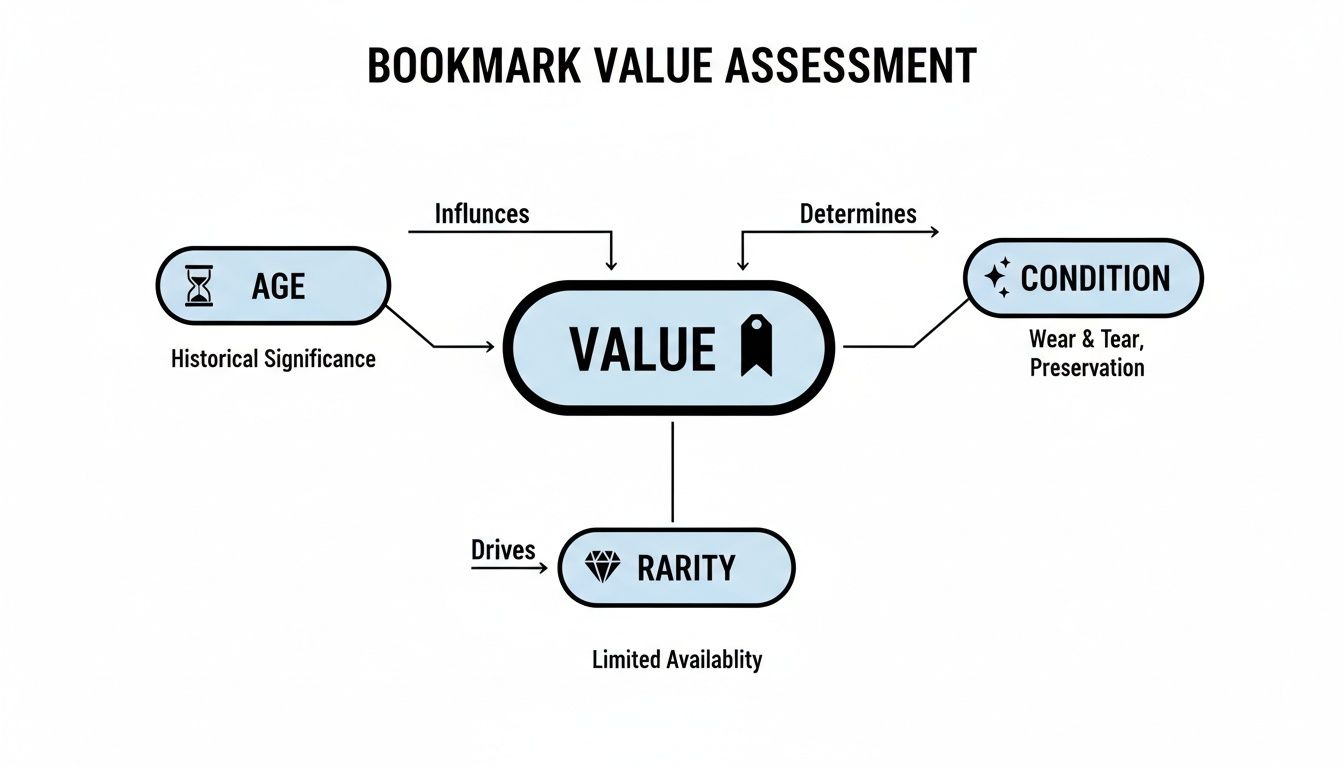
As you can see, while these three factors are separate, they're all deeply connected when it comes to figuring out what any collectible bookmark is truly worth.
The Victorian period was all about elaborate decoration, and bookmarks were certainly no exception. The most valuable examples from this time were made using chromolithography, a painstaking printing method that created rich, layered colours without the tiny dots you see in modern printing.
These bookmarks often feature:
A classic Victorian bookmark just feels substantial in your hand. The paper is usually thick and high-quality, and the colours pop with a vibrancy that's lasted over a century. The craftsmanship is so evident, making them a top prize for collectors.
As the world turned to the early 20th century, design styles changed in a big way, and bookmarks went right along with them. Knowing the difference between these two periods is vital for accurate dating.
The Art Nouveau period (around 1890-1910) was a celebration of nature, full of flowing, organic shapes. Bookmarks from this time often show graceful, stylised women with long, flowing hair, intertwined with vines, lilies, or dragonflies. The lines are curved and asymmetrical, giving them a real sense of movement.
Then came the Art Deco era (1920s-1930s), which was a complete contrast. It embraced modernity, geometry, and the machine age. For these, you'll want to look for:
These artistic shifts are fascinating to see side-by-side. You can see the same transition from ornate to geometric designs when you explore the history of vintage posters in Sweden, which often followed these major European art trends.
By the 1940s and 1950s, Swedish bookmark production really took off, partly because of wartime import rules. This period gave us charming, often whimsical illustrations, frequently of rosy-cheeked children, cute animals, and idyllic country scenes.
A key giveaway for bookmarks from the mid-20th century is the change in materials. While paper was still king, early plastics like celluloid started appearing. These have a distinct smooth, slightly shiny feel and were often used for advertising bookmarks.
Learning to identify these materials by touch and sight is a skill you'll develop over time. A celluloid bookmark feels completely different from a Victorian chromolithograph. Recognising these material and style clues gives you the context you need, turning you from a casual browser into a knowledgeable collector, ready to accurately gauge the potential gamla bokmärken värde of your finds.
Just like in the art world, the person or company behind a bookmark can make all the difference to its value. A pretty, unsigned floral design is one thing. But a piece signed by a well-known illustrator or printed by a famous publisher? That's another story entirely. The real treasure hunt is for these little clues—maker's marks, artist signatures, and publisher logos—which are key to understanding the true gamla bokmärken värde (old bookmarks value).
Think of these marks as the fingerprints of history. They confirm where a bookmark came from and connect it to a specific time, place, and artist. Finding one is like discovering the signature on a painting; it instantly elevates the piece from a simple keepsake to a documented artifact. For serious collectors, this kind of provenance is everything.
While Germany was really the powerhouse of bookmark production in the late 19th and early 20th centuries, several Swedish and English companies created pieces that are now highly collectible. Getting to know their names and marks is a vital skill for anyone looking to build a serious collection.
A few of the most sought-after names include:
Spotting a mark from one of these makers immediately adds a layer of history and desirability, which almost always means a higher value.
Beyond the maker's mark, the reason a bookmark was made is a huge clue to its rarity. Not all bookmarks were created equal. Some were churned out in the thousands for the general public, while others were created for very specific, limited events. Figuring this out helps you guess how many might still be floating around today.
Think of it like this: a mass-market poster is common, but a limited-edition lithograph, signed and numbered by the artist, is rare and valuable. The same principle applies to bookmarks. A signed piece by a famous artist like Jenny Nyström is a treasure compared to a generic one.
The world of collectible art posters works in much the same way. As we explore in our guide to Keith Haring posters, an artist's signature and a limited print run are precisely what drive significant market value.
To get a better handle on rarity, think about the bookmark's original job. It usually falls into one of a few key categories, and each one has its own level of scarcity.
This focus on rarity and origin echoes throughout other areas of Swedish collectibles. Take the market for vintage folk art and toys, which brought in US$122.90 million in revenue in 2022. It places enormous value on being able to identify the artisan. Between 2015 and 2023, for example, the auction value for old Dala horses from known Dalarna artisans shot up by 204%. This was largely because they're getting harder to find as the number of active artisans has declined. You can learn more about these fascinating Swedish market trends from Statista.
By learning to spot these details, you shift from being a casual owner to an informed collector—someone who can read the subtle clues that separate a common piece from a truly rare and valuable find.
When it comes to figuring out the värde of your gamla bokmärken, condition is king. You can have the rarest bookmark in the world, but if it's in rough shape, its value can plummet. I’ve seen scarce bookmarks sell for a fraction of their potential simply because of their condition, while more common ones in perfect shape fetched impressive prices.
Think of it like this: condition is the foundation. Without a solid foundation, everything else—rarity, age, maker—matters a whole lot less. This is why getting a handle on grading is so crucial for any serious collector. It’s the shared language that helps buyers and sellers agree on a fair price, and it protects you from overpaying for a piece that looks better online than it does in person.
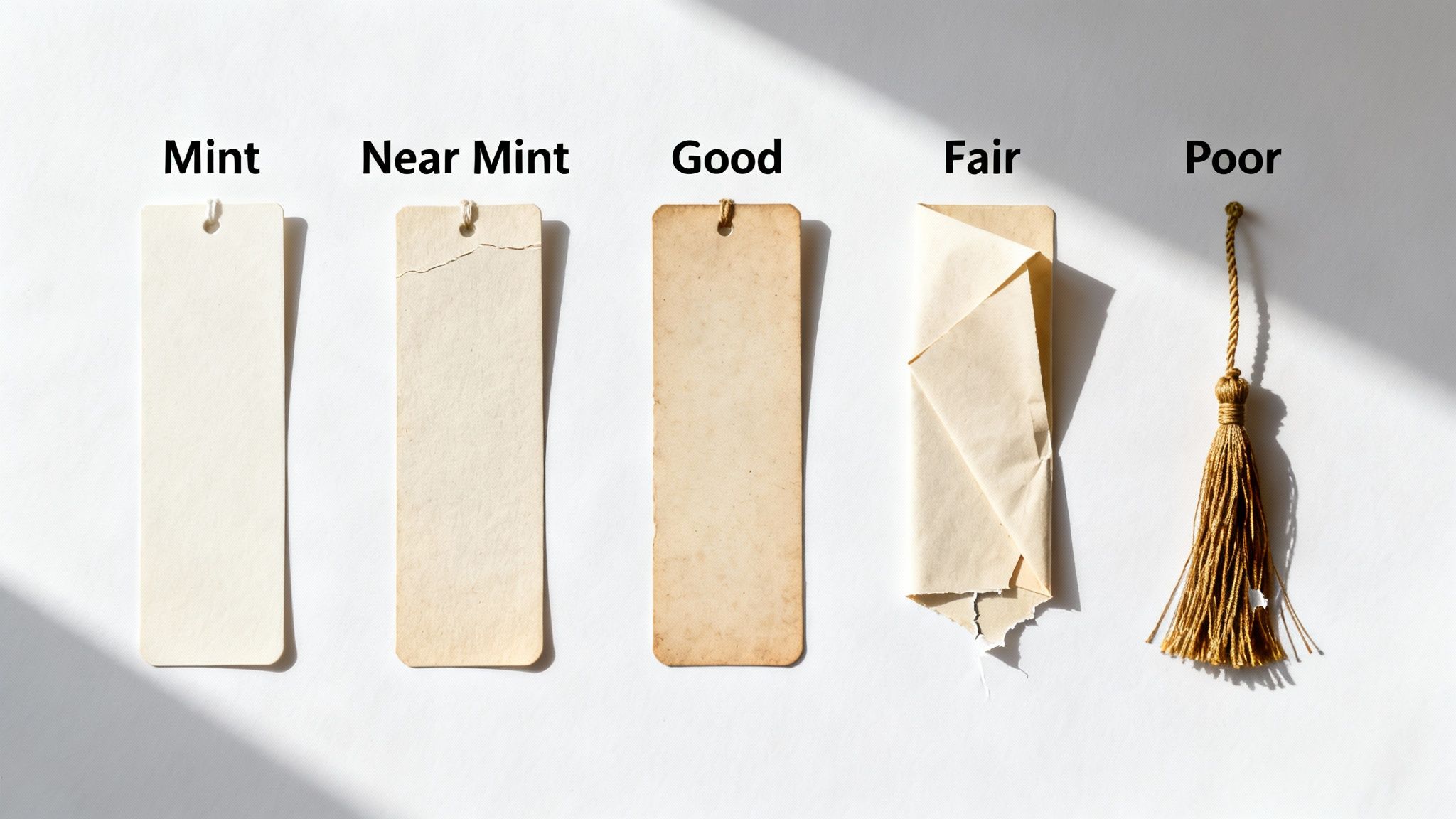
To keep things consistent, collectors rely on a grading scale. While some official systems can get incredibly detailed, a straightforward five-tier system is all you really need for vintage bookmarks. It's a practical way to quickly assess and categorise what you've got.
Here are the key grades you'll want to get familiar with:
When you’re examining a bookmark, you’re essentially playing detective. You're searching for clues about its past and any damage that will affect its grade and, ultimately, its price.
One crucial thing to remember: damage adds up. A bookmark with several small issues, like a soft corner and a tiny stain, will often grade lower than one with just a single, more obvious flaw.
Keep an eye out for these common culprits:
A final tip: always handle these delicate items with clean, dry hands, and try to hold them by the edges. Good, natural light is your best friend for spotting subtle flaws. By taking your time and applying these standards, you'll be able to accurately assess any bookmark that comes your way.
Once you’ve carefully identified, dated, and graded your bookmarks, the real fun begins: finding out what they're actually worth. This is where your detective work pays off. Figuring out the gamla bokmärken värde isn't about guesswork; it’s about gathering solid data by comparing your items to similar ones that have recently sold.
Think of it like appraising a house. You wouldn't just pull a price out of thin air without looking at what similar homes in the neighbourhood sold for. The same idea applies to these miniature paper treasures. You need to find "comparables" to set a realistic price and connect with the right collectors.
For anyone based in Sweden, your first stop should always be the local online auction sites. These platforms are a direct window into what Swedish collectors are actively looking for and what they're willing to pay.
As you research, pay close attention to the listings themselves. Notice how the most successful sellers describe a bookmark's condition, maker, and era. Look at the quality of their photos. This is how you learn what information buyers need to feel confident enough to place a bid.
While Swedish sites are fantastic for the local market, international platforms can introduce your collection to a global audience of ephemera lovers. Each has its own unique character.
eBay: As the world's largest online marketplace, eBay gives you unparalleled reach. You can connect with buyers from every corner of the globe, which is a huge advantage if you have bookmarks from internationally known makers like Littauer & Boysen. The flip side is that the sheer volume of listings can make it tough for your items to get noticed.
Etsy: Known for its focus on vintage treasures and handmade goods, Etsy attracts a different kind of buyer. These are often people looking for unique, curated pieces with a story to tell, which can be a perfect match for especially beautiful or artist-signed bookmarks. If this sounds like a good fit, our in-depth guide offers practical advice on how to get started selling on Etsy and find your ideal customers.
The global collectibles market is thriving, with a growing appetite for unique pieces of history. In Sweden alone, the vintage folk art market was valued at USD 28.4 million in 2024 and is projected to hit USD 46.9 million by 2032. This trend shows a wider interest in tangible history, which has a direct and positive impact on the gamla bokmärken värde.
Data also reveals that 73% of top heritage auction sales are for items with clear, documented origins, which can boost final values by as much as 42%. This really highlights how important it is to document your bookmark's history. You can dig into more of the numbers on these market dynamics from StellarMR's 2024 report.
One of the final big decisions is how to package your bookmarks for sale. Do you sell them one by one, or group them together as a 'lot'? There are good reasons for doing it both ways.
In the end, a hybrid approach often yields the best results. Cherry-pick your most valuable items to sell individually, and then create attractive, themed lots with the rest. This strategy helps you maximise your returns while making sure your entire collection finds a new home.
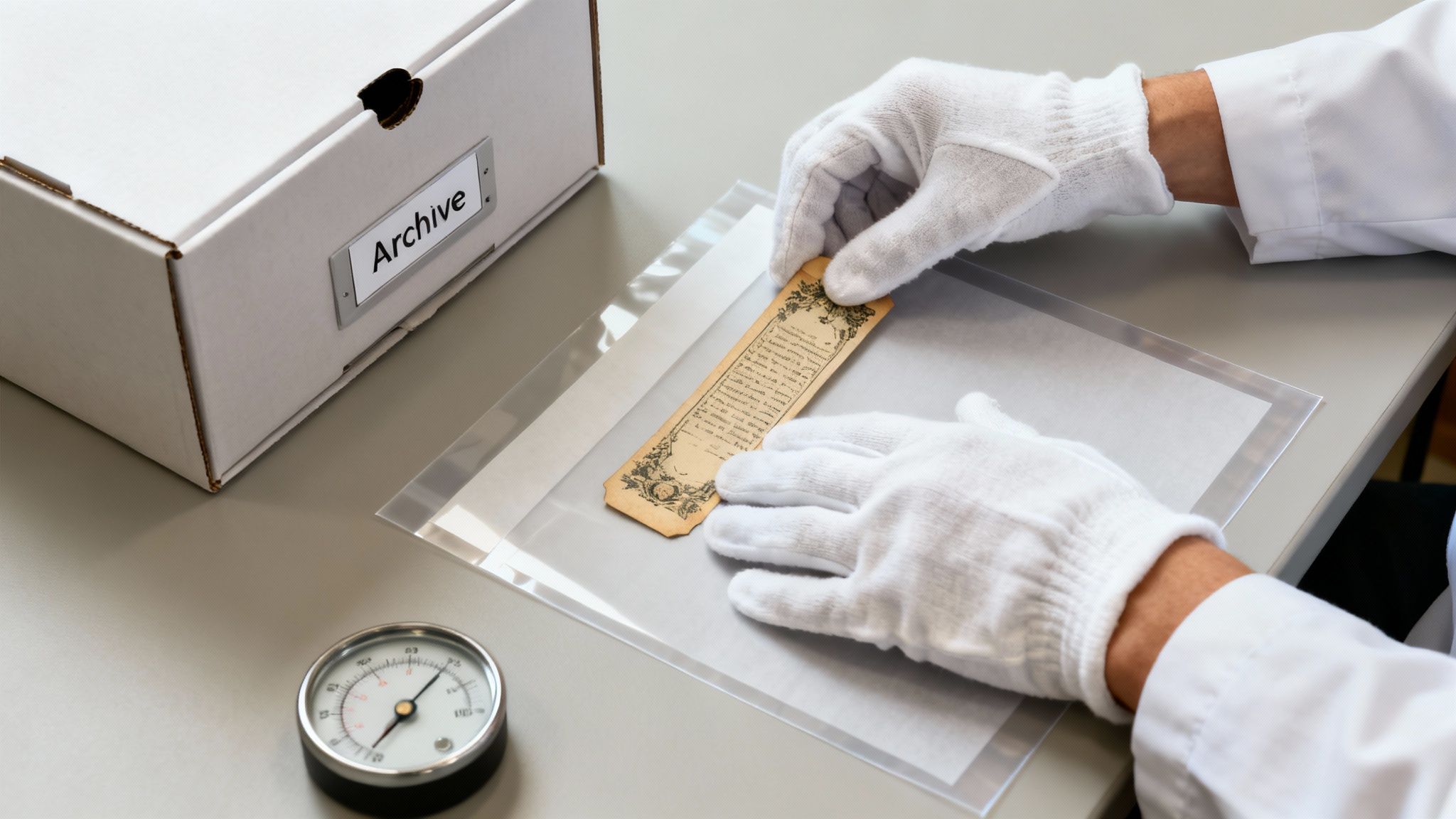
Protecting the long-term värde of your gamla bokmärken is about more than just gentle handling. Real preservation means creating a stable, safe home for your delicate paper treasures, shielding them from the very things that cause irreversible damage over time.
Think of your collection as being in a constant, quiet battle against the elements. Simple, everyday things in our homes can become their worst enemies. Taking a proactive approach to conservation is the only way to ensure their condition—and their value—remains intact for future generations to enjoy.
The single most important decision you'll make is where your bookmarks will live. Many common containers, like standard paper envelopes or even beautiful wooden boxes, are highly acidic. They will slowly leach chemicals into the paper, causing that dreaded yellowing and making them brittle and weak.
To stop this slow decay in its tracks, you must use archival-quality, acid-free materials. These are made to be chemically stable and won't harm your collection.
Your best options are:
Think of these materials as a crucial investment in the future of your collection. They prevent the kind of subtle damage that can slowly erase a bookmark's value.
Where you keep your collection is just as critical as what you keep it in. Paper and silk are incredibly sensitive to their surroundings. The wrong spot can lead to rapid deterioration, no matter how good your storage containers are.
Think of it as creating a miniature museum environment in your own home. The goal is stability—avoiding the dramatic fluctuations in temperature and humidity that stress the delicate fibres of paper and fabric.
Your preservation checklist should focus on controlling three main culprits:
Diving into the world of vintage bookmarks can bring up a lot of questions, whether you're just starting out or have been collecting for years. Getting a handle on what makes a bookmark valuable is the first step to understanding the gamla bokmärken värde (old bookmarks value) of your own treasures. Let's tackle some of the most common questions that pop up.
Not always. It's a common misconception that just because something is old, it must be worth a lot of money. While age is certainly a piece of the puzzle, it doesn't automatically mean a high price tag. A very common, mass-produced bookmark from the 1950s that's seen better days might only be worth a few kronor.
Real value comes from a mix of things: rarity, condition, who made it, and what it depicts. For example, a rare, artist-signed Art Nouveau bookmark in pristine condition would be a completely different story and highly sought after by collectors. Think of it less about just being old, and more about being a desirable, well-preserved piece of history.
For most collectors here in Sweden, the first stop is almost always Tradera. It's the go-to online marketplace with a huge, built-in audience of local buyers who are specifically looking for vintage paper goods and ephemera.
But if you think you're sitting on a truly special or high-value collection, your best bet is to contact a proper Swedish auction house. Big names like Bukowskis or Stockholms Auktionsverk have the expertise to professionally appraise and market your bookmarks to serious collectors. This route often leads to a much better final price for those top-tier pieces.
Honestly, for the vast majority of common bookmarks, paying for a professional appraisal just isn't worth the cost. You can get a very good idea of the market value by doing your own homework. Spend some time searching for similar sold items on sites like Tradera and eBay.
The big exception here is for those one-of-a-kind finds. If you have a bookmark you suspect is signed by a famous artist, is crafted from precious materials like silver, or has a significant historical connection, then yes. Investing in a consultation with an appraiser who specialises in antiques or ephemera is absolutely the right move.
This is a great question, as chromolithography was a hallmark of the Victorian era and is often a clue that you have an older, more valuable bookmark on your hands. The look is quite different from modern prints.
The colours have an incredible richness and depth to them, giving the image an almost painted feel. The real giveaway is what you see under a magnifying glass. You will not see the tiny dot pattern (called a halftone screen) that you find in all modern printing. The paper itself often feels different, too—thicker, with a slight texture or sheen left over from the intense printing process.


.svg)


.png)


