December 26, 2025
A one line art drawing is exactly what it sounds like: a piece of art created using a single, unbroken line from start to finish. The challenge is to capture the essence of a subject—its form, movement, and character—without ever lifting your pen from the paper. It's a fantastic exercise in simplicity and creative problem-solving.
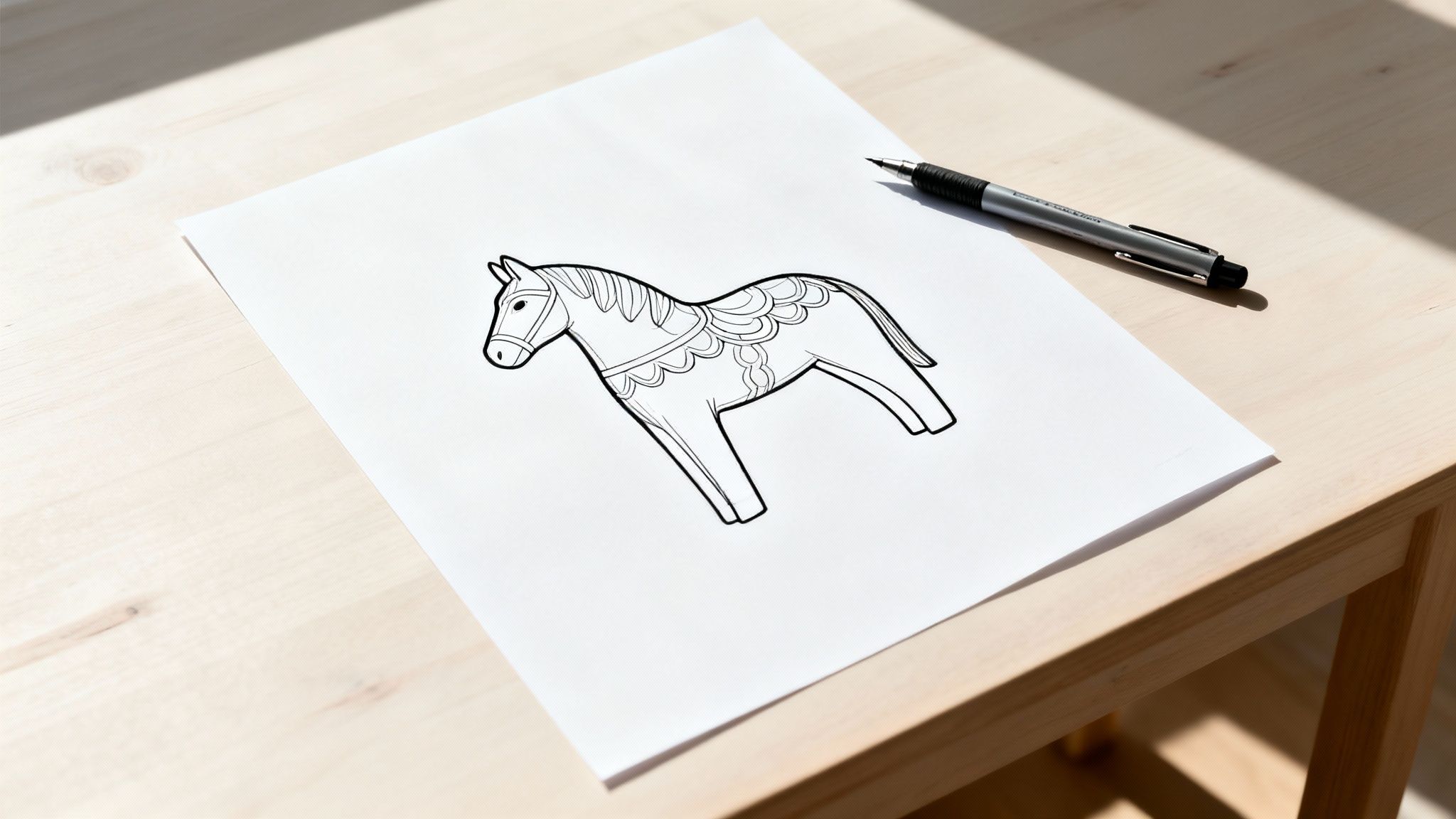
There's a captivating elegance to one line art. It strips away all the usual distractions, forcing both you and anyone looking at your work to focus on the pure form of the subject. Every curve, twist, and turn of the line is a deliberate decision, all flowing together into one cohesive image.
This style shares a deep connection with the principles of Scandinavian design, which has always championed clean lines, functionality, and minimalism. Think about it: just as a well-designed chair uses minimal materials to achieve maximum style, a continuous line drawing uses a single stroke to convey a complex idea. It's all about doing more with less.
The real heart of this art form lies in its continuity. You have to mentally trace the path your pen will take before it even touches the paper. This forces you to see objects not as a collection of separate parts, but as a whole, holistic shape. You start to notice the relationship between different contours and how they flow into one another naturally.
This skill is especially useful when drawing subjects with iconic silhouettes. A perfect example is the classic Swedish Dala horse, which is an ideal subject to start with.
If you're curious about where this iconic horse came from, you can discover more about the cultural journey of the Dala horse and what it symbolises.
The true magic of one line art is how it trains your eye to simplify. You learn to translate intricate details into a single, expressive gesture that captures the spirit of your subject.
By trying this technique, you won't just create striking artwork; you'll also develop a deeper appreciation for form and outline. It’s an approach that values the journey of the line itself, making the creative process as meaningful as the final result. This guide will walk you through turning that simple concept into your own beautiful artwork.
Getting set up for a one-line drawing is as much about your mindset as it is about your materials. Before your pen even hits the paper, taking a quiet moment to pick the right tools and get your head in the game can make all the difference. It’s what separates a frustrating doodle from a flowing, joyful creative session.
Your choice of paper and pen really does matter. I always recommend finding some smooth paper, like a Bristol board or even just a quality sketchbook with a high GSM (grams per square metre) rating. This gives your pen a smooth runway to glide across, without snagging on the paper’s texture—absolutely crucial for keeping that line unbroken and graceful.
The pen you use will completely define the character of your line. There are a few fantastic options out there, and each one brings something a little different to the table.
Beyond the physical tools, the most important piece of the puzzle is your mental approach. One-line art is really a practice in letting go. You have to fight that deeply ingrained instinct to lift your pen to fix a mistake or start a new part of the drawing. Those little "wobbles" and imperfections aren't errors; they're the very soul of this art style.
Think of it like a dance. Your hand is just following the music in your mind. The goal isn't to hit every single mark perfectly, but to complete the movement with grace and continuity.
To build the muscle memory and confidence you need for that fluid motion, simple warm-up exercises are your best friend. Before you even think about your main piece, just fill a page with continuous shapes.
Draw long, looping waves from one side of the paper to the other without stopping. Try creating tight and loose spirals, going both clockwise and anti-clockwise. These drills aren't about making a masterpiece; they're about teaching your hand and brain to work together in a single, sustained action. This little bit of prep helps you find a confident rhythm before you begin your actual one line art drawing.
Alright, you've got your tools, you're in the right headspace—now it's time to actually put pen to paper and see what happens. Building skill in one line art drawing is a journey, not a sprint. It’s all about teaching your hand and your eye to have a single, flowing conversation.
We’ll start with the absolute basics: simple geometric shapes. Try drawing a square or a circle without lifting your pen. It sounds easy, but you'll immediately notice the main challenge is getting back to your starting point without an awkward bump or gap. This little exercise is brilliant for training your brain to plan out the entire path of the line before you even start.
This whole process can really be boiled down into three core actions. Understanding this flow helps you build a creative habit you can rely on, making sure you're ready to go before the ink hits the page.
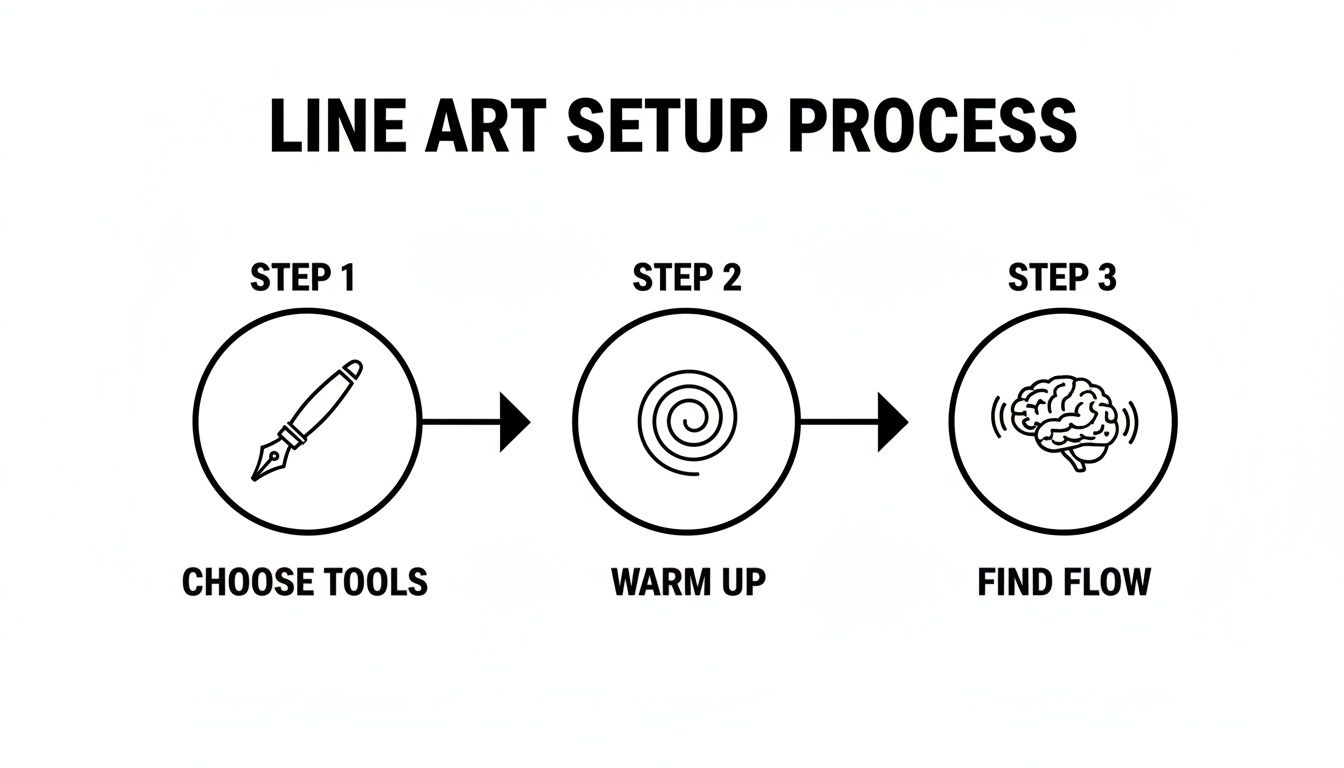
Once you're feeling a bit more comfortable with those rigid shapes, let's move on to something more natural. Organic forms are a lot more forgiving and are perfect for developing a fluid, easy motion.
Think of every single exercise as a small win. You're not just drawing things; you're fundamentally retraining your brain to see connections and continuous paths where it used to see separate parts.
Feeling good? Let's tackle something a bit more complex: an animal silhouette. This is where your ability to see the "big picture" really gets put to the test. For now, forget all the little details like fur or eyes. Your one and only goal is to capture the essential outline that makes the animal instantly recognisable.
A sitting cat, a bird in flight, or a simple fish are all fantastic subjects to start with. Before you even draw, try tracing the outline in the air with your finger. This little trick helps you internalise the path your pen will take and flags any tricky spots, like that sharp turn from a cat’s back down to its tail.
The essence of a good continuous line drawing isn't perfection; it's recognition. Can you capture the spirit of the subject in one unbroken gesture? That is the true measure of success.
This minimalist approach is really catching on globally. In Southeast Asia, for instance, the one line art movement kicked off in Jakarta around 2018 and has seen explosive growth since. By 2025, the number of galleries featuring this style is projected to jump by 300% from 2020 levels. A big reason for this is its accessibility, with prices often being 50% lower than multi-line works. If you're curious about these trends, you can dive deeper into the full market research on online art sales.
All this practice—the shapes, the leaves, the animals—has been leading us right here, to our main event: the Dala horse. Its iconic form is the perfect blend of strong, straight lines and big, sweeping curves, making it a truly delightful challenge.
First, just visualise your line's journey across the page. Where will you begin? A popular starting point is the bottom of one of the front hooves. From there, your pen can travel up the leg, across the chest, and into that proud curve of the neck.
Navigating the head and ears will require a few shifts in direction before you sweep down the long, strong back and over the hindquarters. The real key is to maintain a steady, even pace. Don't rush through the curves or get hesitant on the straight sections. Let all that practice with simpler forms guide your hand, and you’ll find a confident, unbroken flow that brings the spirit of this Scandinavian icon to life.
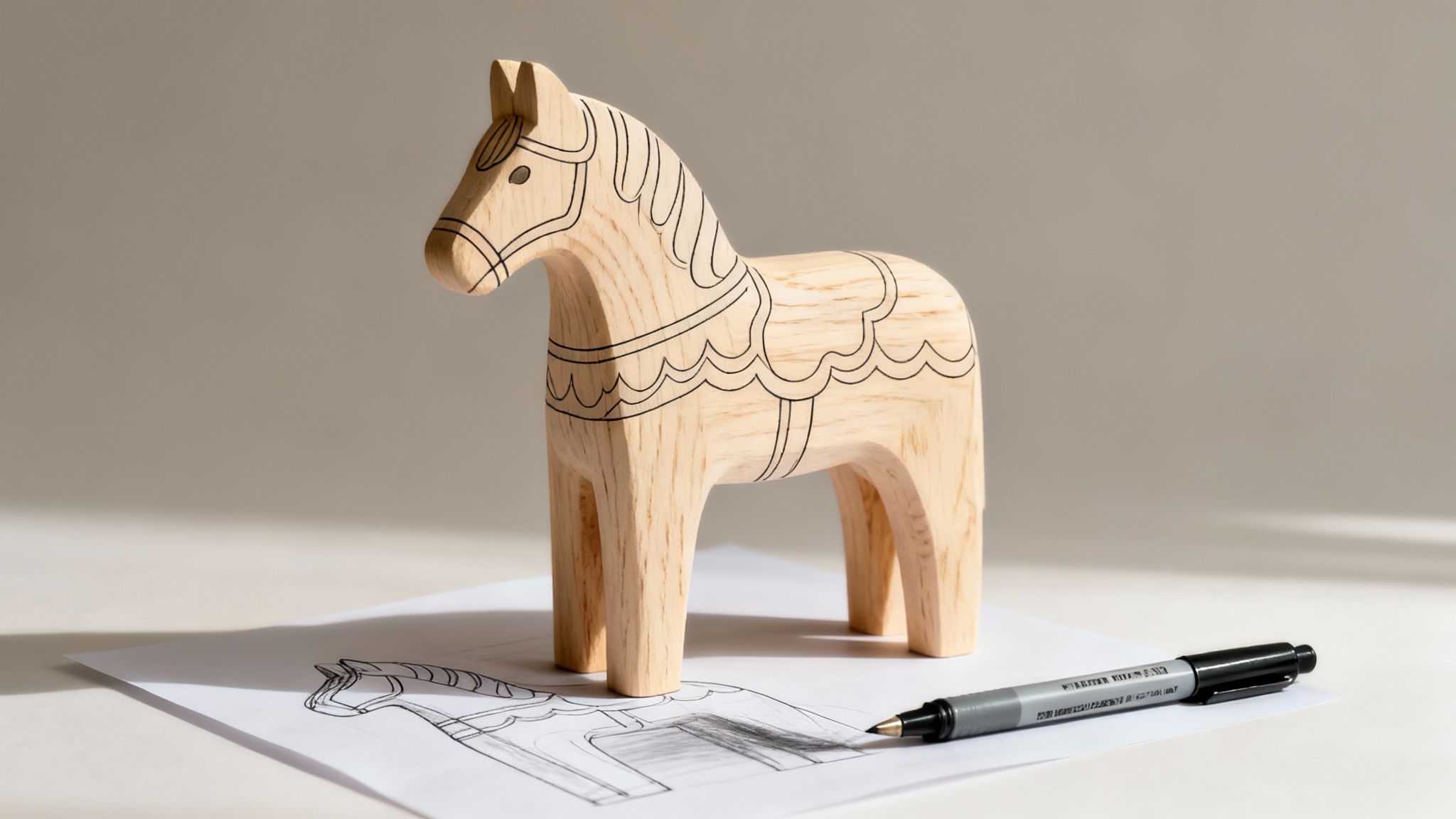
This is the magical part. Taking your one line art drawing from a flat piece of paper and bringing it to life on a three-dimensional object is where your design truly becomes a tangible piece of art. Applying that continuous line to a wooden Dala horse turns a simple sketch into your very own piece of folk art.
To get started, you’ll want a smooth, prepared surface. The natural grain in unpainted wood, especially soft woods like the pine often used for Dala horses, can make pen lines bleed. A quick, light sanding with fine-grit sandpaper (something around 220-grit) will create the perfect canvas for crisp, clean lines. Just be sure to wipe away any dust with a soft, dry cloth afterwards.
Getting your design from the paper to the wood accurately is the key to a great result. I've found a couple of dependable methods that work well, depending on the tools you have handy and the complexity of your art.
The right pen is crucial. You don't want your beautiful, fluid line feathering into the wood grain. The pens you used for paper probably won’t cut it here; you need something that can handle a more porous surface.
Your best bets are fine-tipped paint pens or permanent markers. Paint pens give you an opaque, consistent line that sits beautifully on top of the wood. Fine-tipped permanent markers are also excellent, but I always recommend doing a quick test on a hidden spot (like the bottom of a hoof) to check for bleeding before you commit to the final piece. Both will give you the control you need to recreate your one line art drawing with confidence.
The goal is to find a tool that flows as smoothly on wood as your original pen did on paper. That consistency is what maintains the unbroken, graceful motion that defines this art style.
This trend of applying minimalist art to everyday objects is part of a much bigger picture. In Southeast Asia, for instance, the appreciation for one-line art is part of a broader digital shift in the art world. While the global online fine art market hit $10.5 billion in 2024 (a 76% increase from pre-pandemic figures), regional platforms in SE Asia saw a massive 200% jump in sales for one-line pieces used in home decor. You can discover more about how Asia's art market is influencing global trends.
Once your design is on the wood, all that’s left is the satisfying process of tracing your path. Take your time, keep a steady hand, and watch as your unpainted DIY Dala horse comes to life with a single, elegant, and unbroken line.
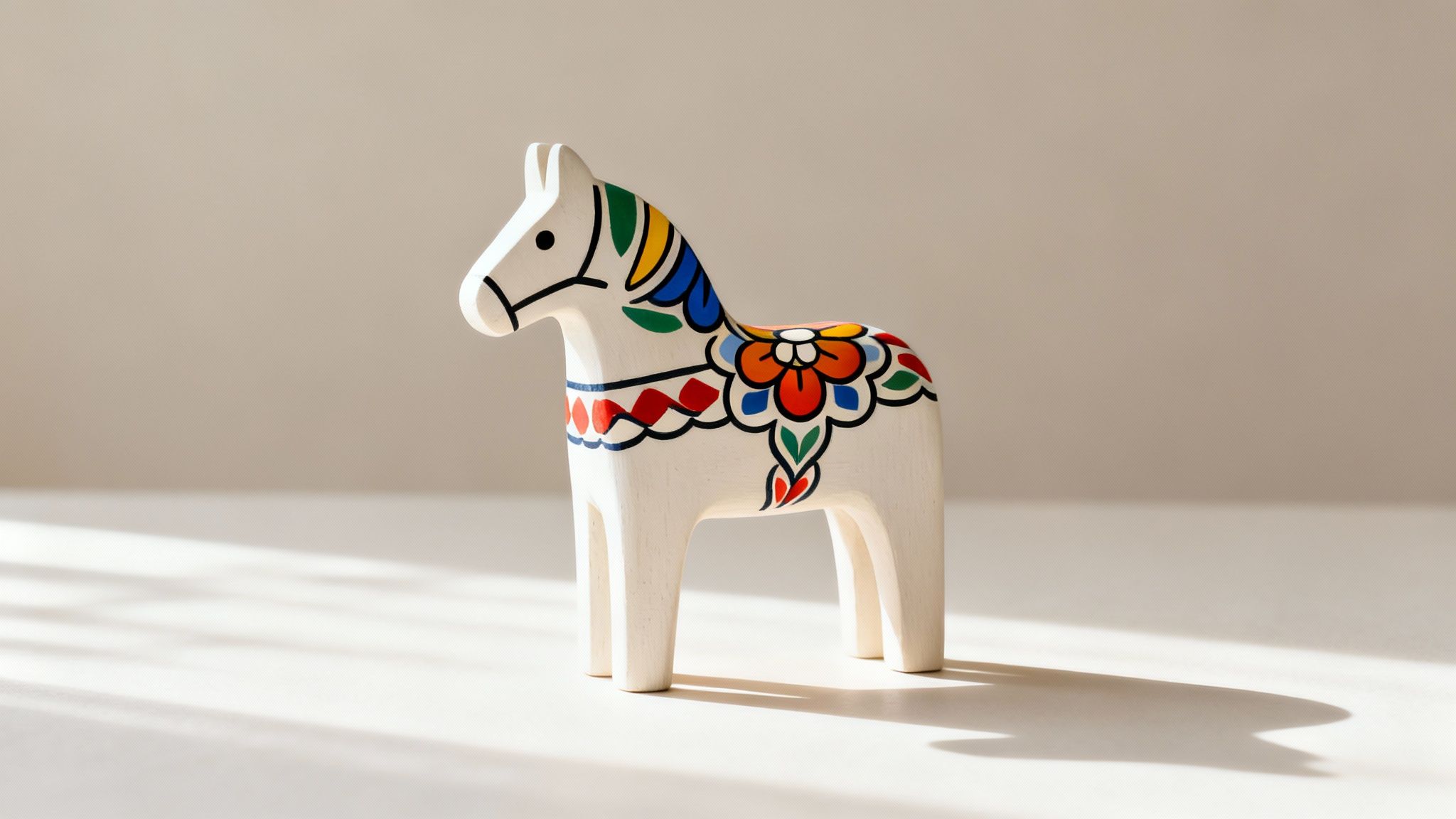
Now for the fun part. With your single, unbroken line transferred onto the wood, the real magic begins. This is where you get to infuse your piece with colour and character, turning a simple drawing into a truly personal work of art.
The key is to enhance the minimalist elegance of your one line art drawing, not overwhelm it. There are a few ways to go about this, and the path you choose will give your Dala horse its final personality.
One of my favourite techniques is to fill in sections of the design with bold, flat colours. This approach really honours the traditional Dala horse painting style and creates a fantastic contrast between the clean black outline and the vibrant colour patches. It’s a great way to give a classic folk art object a modern, graphic feel. For a little help mixing the perfect shades, check out our guide on using a color mixing chart.
If you’re after a more subtle finish, try applying thin washes of watercolour. This allows the beautiful wood grain to show through, adding a lovely depth and texture to the piece. It’s a method that works beautifully with the flowing nature of one line art, giving your creation a gentle, rustic charm.
Personal touches are what will make your Dala horse uniquely yours. You could draw inspiration from traditional Swedish folk art by adding simplified 'kurbits' patterns—those flowing, gourd-like floral designs you often see on Dala horses. Try weaving these motifs into the negative spaces of your drawing or letting them sprout organically from your main line.
Don't be afraid to add your own symbols or patterns. Whether it’s a simple geometric design or a motif that holds personal meaning, these are the details that tell your story.
This fusion of modern minimalism and traditional motifs is more than just a creative exercise; it’s part of a powerful global trend. In Southeast Asia's art scene, for example, the popularity of one line art has surged since 2020. Local artists have seen a staggering 150% increase in commissions for one-line pieces. This reflects a broader shift, with 44% of Christie's Asia bidders in 2024 being millennials or younger, who are often drawn to this blend of old and new.
This last step is crucial for making sure your creation lasts. Sealing your artwork protects it from dust, moisture, and the kind of fading that can happen over time.
This final touch not only protects your hard work but also gives your custom Dala horse a polished, professional look. Now your piece is ready to become a cherished keepsake or a thoughtful, handmade gift.
Of course. Here is the rewritten section, crafted to sound like it was written by an experienced human expert, following the specific style and tone of the provided examples.
As you start exploring the world of continuous line art, a few questions are bound to pop up. That’s perfectly natural. The technique looks simple, but there are a few common hurdles that everyone faces, from total beginners to seasoned artists. Let's tackle some of the most frequent ones so you can draw with more confidence.
The biggest worry I hear is about what to do when you accidentally lift your pen from the paper. It happens to all of us, so the first rule is: don't panic! You haven't ruined anything.
The real spirit of a one line art drawing is in the practice, the movement, and capturing the feeling of a subject—not achieving flawless perfection on the first try. Think of it as a learning moment that makes your next drawing even better.
Lifting your pen mid-drawing isn't a disaster, I promise. Don't let a small slip-up break your creative focus. You have two great options: you can either carefully place your pen right back where you left off and continue, or you can just embrace the tiny gap.
Honestly, these little imperfections often give a piece more character and make it uniquely yours. The whole point is to build muscle memory and get lost in the fluid motion, not chase some impossible idea of perfection.
Now this is where the real artistry of the one line technique comes in. It’s all about the art of simplification. Before your pen even touches the paper, take a moment to really look at your subject. Find its most essential lines—the contours that define its shape and personality.
For something like a Dala horse, that would be the iconic curve of its back and the proud arch of its neck. Start by focusing on capturing that overall silhouette. Once you get more comfortable, you can start experimenting by looping the line inward to hint at more detail, like the shape of an ear or the edge of a saddle, all without breaking that continuous flow. It’s like a creative puzzle that gets easier and more fun with practice.
Absolutely! In fact, I highly recommend this, especially when you're just starting out. Think of a light pencil sketch as a roadmap for your pen. It lets you plan the entire path of your line, figure out any tricky spots, and make changes without the pressure of permanent ink.
Once you’re happy with your pencil guide, you can go over it with your pen in one single, confident stroke. This approach takes all the pressure off, allowing you to focus purely on creating that smooth, flowing line you're after.
At Dalaart, we believe art is for everyone. Whether you're decorating a classic Dala horse or starting fresh with one of our DIY models, we provide authentic, handcrafted pieces to spark your creativity. Explore our collection and find your next project today at https://dalaart.com.


.svg)


.png)


