March 22, 2026
Welcome to the World of 3D Printed Miniatures
Step into an exciting world where digital artistry becomes a tangible reality. The idea of creating a detailed, physical object straight from a computer file might sound like science fiction, but it has quickly become an accessible and beloved hobby for people all over the world.
This process mirrors the same custom, creative spirit you find in traditional crafts, like hand-carved Dala horses. It’s not about replacing timeless skills, but rather expanding the artist’s toolkit with fascinating modern methods.
At its heart, a 3D printed miniature is the physical result of additive manufacturing on a small scale. Imagine building something with microscopic bricks, one layer at a time. The printer reads a digital blueprint—an STL file—and meticulously constructs the object from the ground up.
This technology has unlocked a new level of personalisation. You are no longer limited to what you can find in a shop. Instead, you have the power to create:
This very shift towards personalised creations is a major driver of the industry's growth. In South East Asia, the 3D printing market hit USD 983.3 million in 2024 and is projected to climb to an incredible USD 5,291.9 million by 2033. The demand for custom consumer goods, where miniatures are a key part, is what fuels this expansion. You can discover more on this market trend from the IMARC Group report.
The appeal of 3D printed miniatures lies in that beautiful fusion of technology and artistry. It gives creators complete control, from the initial digital design to the final painted model. It is a journey that marries digital skill with hands-on crafting.
For many, the ability to make miniatures at home that are almost—and in some cases, completely—indistinguishable from those bought in a store is a game-changer. What was once expensive industrial technology is now an affordable hobbyist tool.
This accessibility has nurtured a vibrant community of designers, painters, and collectors. Whether you want to print an army for a wargame, create a one-of-a-kind gift, or simply enjoy the process of bringing a digital design into the physical world, the possibilities are nearly endless.
When you first dip your toes into the world of 3D printed miniatures, you'll quickly find there are two main roads you can take. These are the two primary printing technologies, and understanding how they differ is the first step in getting the results you want. Think of it less as a competition and more like choosing the right tool for a specific job.
At its heart, the journey from a digital idea to a physical object you can hold is quite simple. The flowchart here gives you a bird's-eye view of the entire process.
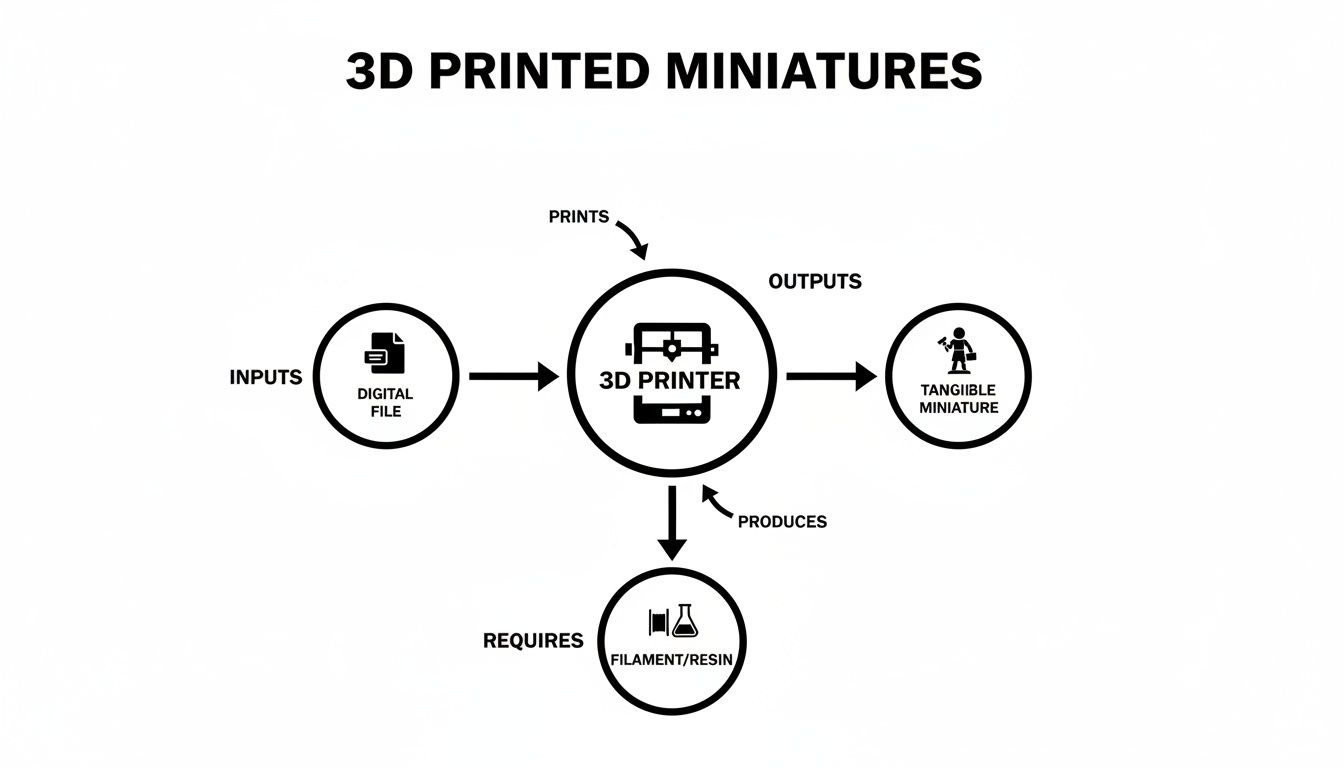
As you can see, every project starts as a digital file. That file is sent to a 3D printer, which then builds the final, tangible miniature. The real magic—and the big difference—is in how the printer actually builds that object.
The first technology is Fused Deposition Modeling (FDM). The easiest way to picture it is to imagine a tiny, incredibly precise, robotic hot glue gun. An FDM printer feeds a spool of solid plastic, called filament, through a heated nozzle to melt it.
It then draws your miniature one layer at a time, building it from the bottom up. This method is known for being incredibly robust and quite cost-effective, which is why it's such a popular starting point for so many people.
Because it works with sturdy plastics like PLA (Polylactic Acid), FDM printing really shines in a few key areas.
Of course, there's a trade-off. Because the printer draws the model line by line, FDM prints often have visible layer lines. These can sometimes hide the finest details, and while you can smooth them out later, it does require an extra step.
The second technology is Stereolithography (SLA), but you'll almost always hear it called resin printing. This method feels a bit more like alchemy than engineering. A resin printer has a vat of liquid photopolymer resin and a powerful UV light source.
The printer works by projecting slices of UV light onto the resin, curing the liquid into a solid layer. It essentially pulls the solid object right out of the liquid, one solidified slice at a time.
The undeniable advantage of resin printing is its ability to produce a truly astonishing level of detail. Since it cures an entire layer at once instead of drawing individual lines, it can capture textures, facial expressions, and tiny, intricate patterns that are simply out of reach for FDM printers.
This incredible precision makes resin the undisputed champion for creating character models. If you’re after a 3D printed miniature with lifelike features, delicate scrollwork on its armour, or the subtle texture of cloth, resin is the only way to go. The finish is exceptionally smooth, often with no visible layer lines at all, especially when using very thin layers like 0.02mm.
So, which one is for you? Choosing between FDM and resin really comes down to your priorities. There isn't a single "best" option—just the best option for the specific thing you want to create.
FDM Printers are ideal if you prioritise:
Resin Printers are the better choice if you value:
In the end, many hobbyists find they have a need for both. They might use an FDM printer for their sprawling dungeon tiles and a resin printer for the heroes and monsters that will bring it to life. By understanding the strengths of each, you can make a smart decision and start bringing your own 3D printed miniatures into the world.
Sooner or later, anyone drawn into the world of 3D printed miniatures faces a big decision. Do you dive in headfirst and buy your own printer, or do you stick to purchasing ready-made models from artists and sellers? There's no single correct path here; the best choice really boils down to your own goals, available time, and budget.
Think of it like deciding between a finished, hand-painted Dala horse and a blank, unpainted one you decorate yourself. One gives you an instant piece of art, while the other offers a rewarding creative journey from start to finish.
Choosing to print your own miniatures is incredibly empowering. It immediately shifts your role from a simple consumer to a creator, opening up a nearly endless catalogue of models right at your fingertips. With a home printer, the entire world of digital designs becomes your personal workshop.
The biggest draw is limitless customisation. You can tweak a design on the fly, scale a model up or down to fit your vision, and print the exact miniature you need for a project. Over time, the cost for each individual miniature drops to almost nothing, especially when you compare it to buying them one by one.
Of course, this path isn't without its own set of hurdles.
On the other hand, you can simply buy pre-made miniatures. This route gives you instant gratification and professional-grade quality without any of the technical headaches of printing. It's a fantastic way to get started or to add a few show-stopping hero pieces to your collection.
When you purchase from an independent artist or a small studio, you're also directly supporting the creative community. You get a perfectly printed and cleaned model that's ready for priming and painting, which saves you a huge amount of time and effort. Many sellers even offer painting services, delivering a display-ready piece right to your doorstep.
Choosing to buy pre-made is about valuing your time and the expertise of others. You get a guaranteed result and the satisfaction of knowing you are helping a small business or artist thrive in a growing industry.
The rise of specialised 3D printing businesses is proof of this demand. This trend is especially strong in the ASEAN region, where local firms have captured a commanding 40% market share. The sector has shot up by 30% in just two years, helped along by government initiatives to train professionals and support small businesses. You can read more about how Singapore firms are leading this charge.
Ultimately, deciding whether to print or buy is a deeply personal one. If you love tinkering, learning new tech, and having complete control over your creations, the DIY path is incredibly rewarding. It's like starting your own crafting adventure, much like painting a personal collection of mini Dala horses.
But if you’d rather spend your precious time painting and playing, or you want to guarantee top-tier quality for a special character, buying from a professional is a brilliant choice. It lets you focus on appreciating the final product, just like displaying an expertly crafted work of art in your home.
Many hobbyists find a happy medium and do both—printing their own rank-and-file models while buying unique characters from their favourite artists.
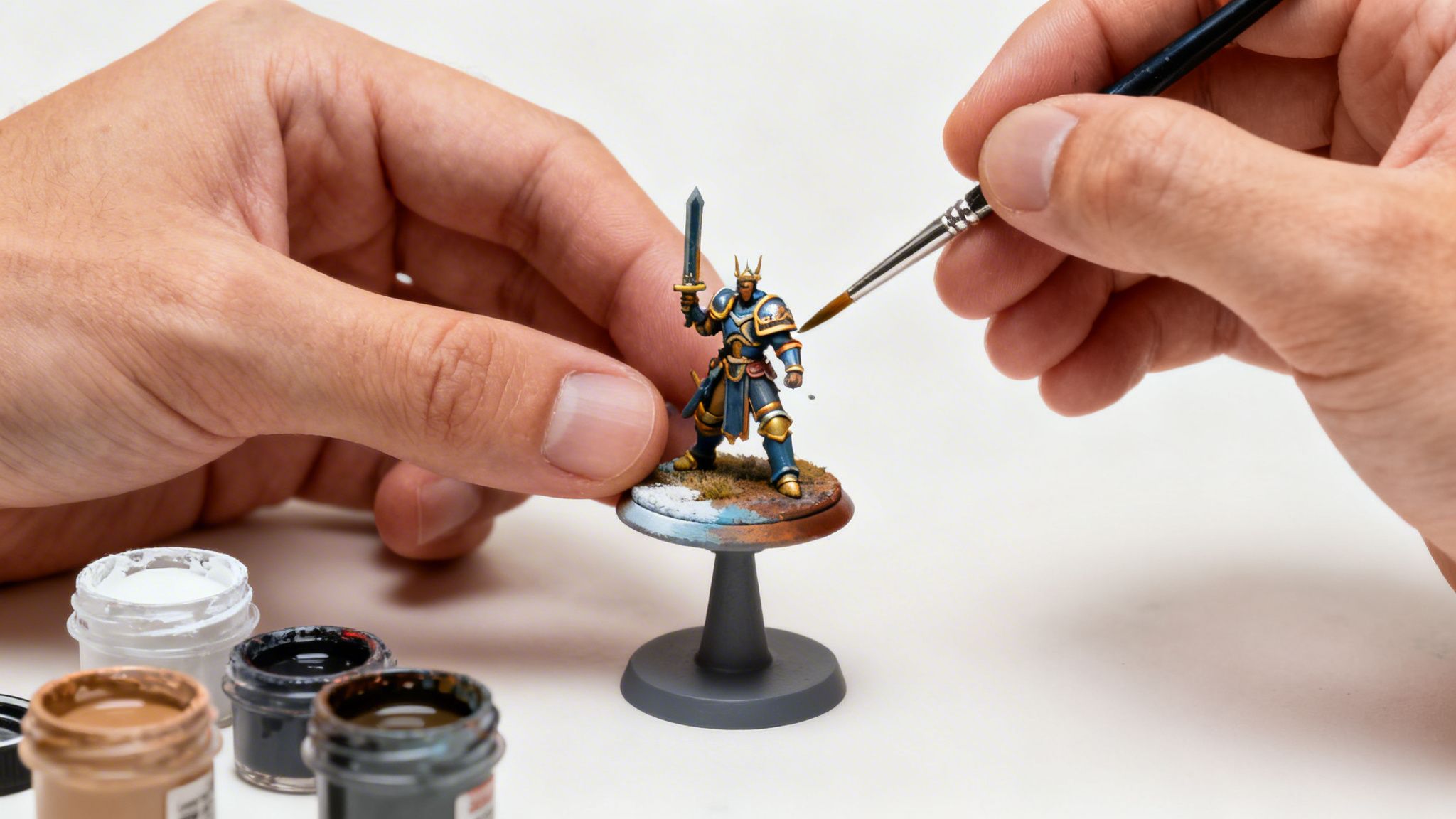
There's a special kind of magic in watching a miniature come off the print bed. But that raw print, whether plastic or resin, is really just the beginning of its story. Think of it as a blank canvas, brimming with potential.
Transforming that print into a piece you’d be proud to display involves a few crucial steps. This is where your personal touch truly shines through, much like how a hand-carved Dala horse only comes alive with its final, vibrant coat of paint.
Before you even think about picking up a paintbrush, a little bit of clean-up is in order. This stage is all about preparing the surface for paint, and it differs depending on whether you're working with an FDM or a resin print. The goal, however, is always the same: create the smoothest, cleanest foundation possible.
With FDM prints, the main job is smoothing out those visible layer lines. A gentle pass with fine-grit sandpaper can work wonders, but be careful not to sand away any of the tiny details you worked so hard to print. For more stubborn lines, a filler primer can also be a fantastic solution.
Resin prints need a different kind of care, with a big focus on safety. Here’s a simple look at the workflow:
Always wear nitrile gloves and safety glasses when handling uncured resin and cleaning fluids. Putting safety first is fundamental to the resin printing hobby, ensuring you can enjoy it for years to come.
With a clean, cured model in your hands, the real fun can start. Painting is what breathes character and personality into your 3d printed miniatures. And here’s a secret: even if you’ve never held a brush before, you can get amazing results with just a few basic techniques.
You don’t need to be a seasoned artist. In fact, many of the skills are surprisingly easy to pick up. Just like painting a traditional Dala horse is about layering colours to build depth, miniature painting follows the same core ideas. Mastering just a handful of concepts will take your models from simple prints to miniature masterpieces.
For a great primer on colour theory, our guide on creating a colour mixing chart can be a massive help when you're choosing a palette for your next project.
To get started, you only need a few supplies: some acrylic paints, a couple of small brushes, and a palette. From there, it’s all about applying the paint in a thoughtful, structured way.
When you place a 3D printed miniature next to a traditional, hand-carved piece like a Dala horse, it’s not about asking which one is better. It's about celebrating two beautiful, yet distinct, forms of artistry, each with its own soul and story. It’s a fascinating glimpse into how modern technology and timeless craft can live together in the same space.
A hand-carved wooden miniature carries the unmistakable touch of its creator. You can feel the artisan’s presence in every subtle curve and line—from a slight variation in shape to the unique way the wood grain peeks through the paint. These aren’t flaws; they are badges of character, making each piece a one-of-a-kind treasure that can never be perfectly replicated.
3D printing, on the other hand, offers something else entirely: absolute precision. It excels at flawless replication, capable of producing incredibly complex or delicate designs with a consistency that’s simply impossible to match by hand.
Imagine the intricate latticework on a tiny suit of armour or the perfectly symmetrical scales of a miniature dragon. This is where 3D printing truly comes into its own. It follows a digital blueprint with mathematical accuracy, ensuring every single copy is an exact match of the original design. This capability has become a major force in creative industries all over the world.
The core difference really lies in how they are made. One is born from subtraction, as a skilled hand carves away material to reveal the form within. The other is built through addition, as a precise machine brings a digital vision into reality, layer by layer.
This technological precision has completely changed production speeds for hobbyists and professionals. The impact is especially clear in the powerhouse ASEAN markets of Singapore, Thailand, and Malaysia, which together capture 80% of the regional market value. Here, the creation of 3D printed miniatures, from D&D figures to cultural replicas, has become up to 50% faster. You can explore more data on this incredible trend in AMFG's analysis of the APAC region.
Of course, this doesn't take away from the value of hand-craftsmanship; it just offers a different kind of value. The perfection of a 3D print appeals to collectors who seek incredible fidelity and detail, while the uniqueness of a hand-carved piece speaks to those who cherish artistry and human connection.
Today, any conversation about craftsmanship has to include sustainability. And in this area, we see both traditional and modern methods making positive contributions. It’s a common myth that one is automatically "greener" than the other.
Traditional crafts like Dala horse carving have long embraced eco-friendly practices. Many authentic pieces are carved from recycled or scrap wood sourced from local sawmills, giving a second life to materials that would otherwise be thrown away. The paints used are also often environmentally safe and non-toxic.
At the same time, the world of 3D printing is rapidly advancing its material science with sustainability as a key focus. While the earliest materials were petroleum-based, the industry has made a significant shift.
Ultimately, both approaches show a commitment to mindful creation. The choice between the "imperfect" charm of a hand-carved figure and the "perfect" detail of a 3D printed miniature is simply a matter of personal taste. A modern collection has plenty of room for both, celebrating the full spectrum of artistry from centuries-old tradition to cutting-edge technology.
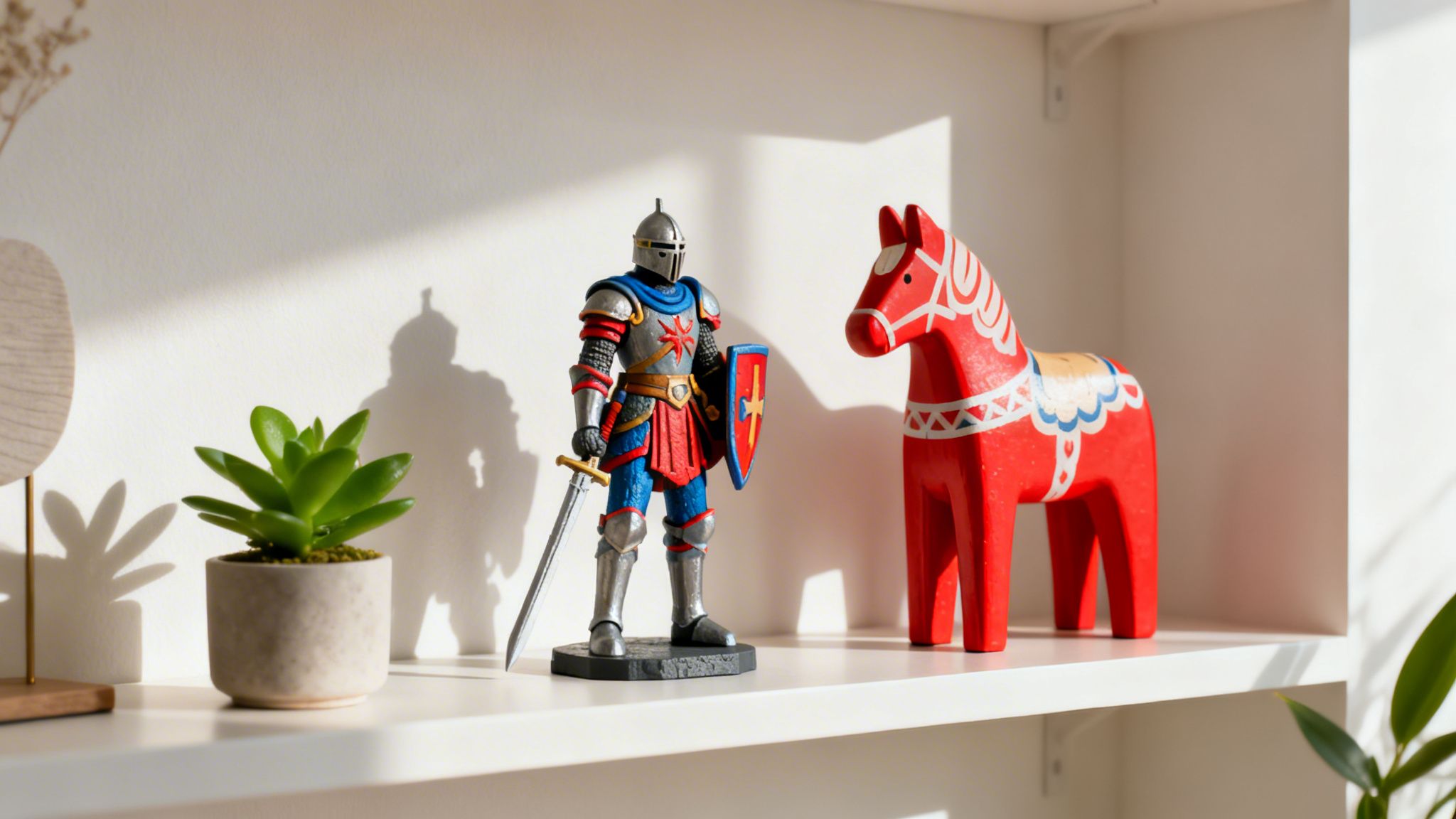
Your collection of 3d printed miniatures deserves a place beyond the gaming table or a collector’s case. Each piece is a small work of art, a unique accent ready to inject personality and a touch of the modern into any room. By thoughtfully mixing them with traditional decor, you can curate compelling visual stories that are entirely your own.
The secret is to think less about simply placing objects on a shelf and more about creating small, intentional scenes. It's about sparking a dialogue between the old and the new, proving that timeless tradition and modern technology can coexist beautifully in your home.
One of the most powerful ways to display your miniatures is to use them to tell a story. Try pairing objects that share a theme, even if their styles are centuries apart. This simple act of juxtaposition can add layers of depth to your decor and make for a wonderful conversation piece.
For instance, picture a meticulously detailed, 3D printed fantasy knight standing beside a classic, hand-carved Dala horse. This pairing immediately bridges the gap between ancient folklore and modern fantasy, creating a display that feels both nostalgic and fresh. The two figures, though born of different eras, speak a common language of heroism and legend.
The most interesting home decor tells a personal story. By mixing your hobbies and your heritage—like a futuristic sci-fi scout alongside a vintage family photo—you create a space that is authentically and uniquely you.
These small vignettes transform a simple bookshelf or mantelpiece into a miniature gallery of your passions. Another wonderful idea is to build a themed display; a collection of tiny, intricate houses could create a fascinating street scene right on your shelf. Our article on crafting a magical book nook offers more inspiration you can easily adapt for your miniatures.
To ensure your 3d printed miniatures feel right at home amongst your other decor, it helps to keep a few design principles in mind. Scale and colour are your two best friends for creating a display that looks deliberate and balanced, not cluttered.
Ultimately, arranging these pieces in your home is a wonderful act of creative expression. Don't be afraid to play, to move things around, and to discover what combinations bring you the most joy. Your home should reflect your story, and these modern marvels offer a fantastic new way to tell it.
When you first step into the creative world of 3d printed miniatures, it's only natural to have a few questions bubble up. It's a fascinating hobby where modern technology and pure artistry meet, and getting a handle on a few key details will make your journey that much smoother right from the start.
One of the first things newcomers wonder about is durability. Are these little figures going to shatter the first time they're used in a game? While it's true that early resins could be quite brittle, the materials we have today are a world apart. Many standard resins are now more than tough enough for regular tabletop handling.
Another question that comes up a lot is where to find all the incredible digital designs. The community around 3d printed miniatures is wonderfully vast and generous. You can discover thousands of top-notch files, both free and for purchase, on platforms like MyMiniFactory or by supporting artists directly through Patreon. Many designers even offer pre-supported files, which takes a huge amount of the guesswork out of the printing process for you.
Safety is, quite rightly, a frequent and important topic of conversation, especially when it comes to resin printing. The main thing to remember is that uncured liquid resin and its cleaning agents need to be handled with care. Always work in a well-ventilated space, and make sure you're wearing nitrile gloves and eye protection. This keeps the process safe, simple, and enjoyable.
People also ask if 3d printed miniatures are safe for children. Once a resin print has been thoroughly washed and properly cured under UV light, it becomes completely inert and is perfectly safe to handle. That said, because of their small size and potentially delicate parts, they aren't a good choice for very young children as they can be a choking hazard.
Ultimately, with just a little bit of know-how, anyone can dive into this hobby with confidence. By understanding the materials, knowing where to find fantastic designs, and following a few simple safety rules, you can unlock a world of endless creativity and bring any character you can imagine to life.
At Dalaart, we celebrate the blend of modern creativity and timeless tradition. Discover our collection of authentic, hand-crafted Swedish Dala horses and let artistry inspire you. https://dalaart.com


.svg)


.png)


