May 11, 2026
A woodcarver in Dalarna once showed me a small horse with an unusual mark on its flank. It wasn't there for decoration alone. It was there, he said, to make the piece feel guarded.
The helm of awe, also known by its Old Norse name Ægishjálmur, is one of those symbols that stops people in their tracks. Its radiating form feels ordered, forceful, almost watchful. Even before you know its history, you can sense why people have long linked it with protection, courage, and the ability to face danger without flinching.

Many readers first meet the symbol on jewellery, tattoos, or carved wooden decor. That's often where confusion begins. Is it a Viking battle sign, an Icelandic magical stave, a literary image from the sagas, or a modern design adapted for craft? The honest answer is that it carries all of those layers, but not all from the same moment in history.
That's what makes the helm of awe so fascinating. It didn't stay locked in one time or one medium. It appears in mythic language, in protective inscriptions, in later books of magic, and now in Scandinavian craft traditions that give old symbols new life through wood, paint, and careful handwork.
The symbol matters not only because of what it once meant to warriors, but because it still gives makers a language for strength, steadiness, and intention.
For collectors of Swedish folk art, the helm of awe opens an especially rich path. It can be studied as a historical symbol, but it can also be approached as a living motif that sits surprisingly well beside carved horses, painted kurbits flourishes, and the warm surfaces of traditional wooden objects. Used thoughtfully, it becomes more than an ornament. It becomes a bridge between Norse imagination and Swedish folk artistry.
The history of the helm of awe becomes clearer when we separate literary evidence, physical evidence, and later magical tradition. People often blend these together, but they come from different moments and tell us different things.
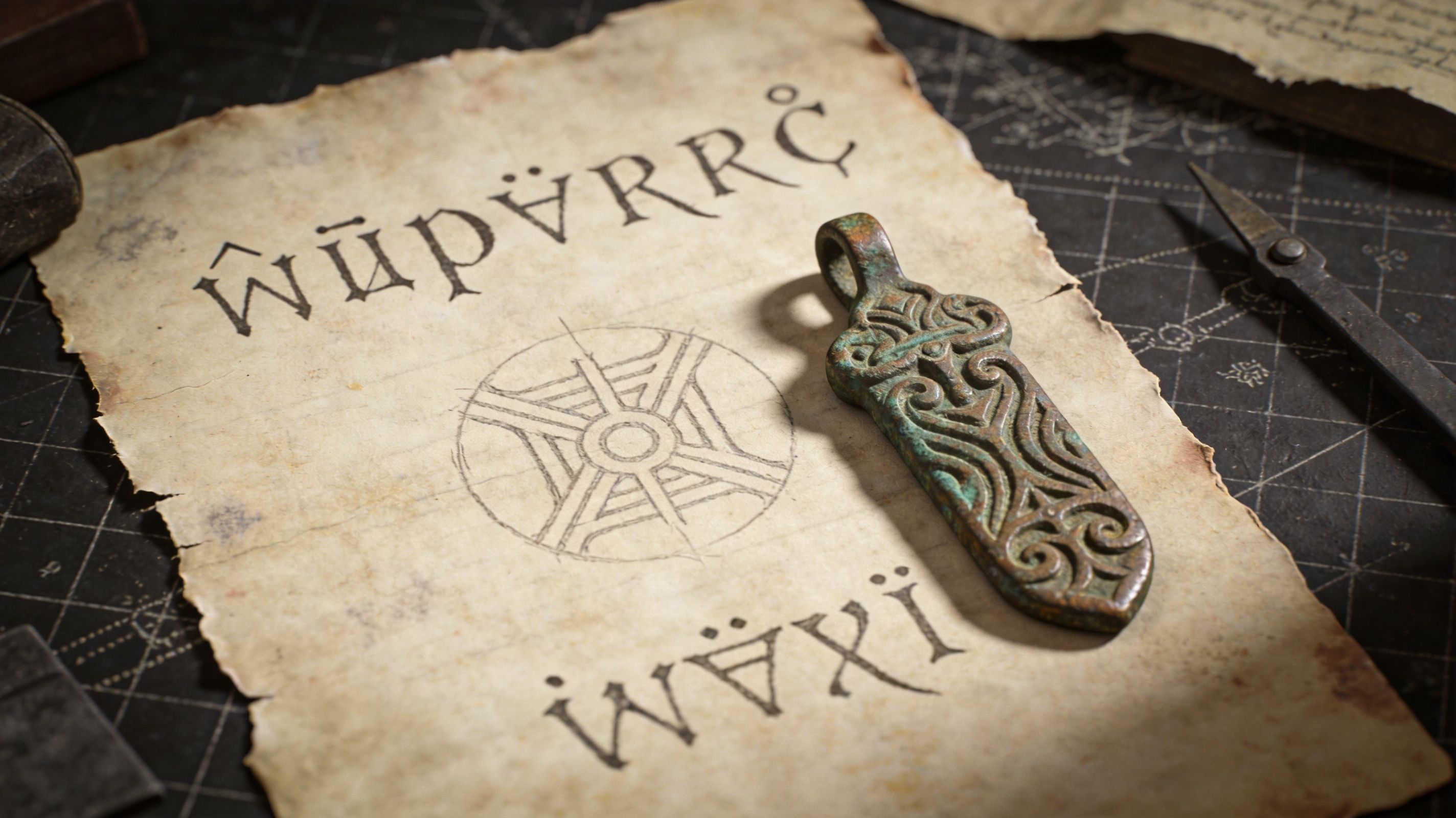
The term Ægishjálmr comes from Old Norse ǿgishjalmr. Its first literary attestation appears in the Poetic Edda manuscript Codex Regius, compiled around 1270 CE from oral traditions dating to 800 to 1200 CE, specifically in Fáfnismál stanza 16, where the dragon Fáfnir boasts of bearing the øgishjalm atop his treasure hoard before Sigurd kills him. According to World History's note on the helm of awe, this is the symbol's only explicit reference across the 29 surviving Eddic poems, and only 12% of those poems detail magical artefacts.
The word itself helps explain the symbol's emotional force. The first element suggests awe, terror, or reverent fear. The second means helmet or protective covering. So even at the level of language, this isn't just about a physical object. It's about protection wrapped in psychological power.
If you enjoy tracing mythic terms back into their literary roots, a good companion read is this guide to a Norse mythology book, which helps place symbols like this inside the wider story world they came from.
The earliest documented historical mention of the helm of awe appears in a runic inscription on the Viking Age monument known as the Aegis Stone from the churchyard of St. Paul's in London, dated between 958 and 1020 CE based on paleographic and contextual analysis. The inscription explicitly translates to “Aegyshjalmr is [this] helmet's name; repels one and all harm”, according to the documented summary in this study discussion of the Aegis Stone.
That matters for two reasons.
The same source notes that this stone is one of only approximately 300 surviving runic stones from the Viking diaspora in England, with fewer than 10% featuring overt magical or protective symbolism. It also observes that while Scandinavia yields over 3,000 runic inscriptions from 800 to 1100 CE, none predate this English example for the Ægishjálmur.
The symbol didn't disappear when the Viking Age ended. The same World History entry notes its alignment with the 17th-century Galdrabók, which contains 47 spells, and in the 41st spell prescribes forging the stave in lead for inscription on the forehead. That shows a later magical afterlife for the symbol in Christian-era Scandinavia and Iceland.
Historical continuity doesn't always mean an unbroken line of identical use. It often means an idea survives by changing form.
That pattern is important for Swedish folk art. Old protective motifs often survive not as exact replicas of ancient artefacts, but as adapted marks carried forward into new materials, new households, and new kinds of making.
A symbol this memorable lasts because it works on more than one level. The helm of awe doesn't just say “protect me.” It also says “stand back.”
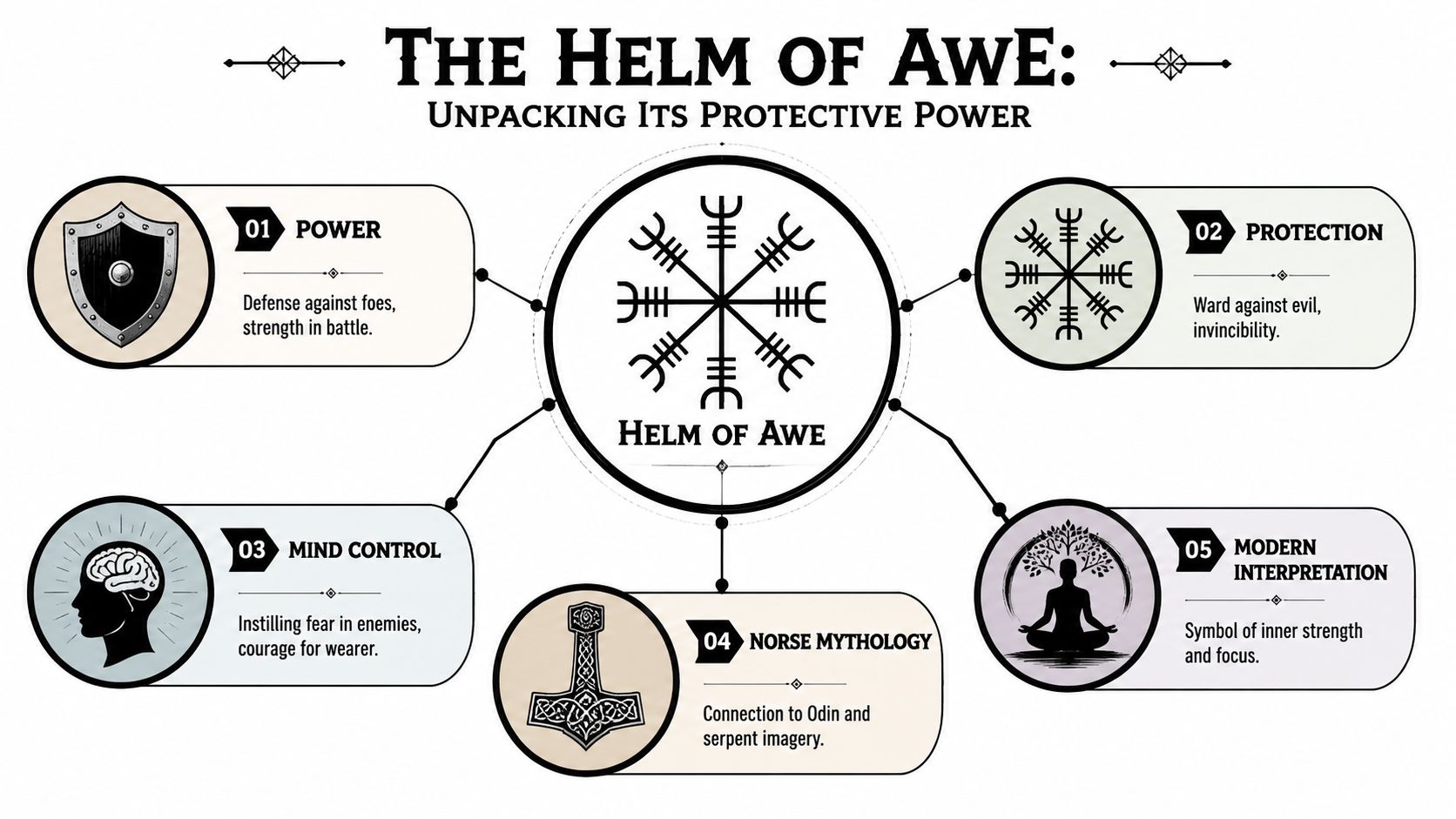
In modern English, awe often sounds soft, spiritual, even peaceful. In the old Norse context, the feeling is sharper. It includes dread, force, intimidation, and the kind of reverent fear that makes a person stop where they stand. That's why “helm of awe” can also be understood as a helm of terror.
This double meaning matters. The symbol protects the bearer, but it also unsettles the opponent. Its power is inward and outward at the same time.
Practical reading: Think of the helm of awe as a sign of defended presence. It doesn't hide weakness. It projects steadiness.
Visually, the helm of awe is built around a centre with arms radiating outward. Many people read those arms as protection in all directions. That interpretation makes intuitive sense, especially in the context of a symbol meant to repel harm.
A more technical reading appears in a claim linked from a product page discussing Swedish archaeological context. It describes an 11th-century runestone in Uppland, designated U 1121 and dated to about 1050 CE, where the inscription “ægišhjalmr” explicitly invokes the symbol to “repel harm”. The same write-up says that phrase appears on 17 analogous SE stones. It also describes the symbol's eight-triskelion arms, each with a radial length of 8 to 12 cm and carving depth of 2 to 3 mm.
That same source goes much further and makes several strong modern claims about battlefield efficacy and auction value. Because those claims come through a commercial product page rather than a clearly established primary museum or academic publication, it's best to treat them cautiously. What we can safely take from the material is the enduring association between the symbol, radial symmetry, and formulas of warding.
For most readers, the clearest way to understand the helm of awe is to hold three ideas together:
Protective intent
The symbol is repeatedly linked with warding off harm.
Psychological force
Its very name suggests fear, gravity, and commanding presence.
Focused centre
The radiating structure implies order under pressure, not chaos.
That combination helps explain why the symbol still speaks to modern makers. It isn't just ancient. It feels usable. It gives visual form to a very human wish: to remain centred while the world presses in.
Today, the helm of awe appears almost everywhere Norse visual culture appears. You'll see it engraved on pendants, inked into shoulder pieces, burned into leather, painted on shields, and worked into home decor. Some people choose it because of ancestry. Others are drawn to its geometry. Many feel that it carries a steadier emotional weight than a decorative motif with no story behind it.
The modern appeal is easy to understand. The symbol looks formal and ancient, but it also feels personal. A tattoo wearer might read it as a mark of resilience. A jeweller might treat it as a protective charm. A woodworker might see a perfect radial design for a circular plaque or carved panel. The same symbol can travel across all those settings without losing its core identity.
One of the most interesting recent developments is the shift from passive consumption to hands-on craft. According to a trend summary on helm of awe interest, Swedish e-commerce platform data from Etsy Sweden and Tradera in Q2 2025 showed a 42% increase in sales of “Helm of Awe stencil” and “Aegishjalmur wood carving kit” in the Stockholm-Uppsala region. The same summary states that a 2025 National Museum of Stockholm exhibit called “Rune Revival in Modern Slöjd” drew 150,000 visitors and boosted online searches by 67%.
That shift tells us something important. People don't just want to wear the symbol. They want to work with it.
The same source says Statistics Sweden recorded 15,200 new registrations for folk art workshops in Dalarna and Gävleborg counties from May 2025 to May 2026, with 22% specifying Norse symbols for home decor. It also notes that hobbyists are increasingly placing such symbols on eco-friendly Dala animal figures, including moose and other carved forms.
If you're interested in the broader Scandinavian cultural background behind this revival, this piece on Sons of Odin in Sverige offers a useful cultural lens.
The symbol's revival in making circles isn't hard to explain.
Commercial jewellery gave the helm of awe a modern audience. DIY culture is giving it a new home in living folk practice.
Using the helm of awe well starts with understanding what kind of symbol it is. It isn't a random Viking-looking ornament, and it isn't an empty pattern available for any meaning at all. It comes from a real cultural world shaped by myth, language, protective practice, and later folk magic.
Respect doesn't mean fear. It means attention.
If you paint or carve the symbol onto an object, know at least the basics of its background. Understand that it's associated with protection, awe, and warding. Know that the surviving evidence comes through a mix of literary references, runic material, and later magical tradition.
That knowledge changes the way you use it. A symbol applied with care carries a different feeling than one copied because it looked dramatic on social media.
Don't treat old symbols as a shortcut to depth. Depth comes from knowing what you're handling.
The helm of awe has sacred and spiritual meaning for some modern practitioners of Norse-inspired belief. Even if you approach it as an art motif rather than a religious sign, it's wise to avoid trivial uses that turn it into a joke, a gimmick, or an aggressive costume prop stripped of context.
A respectful use often has these qualities:
Many Norse symbols have been misused by extremist groups in modern times. The helm of awe itself is not a hate symbol, but that doesn't mean context is irrelevant. If you share or sell work using it, present it clearly as part of Scandinavian history, folk art, and protective symbolism. Don't leave room for confusion through careless styling or inflammatory language.
Respectful use is not about gatekeeping who may appreciate the symbol. It's about making sure appreciation is rooted in knowledge, not flattening. When people understand the helm of awe, they usually use it more beautifully.
For Swedish folk art lovers, the helm of awe becomes especially exciting. It isn't only a subject for study. It can become part of a making practice grounded in wood, paint, rhythm, and surface.

A lot of people assume this combination is too modern to feel authentic. In fact, there is already a documented cultural shift in that direction. A 2024 survey by the Swedish Handicraft Association reported that 28% of artisans in Dalarna had incorporated Norse symbols like Ægishjálmr into hand-carved wooden pieces, blending them with traditional Dala horse motifs for protective talismans, as summarised in this discussion of modern Swedish handicraft trends. The same summary notes a 35% rise in demand for “Norse-inspired folk art” in tourism data from Visit Dalarna.
That matters because it confirms something many collectors already feel. This isn't a forced mash-up. It's becoming part of a living craft language.
Placement changes everything. The helm of awe is a structured sign, so it needs a surface that gives it room to breathe.
The most successful placements tend to be:
Avoid forcing it into narrow legs or highly curved edges where the geometry will distort. The symbol needs symmetry to keep its visual authority.
Traditional Dala painting often relies on flowing florals, leaf forms, and rhythmic brushwork. The helm of awe is more angular and centred. The trick is not to make one imitate the other. Let each keep its character.
A simple approach works well:
If you want help with Swedish craft vocabulary while planning your motifs, this Swedish English lexicon is handy for decoding common terms used in folk art and heritage discussions.
A good Dala design doesn't hide the symbol inside decoration. It gives the symbol a home, then lets the surrounding ornament support it.
Colour is where many projects go wrong. Crafters either make the helm of awe too harsh, or they soften it so much that it disappears.
Try thinking in layers instead of contrasts.
The goal isn't to make the horse look ancient. It's to make it feel rooted.
Here's a visual reference point for carved work before painting:
If you're making your own piece, start modestly. You don't need a highly complex composition for the symbol to feel meaningful.
Try this sequence:
Some makers also prefer using the helm of awe on companion animals like moose or bears rather than the horse itself. That can work beautifully, especially when the form of the animal suggests watchfulness or strength. The key is always the same. The symbol should look placed, not pasted on.
The helm of awe has travelled a remarkable path. It appears in old Norse language, in a powerful literary image connected to Fáfnir, in documented protective inscription, in later magical tradition, and now in the hands of modern makers who work in wood and paint rather than stone and metal.
That long life is part of its beauty. The symbol has never belonged to only one exact moment. It has kept being re-read, re-made, and re-situated by people looking for ways to express protection, courage, and presence. Some wear it. Some carve it. Some place it carefully on a Dala horse so that an old protective sign can live inside a familiar Swedish form.
For collectors, that makes the symbol more than visually striking. It becomes a clue to continuity. For crafters, it offers a disciplined design language with emotional depth. For heritage enthusiasts, it reminds us that Scandinavian tradition isn't static. It survives because people keep making with it.
The strongest folk symbols endure because they can move across centuries without losing their centre.
The helm of awe still speaks because the need behind it is still recognisable. People still want steadiness. They still want beauty with meaning. They still want objects that do more than fill space. In that sense, this old mark remains exactly what it has long been. A sign of strength, held close.
If you'd like to explore authentic Swedish folk art shaped by that same respect for heritage, Dalaart offers hand-carved and hand-painted Dala horses and companion animals made in Dalarna, including classic collector pieces, vintage finds, and DIY models for your own creative work.


.svg)


.png)


