May 27, 2026
A true vintage wedding ring is generally 20 to 100 years old, while an antique ring is 100+ years old. The catch is that sellers don't always use those words the same way, and some trade specialists also use 50+ years as the practical threshold for vintage, so asking exactly when the ring was made matters from the start.
You're probably here because a brand-new ring feels a little too polished, a little too standard, or not personal enough. You want something with character. Something that doesn't look as if it came from the same tray as a hundred others. That instinct makes sense. A vintage ring isn't just older jewellery. It's a small object that has survived fashion changes, daily wear, repairs, resizing, and family histories.
That's why the best wedding ring vintage search isn't really about age alone. It's about story, workmanship, and the feeling that a piece has a life before it reaches your hand. Some rings carry the crisp geometry of the interwar years. Others show hand-cut details, softened edges, and a patina that only time can make. When you find the right one, you're not buying “used”. You're becoming the next keeper of a piece of design history.
A friend once described her ring search to me this way: every modern display case looked immaculate, but none of it felt memorable. Then she tried on a slim older band with tiny hand-worked detail along the edge. It wasn't louder. It wasn't larger. It had presence.
That's the heart of vintage jewellery. A good vintage wedding ring doesn't ask you to admire perfection. It asks you to notice evidence of a maker's hand. You see engraving that isn't mechanically uniform. You notice proportions that feel slightly different from modern mass-market styling. You start wondering who chose it first, what clothes they wore, what promises they made.
For many buyers, that emotional response comes before any technical knowledge. They don't begin by saying, “I want a ring from a specific era.” They begin by saying, “I want something with soul.” That's a sensible place to start.
A vintage ring often feels less like a product and more like an inheritance you happened to find.
There's also pleasure in the hunt. Looking for a period ring has the same appeal as searching for a beautifully made old object in any collecting field. You learn to compare line, craftsmanship, wear, and rarity. If you enjoy objects with maker marks, regional tradition, and hand-finished detail, you may recognise the same collector's instinct in handcrafted folk art and small-scale hand-finished treasures.
Two rings can look similar across a counter. One may be a modern ring made to resemble an older design. The other may be a genuine period piece that has already lived through decades of fashion and family history. Visually, both may be attractive. Emotionally, they are not the same object.
When buyers talk about wanting authenticity, they're often talking about more than materials. They want continuity. A real vintage ring connects them to a specific design moment and to the people who wore jewellery differently from us. That's why provenance, period workmanship, and original details matter so much.
People who fall in love with vintage rings usually care about at least one of these things:
That combination is powerful. It turns ring shopping into collecting, and collecting into caretaking.
The first question to ask is simple: Is this ring old, or is it only made to look old? That single distinction clears up a huge amount of confusion.
One jewellery reference defines a vintage ring as 20 to 100 years old, while antique begins at 100+ years. Another common trade benchmark treats pieces made 50+ years ago as vintage and 100+ years as antique. The inconsistency is real, and it's exactly why many buyers get mixed answers when they ask what “vintage” means. The clearest discussion of that definitional gap appears in this explanation of how old a ring must be to count as vintage.
Use this practical framework when you shop:
That third category causes most of the trouble. A vintage-style ring can be lovely, well made, and worth buying. But it isn't the same as a ring that was made during the period it references.
Some sellers use “vintage” as a style word because it sounds romantic and desirable. They may mean “old-fashioned in appearance” rather than “made decades ago”. Others use “estate” to mean pre-owned, which also doesn't automatically mean vintage. A recently made second-hand ring is estate jewellery, but not necessarily vintage.
Practical rule: Never rely on the label alone. Ask for the estimated production period, not just the selling category.
That question changes the whole conversation. If the seller says, “It's vintage inspired,” you know you're dealing with a modern interpretation. If they say, “We date it to the mid-century period,” you can begin asking what evidence supports that dating.
This isn't just academic language. Age affects value, restoration decisions, and expectations around construction. A true period ring may show handmade techniques, old repairs, or wear patterns that are normal for its age. A modern reproduction won't tell the same story, even if the silhouette looks similar.
For buyers who care about history, the point isn't to chase a label for prestige. It's to know what object you're bringing into your life. If you want a piece of the past, the ring must belong to the past, not only imitate it.
The pleasure of shopping vintage grows when you start recognising eras by eye. Rings stop looking like a blur of “old jewellery” and begin to reveal their own design language.
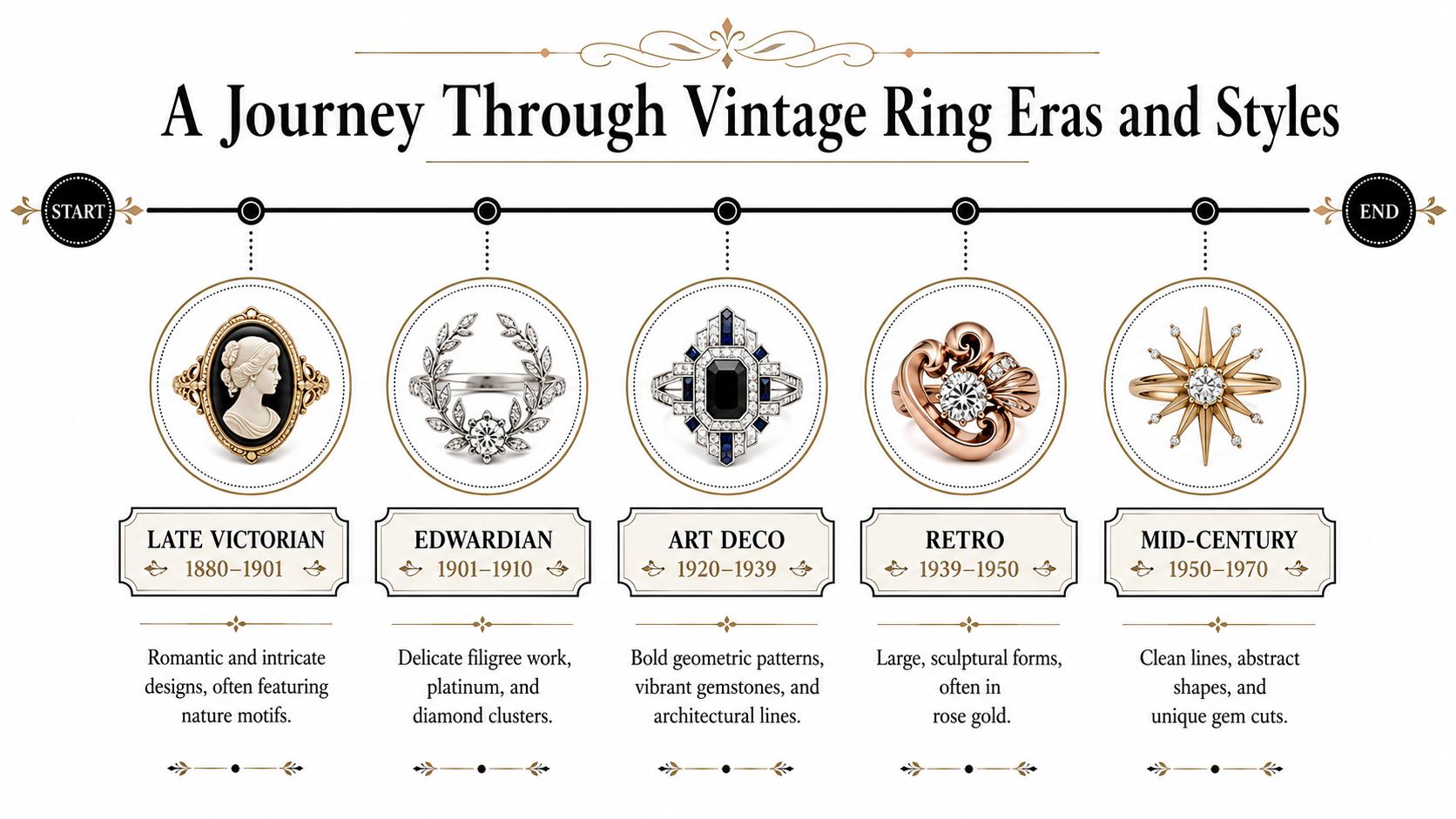
Late nineteenth-century and early twentieth-century rings often feel lyrical. You'll see nature motifs, scrollwork, flowers, leaves, and softly flowing lines. These pieces can look intimate and handcrafted, as if they were made for close looking rather than instant sparkle across a room.
Edwardian pieces often move toward delicacy. They're known for lightness, lace-like metalwork, and refined detail. The overall mood is graceful rather than bold. If you love intricate openwork and airy settings, this period often wins people over quickly.
Then the mood changes. Art Deco rings are architectural. They favour symmetry, clean line, crisp geometry, and strong visual contrast. Even when small, they look intentional and structured. This is the era many people recognise immediately, because it still feels sharp today.
That period also sits inside a larger historical shift in engagement ring taste. The share of U.S. brides receiving diamond engagement rings rose from 10% in 1939 to 80% in 1990, and vintage rings made before that diamond standardisation became dominant preserve an earlier world of more varied gemstone taste, as discussed in JCK's history of the wedding industry.
That's one reason pre-1990 rings can feel so compelling. They aren't just older. They come from a time when bridal style had not yet narrowed so strongly around one dominant look.
Retro rings often feel bolder and more sculptural. You may see fuller forms, dramatic curves, and a glamour that reads almost cinematic. These rings can have real presence on the hand. They don't whisper.
Mid-century designs tend to simplify again. Some move toward sleeker lines, abstract motifs, and cleaner profiles. If Deco feels composed and Retro feels theatrical, mid-century often feels edited.
For buyers who also care about the broader vintage aesthetic, vintage wedding dress styling can be a useful companion reference, because dress silhouettes and jewellery proportions often speak the same visual language.
If you're not sure where you belong, stop asking what era is “best” and ask what kind of presence you want.
Some people choose a vintage ring because it looks unusual. The happiest buyers usually choose one because it looks like them.
That difference matters. You're not selecting a museum specimen. You're choosing a ring to wear, notice, and live with.
The fastest way to become a smarter buyer is to stop looking only at the face of the ring and start looking inside the band, under the gallery, and along the edges. A ring tells its story in small clues.
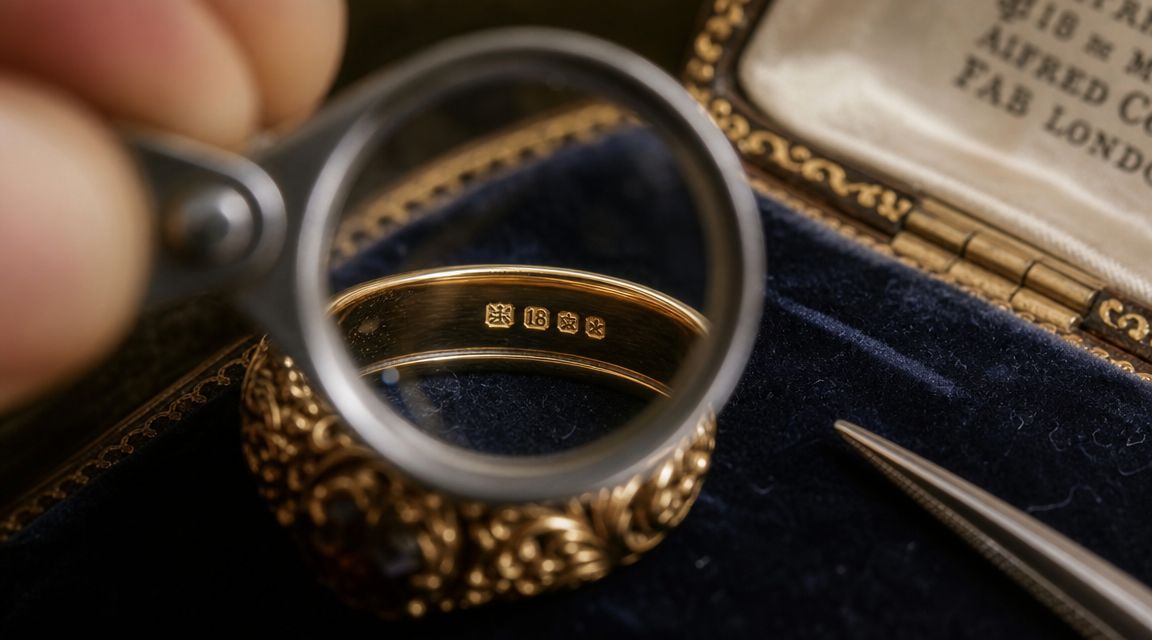
In jewellery trade usage, an antique ring is at least 100 years old, while a vintage ring is typically 20 to 100 years old. That dating matters because it helps distinguish earlier handcrafted rings from later mass-market styles, especially as platinum, white-metal settings, and synthetic gemstones became more common in the early twentieth century, as outlined in this history of vintage engagement rings.
Metal choice can hint at period, though it never works as proof on its own. Platinum and white metals became more common in the early twentieth century. That matters because certain airy, delicate settings depended on metals that could hold fine detail while supporting stones securely.
Yellow gold can appear across many periods, so context matters. A yellow gold ring with bold volume may suggest one era, while a finely engraved yellow gold band may suggest another. The metal is one clue among several.
Look for stamps such as purity marks and abbreviated metal designations. These may tell you what the ring is made from, but they don't automatically tell you when it was made. A hallmark is evidence, not a complete biography.
Hallmarks, maker's marks, and other interior stamps are often the closest thing a ring has to a birth record. They may indicate metal fineness, manufacturer, or assay information. Sometimes they help date a piece more closely. Other times, they narrow the possibilities.
Use them like a detective would use a note found in a drawer. Valuable, yes. Final proof, no.
Look carefully at:
A short visual guide can help train your eye before you inspect pieces in person.
The ring's construction often speaks just as loudly as its stamps. Hand-sawn details, hand-engraving, and hand-set stones can point toward earlier methods. By contrast, a ring with very uniform machine-like surfaces may be later or newly made in an old style.
When a hallmark and the construction tell the same story, confidence grows. When they don't, slow down and ask more questions.
Authenticating a vintage ring is less about finding one magic sign and more about building a convincing case. Think like a historian. One clue is interesting. Several clues that agree with each other are persuasive.
In the Swedish jewellery market, trade and auction specialists often classify rings made 50+ years ago as vintage, while 100+ years old is generally treated as antique. That distinction matters because it affects valuation and the construction methods you should expect to see, including more common use of hand-sawed, hand-engraved, and hand-set work in older pieces, as described in this discussion of vintage versus modern engagement rings.
Start with construction. Look at how the ring was made, not just how it looks from above. Are the details sharp in a hand-worked way, or do they feel cast and repeated? Is the under-gallery thoughtfully formed, or does it look generic?
Then assess wear. A real period ring usually shows age in believable places. Edges soften. Engraving may wear down where fingers rub. Older repairs may exist. Honest wear often looks coherent across the whole piece. Artificial ageing, by contrast, can look random or theatrical.
Finally, review documentation. A trustworthy seller should be willing to explain what supports the date they've assigned. If a centre stone has a gemological report, read it carefully. If the ring has an appraisal, look at what the appraiser states, rather than assuming the headline label settles everything.
Ask direct questions and listen for direct answers.
A good seller won't be annoyed by these questions. They'll expect them.
If the story is romantic but the evidence is thin, treat the story as decoration.
Many buyers assume an old-cut stone automatically means an old ring. Not always. Stones can be reset. Others assume a worn band proves age. Not always. Newer rings can be damaged or deliberately distressed.
That's why you need agreement between style, construction, wear, hallmarks, and seller documentation. No single sign should carry the whole argument.
If you can, involve an independent appraiser or a jeweller with genuine period experience before final purchase, especially for expensive pieces. A second set of trained eyes is often the difference between buying confidently and buying on hope.
Buying vintage rewards patience. It also punishes rushing. The most expensive mistake is often not overpaying. It's falling for a ring that was never right for you in the first place.
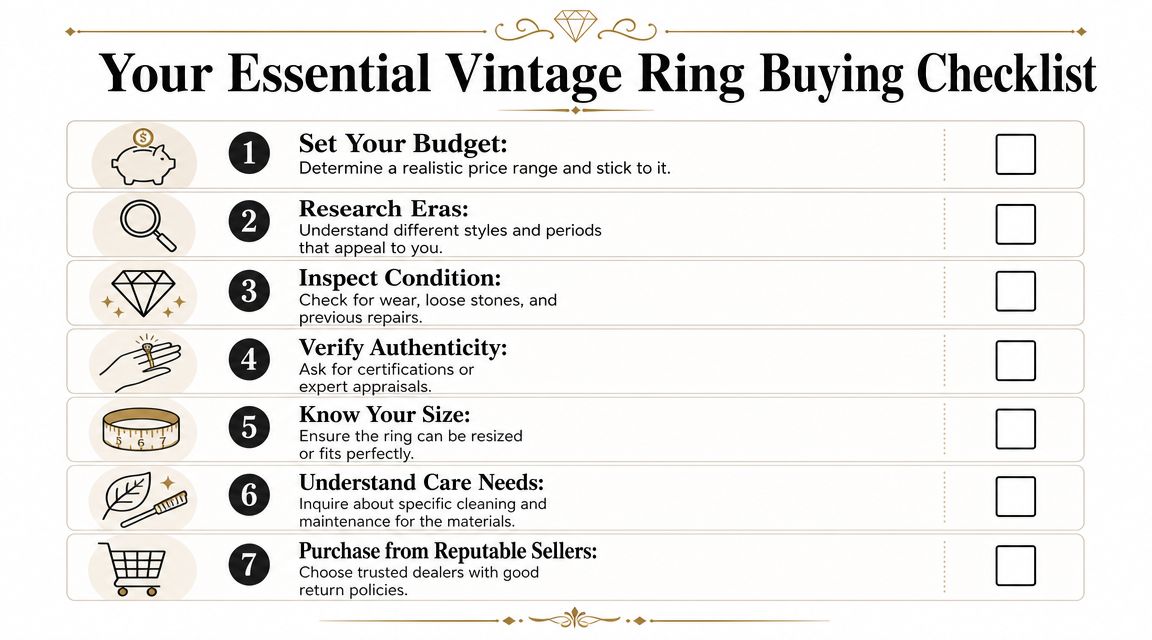
Some shoppers become so enchanted by period detail that they forget to assess daily wearability. A high-profile ring with delicate openwork may be marvellous, but not for someone who works with their hands every day.
Others focus only on the centre stone and ignore the mounting. Yet the mounting is often where the ring's historic value lives. A replaced stone can change the whole character of a piece. So can an over-restored setting.
Try wording your questions like this:
These questions do two jobs at once. They give you information, and they show you how the seller handles scrutiny.
Buying standard: Choose the seller as carefully as you choose the ring.
A careful process is not unromantic. It protects the romance. The story feels better when you know it stands on solid ground.
Owning a vintage ring means accepting that preservation matters as much as appearance. Old jewellery isn't fragile by definition, but it does ask for respect.
Intricate filigree, milgrain, and other recessed details trap lotion, soap residue, and debris, so cleaning becomes more complicated as surface detail increases. The aged metal patina is often part of the ring's value and character rather than a defect, which is why conservation cleaning is usually preferable to aggressive polishing, as explained in this guide to vintage wedding ring care.
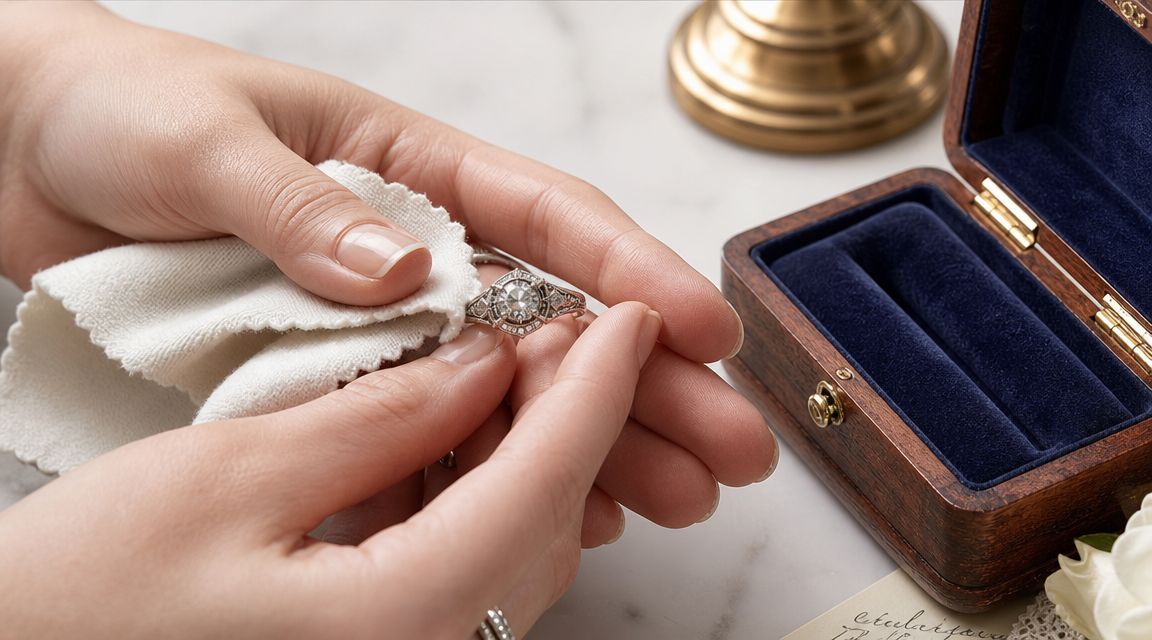
Use a soft approach. Gentle cleaning preserves detail. Harsh polishing can erase the crisp edges and aged finish that make an old ring feel authentic. If a jeweller immediately suggests making it “look new”, pause. That may be the opposite of what the piece needs.
When resizing or restoring, find someone who understands period work. A vintage ring should be repaired with sensitivity, not modernised by default.
Vintage rings can pair beautifully with modern engagement rings or additional bands. The key is balance. Let the older ring remain the visual storyteller, and use simpler companion bands to support rather than compete.
If you enjoy layered jewellery, stacking rings with intention can help you combine a historic band with cleaner contemporary shapes without losing the character of the original piece.
Store the ring separately, remove it for tasks that could stress the setting, and have it checked periodically by a jeweller who respects old work. A vintage ring doesn't need to be hidden away. It just needs an owner who understands that stewardship is part of the beauty.
If you love objects with provenance, craftsmanship, and Swedish heritage, explore Dalaart. Their collection of hand-carved and hand-painted pieces celebrates the same qualities that make vintage rings so compelling: authenticity, artistry, and the pleasure of owning something with a real human story behind it.


.svg)


.png)


